


Wild night forged one man's medical mission
By Jan-Mikael Patterson
Navajo Times
WINDOW ROCK, June 11, 2009
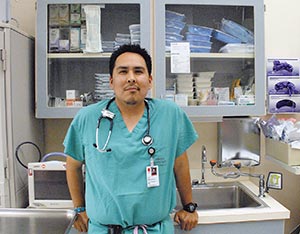
(Times photo - Paul Natonabah)
Aaron Price, posing at the Fort Defiance Indian Hospital, earned his medical degree from the University of New Mexico on May 16. Dr. Price will begin his residency in Las Vegas, Nev.
It's been a long arduous journey for Aaron Price...excuse me, Dr. Aaron Price.
Price, 31, a 1996 Window Rock High School graduate, just earned his medical degree from the University of New Mexico School of Medicine and is now beginning his residency in Las Vegas, Nev.
"It's very hard to address myself as a physician now," Price said. "It's very surreal to say that and to have people address you as 'doctor.' It's been a long time coming and I never thought I would see the day..."
Price is the son of Evangeline Price and is originally from Fort Defiance. His grandparents are the late Joseph and Irene Price of Fort Defiance. His brother, Lyman Price, is currently a first-year nursing student at UNM.
Price is Táchii'nii (Red Running Into Water Clan), born for Tó'aheedlíinii (Water Flows Together Clan). His maternal grandfather is Ma'ii Deeshgiizhnii (Coyote Pass Clan) and his paternal grandfather is Honágháahnii (One Who Wanders Clan).
Price's journey started when he worked as an emergency medical technician with the Navajo Nation Emergency Medical Services.
"It was prom night for Window Rock High School," Price recalled. "We were in Navajo (N.M.) responding to a call when we got another call about a vehicle accident at the Summit. We got a call at three in the morning."
Once the assignment in Navajo was complete, Price and his unit headed to the other accident site west of St. Michaels, Ariz., where they came across a vehicle that had overturned. The driver had been ejected and was some 20 feet away.
"Once we got there we had to fight an angry mob of drunken teenagers," Price said. "They were upset about how long it took (EMTs) to respond."
The victim was prepped and transported to the emergency room at Fort Defiance Indian Hospital. While in transport Price remembers giving the victim CPR when he saw that the victim had vomited into the tubes supplying oxygen to help him breathe.
"That's when I looked into his eyes and saw how dilated they were. He had been dead for a while," Price said. "I was only 20 years old at the time. That guy was only a couple of years younger than me."
Later that morning, the grandmother of the accident victim arrived at the hospital, not fully understanding that her grandson was gone.
"She could only speak Navajo," Price recalled. "She was standing there in the same room he was in telling him, 'Get up. You're supposed to take me to Gallup tomorrow.'"
After a while she realized the boy was dead and began crying. Price remembered wanting to cry himself. He then questioned himself about his journey into the medical field.
Soon enough his answer came.
"I was just about to leave my shift when a car came screeching and swerving (into the ER parking bay)," Price said. "There was lady who was screaming that she was having a baby."
The baby had crowned and began crying as Price and hospital staff members got the woman into the ER.
"So I helped with the delivery of that baby," he said. "That's when I told one of the nurses 'We lost one but we gained another.'"
At that moment, Price knew he wanted to pursue his career in medicine.
Tough journey
Price earned a bachelor's degree in biology with a minor in psychology.
After that he went on to medical school.
"Medical school at UNM is broken down into four bars, which are about eight inches wide," he said. "I was telling some friends that when I graduate I was going to write a book called '32 Inches of Medical School.'"
The bars are like prerequisites for undergrads.
The journey through med school was tough but Price was determined. He knew he wanted to be there.
His college education actually began at UNM-Gallup, where his human anatomy instructor, Vikki Olson, encouraged him to continue in the health field.
From there he went to the UNM main campus where he found willing mentors among the teachers, including the late Frank Dukapoo, Hopi, who was the first Native American geneticist. His undergraduate advisor, the late Jack Omdahl, also was very supportive.
Price admits that in high school he was a mediocre student, but he got good ACT scores and once in college he went full steam ahead towards a medical career.
It wasn't because of the money and the lavish lifestyle that some doctors pursue, he said. It was simply to help others, a characteristic that Price's parents and grandparents instilled.
"My grandparents were both supportive," he recalled. "My grandma was a type 2 diabetic and she would ask me if the prescription she got was the right one."
His grandfather was the person he most looked to, because he would say the right things to get Price back on track.
"He was the one I always I went to if I felt off track," he said.
In medical school Price found himself alone at times because there weren't other Native Americans in the program.
"When there are other Natives it's easy to talk to them and let loose about things like living on the rez," he said.
Medical school had a lot of non-Natives and because of that Price felt he had to be on his best behavior and cordial. The reason for feeling like that, he now reflects, was partly due to the stereotypes Native American face. Price didn't want to be lumped into any of those categories.
As he progressed further into his medical studies, his deepest cultural beliefs began to surface.
In his first year he took a course in human physiology, in which the students studied cadavers, and a couple of weeks into the classes, Price started to have nightmares.
His grandfather believed that perhaps the spirits of the cadavers felt disrespected or had not been given their last rites. So Price began having ceremonies done to cleanse himself and for protection.
He also learned to pray and indicate to the spirits of the cadavers that he intended no disrespect. Price wanted the spirits to understand that he was honoring them by learning from their bodies.
Mixing the traditional ways with modern medicine were things learned.
"I'm traditional, that's the way I was raised," Price said. "I had ceremonies done once a year or whenever I had free time, which wasn't much."
Price believes that as the modern world evolves, so the Diné people must evolve so they can take care of their own.
Right now, Price is packing his things up and getting ready to make the move to do his medical residency.
So far in 2009, his NFL team, the Arizona Cardinals, made it to Super Bowl, Barack Obama became the first black president, and Aaron Price is a doctor.
In August Dr. Price will become a father. His intended is Yolanda Johnson, Navajo, a nurse who works at UNM Hospital.
"So far this year has been good," he said, smiling.
 E-mail this story