


Keshmish Festival
Annual Navajo Nation Museum show offered basketful of unique, handcrafted gifts
By Jan-Mikael Patterson
Special to the Times
WINDOW ROCK, Dec. 12, 2011
(Times photo - Paul Natonabah)
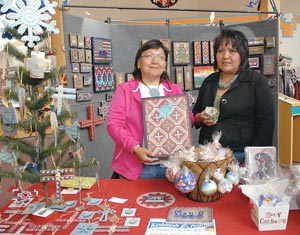
TOP: Elizabeth Whitethorne-Benally, left, and her sister Alma Whitethorne from Shonto, Ariz., hold one of the many Christmas items they had for sale at the 14th annual Keshmish Festival Dec. 2 at the Navajo Nation Museum.
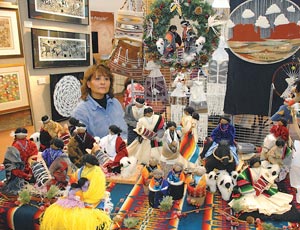
MIDDLE: Sylvia C. Begaye, of Fort Defiance, displays her collection of dolls and Christmas ornaments at the 14th annual Keshmish Festival Dec. 2 at the Navajo Nation Museum.
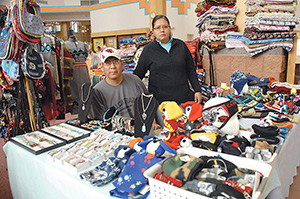
BOTTOM: Joaquin Foster and his friend Gwen Williams from Waterflow, N.M., pose behind Christmas items they were selling for Joaquin's mother, Rosanne Foster of Shiprock, at the 14th annual Keshmish Festival Dec. 2 at the Navajo Nation Museum.
Everything from jewelry to coffee mugs to flutes to beadwork and powwow regalia including jingle dresses was on display.
Among the handcrafted masterpieces were some unique items that were definitely in season.
A mother's livelihood
Behind a table adorned with handcrafted Navajo dolls made of cornhusks, wool, and Pendletons, seamstress Sylvia Begay carefully looks over what she has placed there. She makes a mental review of the price for each doll, pouch, handbag, woven rug, Christmas tree ornament, wreath and wall hanging.
"This is what I do for a living," Begay said. "I put a lot of work into the pieces and they sell. Ornaments run from $6 to $55. The ones that are $55 are low in inventory now because we had a show in Scottsdale last weekend. We did well there, that's why our inventory is low."
She had to rush to make new items in time for the Keshmish Festival.
"Our dolls start from $12 to $250," she said. "They come in a variety of sizes and I do the Navajo Masanis, which are the Navajo grandmothers. People refer to them as 'the storytellers.' They're featured in the catalog for the Southwest Indian Foundation."
For Christmas wreaths, Begay takes a generic wreath and adds a Nativity scene with figures and decorated with Native American designs. At her booth in the museum she had a wreath on display priced at $175.
Begay's company, Aweeschiin Creations, operates from her home and is her sole source of income, she said.
"We try to come up with something different every year," she said. "We do Christmas items year-round. Our tree is up year-round. Every new piece that's finished goes up on the tree. That's how I get my inventory up and it usually gets filled up."
Begay takes part in annual arts and crafts shows at the Navajo Nation Fair, Heard Museum, and in Scottsdale, as well as setting up a booth at the flea markets. At this year's Santa Fe Indian Market, she took custom orders that were sent as far away as Australia.
With the help of her daughter Melanie, Sylvia has established a Facebook page that showcases her work and contact information for potential buyers. The account URL address is www.facebook.com/aweeschiincreations.
Family tradition
For Elizabeth Whitethorne-Benally and Alma Whitethorne the creativity never comes up short in their family, although they could be excused for feeling a bit of sibling rivalry - their brother is the renowned artist Bahe Whitethorne.
"Everyone in my family are artists," Elizabeth said. "For me, I've always been painter."
"I've been an artist for 22 years now," Alma said. "We also have five brothers that are potters, jewelers, painters. Then we have another sister as an artist. We have a younger sister who is into fiber optics."
Elizabeth and Alma traveled from Shonto, Ariz., to showcase their majestically handcrafted Christmas tree ornaments at the museum's Keshmish Festival.
Elizabeth's ornaments included horses, feathers and dragonflies. On a separate tabletop tree, Alma hung her hand-painted, shatter-resistant ornaments.
"We've been doing (ornaments) it for the past 25 years," Elizabeth said. "Most of the stuff we use are recycled or 'out-cycled,' meaning they were used and instead of being thrown out they were donated."
Elizabeth uses Masonite boards and other durable materials to recycle for her artwork.
"Anything that's durable I use," she said. "We say 'out-cycle' because we want to keep them out of the landfills."
Holiday ornaments weren't the only items on display at their booth. The partition behind the two sisters held an array of paintings on canvas and weathered wood.
"I use wood from sheep corrals and horse corrals," Elizabeth said.
"I don't use any boards taken from houses or homes," she adding, alluding to the Navajo traditional belief that houses retain a spiritual connection to those who dwelled there, past or present.
"I like using corral wood because the essence of the animals, the livestock is still there," Elizabeth said. "Once in a while you can smell the corral coming from the wood and people enjoy that because it reminds them of home. It brings back memories and keeps life going."
The smell of a corral feels like a homecoming for many, perhaps because traditionally when a Navajo child is born, his or her umbilical cord is buried in the family's corral. It is said that once this is done, the newborn will always know where home is and will return there as an adult.
Like Sylvia Begay, the Whitethorne sisters were at the arts festival in Scottsdale the week before and had done well with sales.
Far from feeling rivalry among their talented siblings, the sisters credit their success to receiving support from the others.
"When my brothers would set up for a show then they would take us and have us set up with them," Elizabeth said. She said her immediate family is supportive too.
Both sisters can be found in Shonto at their home studios and if people are interested in purchasing from them can do so through [email protected].
They both plan to take part in the Art of the People Fine Art Show & Sales being held Dec. 10-11, at the Tuba City Boarding School small gym.
Mom's creative niche
Shiprock crafter Rosanne Foster chose to stay home because she had some sewing projects to complete. But you could see her handcrafted products at the museum show thanks to son Joaquin and his girlfriend Gwen Williams, who staffed her booth.
They sat surrounded by little purses, booties, potholders, ear warmers, scarves, dresses, quilts, baby blankets, gloves and Pendleton jackets.
"My mom is the seamstress," Joaquin said. "She gets ideas from different places like my aunt in Washington, D.C. - she would send something to my mom to examine and make to sell here."
One unique item was a coffee mug desk organizer, which looks like a potholder but has individual pockets. When fitted on a mug, pockets are located on the inside and outside for pens, pencils, etc.
Also appealing were the handpuppets made from fabric bearing the logo of NFL teams, perfect as stocking stuffers for the children, or child at heart, in your life.
Joaquin showed a photo album of his mother's delightful creations.
"Anything you want, she can make it," he said, noting that all it takes is a consultation to determine what it is you're looking for her to create.
The museum's Christmas arts and craft show collects artisans from near and far each December, so put it on your schedule when you start thinking about your next batch of holiday gifts.