


Code talker, 87, never misses a day in kindergarten
By Sunnie R. Clahchischiligi
Navajo Times
SHIPROCK, Oct. 1, 2010
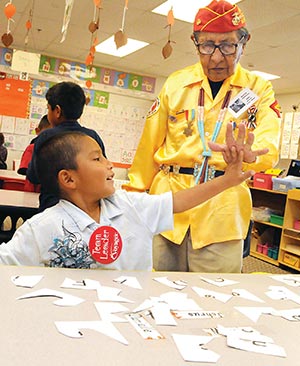
(Times photo - Leigh T. Jimmie)
Kindergartner Jehrus Johnson, 5, gives a high-five to David E. Patterson, one of the original 29 Navajo Code Talkers, in Mrs. Noon's class at Atsa Biyaazh Community School in Shiprock.
He makes a three-mile walk across busy U.S. 91 to a kindergarten class at Atsa' Biyaazh Community School.
Patterson, 87, one of the original 29 Navajo Code Talkers, takes the daily stroll to the classroom of 18 smiling children who make his day.
"I like to work with kids and they like me," he said. "Everywhere I go, no matter whose kids, in town, anywhere, I hear 'Grandpa, Grandpa.'
"They come around to me, hug me, they make me feel good so they are just like my grandkids," he said.
Foster grandparent
For the last seven years Patterson has made his morning walk to the school to spend about six hours with the kindergarten class. He serves under the Foster Grandparent Program and helps the teacher with daily lessons, teaches Navajo language, and often patrols the halls and manages the children during breakfast and lunch.
Atsa' Biyaazh reading coach Julia Donald said Patterson is considered to be everybody's grandpa at the school. She said teachers, staff and students all respect and look up to him.
"We are very lucky to have him. He is like a role model," she said. "Everyone likes him, there's respect all the way around."
Patterson works just as hard as the other teachers and asks for nothing in return. He knows what his daily duties are and can't think of a better way to spend his time.
"I come in and do some bilingual, teaching them how to say different things," he said. "Hogan, sheep and other animals, birds and what it means in Navajo and all that.
"Some speak very little Navajo," he said. "They're learning slowly. Nowadays it seems like parents, they don't have time to teach their kids. They're all working or doing some other things."
That's why Patterson spends his days helping in the kindergarten class, but his work with the Navajo language started many years before.
The old days
Patterson was born on Nov. 11, 1922. He attended boarding school, then Catholic school in Shiprock in 1931. He came home every Friday and returned to the dorms every Sunday.
"Those days we all go through a lot of things," he said. "The Navajo, we used to have a thousand head of sheep, used to herd sheep in the summer time and go to school in the winter time. That time you had boarding school, never had public school.
"They didn't have these bus running," he said. "It wasn't hard for me, those days I could run here and there."
What was hard was 1943. World War II was well underway when the U.S. government requested and drafted Navajo volunteers for "special training."
"I was in the 10th grade ... they wanted some boys to be volunteers," he said. "I volunteered to go in the service, do all this special training. That's when they had the Navajo Code Talker, so I went to school down to San Diego.
"When I went to San Diego we had a training, it was real hard," he said. "It seemed like a whole month, or something like that, we had to learn all those training, in Navajo.
"Everything up in the sky, on the land, in the ocean, everything that exists, we used those words and translated in Navajo, used the language," he said.
He said at times he wasn't sure about his choice but decided to follow it through.
The first 29
"We used those names in Navajo to make it into English to send the message so nobody else understands," he said. "We had to learn all those in one month. We were studying what seemed like days and nights because we had to.
"That's when they tried us out, the first 29 they called," he said. "We had to listen to our leader, our government, we had to go, we didn't have no choice. So I don't see why they liked the Navajo language but they had a good idea."
Patterson served in the 4th Marine Division, 27th Platoon, as one of the original 29 code talkers from 1942 to 1945.
He said he will never forget the impact it has had on his life or the lives of the children of the future.
"You see, we are the greatest people on Earth, the way I look at it," he said. "Way back in history, they say where did the Navajos come from, China? Or what? And an old Navajo medicine man used to tell them we came out an old hole, we came out of there, the ground."
He laughed. Pride beams in his face as he talks about what he did as a Navajo Code Talker.
"The Navajo language helped to win the war," he said. "That is something we should be proud of."
Returning home
When Patterson returned from service he used the GI Bill of Rights to attend school in Oklahoma, the University of New Mexico and New Mexico State University. He studied social work. While in school he met his wife and they had six children, four boys and two girls.
After completing school in 1970, Patterson moved back to the reservation and worked for the Navajo Nation until retiring in 1987.
His children made their homes across the country, and Patterson said he was left with little to do. So he decided to volunteer.
"Every since then (retirement) it seemed like I'm just lonely, looking around, saying what can I do? I want to do something. I'm a person always on the go," he said. "I was lost. I had nothing else to do so I decided I'll do some volunteer work so that's what I did."
Donald said Patterson is one of four foster grandparents who help out at the school. Every year Patterson shows up on the very first day of classes.
"He beats some of our staff here in the morning," she said. "He isn't required to be here but he's here."
So what makes the 87-year-old code talker - one of a tiny handful still living - show up every morning?
"They're beautiful little children," he said.
 E-mail this story