


Saving money
DNA People's Legal Services still working to provide legal services for low-income Navajos
By Bill Donovan
Special to the Times
WINDOW ROCK, Nov. 20, 2008
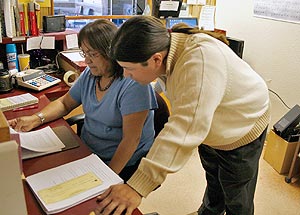
(Special to the Times - Stacy Thacker)
DNA People's Legal Services managing attorney Zackeree Kelin looks over paperwork with Rosie Becenti at the Fort Defiance DNA office in Window Rock on Wednesday.
W hen times get rough financially, who are you going to call?
For many Navajos, bad economic times lead to legal problems and thousands each year seek help from DNA People's Legal Services Inc., the legal aid agency that has been representing low-income tribal members for more than 40 years.
As the Navajo Nation prepares for a new era when a casino will be located within a half hour's drive, staff at DNA are also preparing for the possibility that demand for their services will increase as some people gamble away money needed to make their car payments, buy groceries and other basic needs.
"Will we see a greater need for our services?" asked Levon Henry, DNA executive director. "That's the big question."
DNA officials hope that as the need for free legal services increases, so will the funding, whether from the federal government, the tribe or private grants.
With a Democrat back in the White House in January, the chances of increased federal funding look a lot better now than under the Republicans, who traditionally opposed government-funded legal services for the poor and sought to limit them wherever possible.
The downturn in the local economy and the introduction of Navajo gaming comes at a time when DNA faces the challenge of providing more services with less staff.
Back in the 1980s, the agency had 40 attorneys handling clients from the Navajo and Hopi reservations. Today, the number of litigators - lawyers and legal advocates - has dwindled to 25 while the service area has expanded to an area roughly the size of Illinois with the addition of the Jicarilla Apaches and tribes in the Grand Canyon area.
Surveys have shown that even in economic good times, legal aid agencies like DNA are only able to meet about 50 percent of the need for legal services among people who can't afford to hire a lawyer.
Zackeree Kelin, managing attorney for the Fort Defiance office, is nevertheless confident that DNA will find a way to help when needed.
"We try to help everyone we can," he said.
On a reservation where unemployment is roughly 50 percent and the median income is less than $12,000 a year, that means DNA staff attorneys throughout the reservation have to spend a lot of time dealing with disputes between businesses and customers who find themselves unable, for one reason or another, to keep up their car or loan payments.
Ground rules
It should be pointed out that not all Navajos are eligible for DNA representation. The person seeking help must meet certain income criteria.
And it also should be noted that not all DNA clients are Native American. Non-Natives who need legal advice or representation are also eligible for DNA services, provided they too meet the income criteria to receive free services.
But given this, the vast majority of DNA clients are Native American and family law - divorce, for instance - makes up the bulk of DNA's cases, Kelin said.
Consumer cases - loan disputes, repossessions and the like - come in second.
In many cases, DNA attorneys get involved when a company comes onto Navajo land to repossess a car after the buyer misses a number of loan payments.
There are tribal laws that govern repossession - contrary to prevailing opinion among non-Natives, Navajo courts will allow it - but oftentimes, disputes arise, Kelin said.
Most companies that finance big-ticket purchases for Navajos know the tribal laws dealing with repossession and follow them, he said.
But there are some finance companies, which Kelin characterizes as "last resort" lenders, that don't and these companies oftentimes bend or break tribal laws.
Before the advent of legal aid societies, most low-income people had to go along with whatever the lender did.
One thing reservation residents should realize is that a loan company - and it's mostly a loan company that does this since car dealerships assign the loans to outside companies - can't repossess a vehicle from the reservation without a court order or permission from the buyer.
Without a court order, the loan company must get the buyer to voluntarily sign a form surrendering the car, Kelin said. In many cases, he added, people give up their cars without realizing the consequences or knowing their legal rights.
Some companies have tried to get around this by having the buyer, at the time of purchase, sign a form giving permission to have the vehicle repossessed but Kelin said the current laws "don't support such agreements."
If a family gets into a financial bind and fears they may lose their car, it's probably time to visit the nearest DNA office for some legal advice, Kelin said.
"Oftentimes, we are able to negotiate an agreement that will allow the family to keep the car," he said.
And if you don't qualify for free legal services, Kelin, said, it's still advisable to talk to an attorney, even if it means buying a little of their time.
Payday loan trouble
Kelin said that despite reforms enacted last year by the New Mexico Legislature, he's still seeing payday loan companies take advantage of low-income people by imposing interest rates that are too high.
"All the law did was get the loan companies to change their (business) model," he said. "Now they're making installment loans and the rates are still unconscionable."
But among the worst deals, he said, are loans that people get from local tax services where they get their income taxes done.
For the past couple of years, DNA has provided free tax preparation for low-income families and hundreds each year have signed up.
But thousands of Navajos still go to the off-reservation tax preparers because they offer something that DNA doesn't - instant loans based on the expected tax return people will get.
Instead of waiting 10 days or so - the average length of time that it takes to get a tax refund if the form is filed electronically - many low-income families go to tax services that offer an instant tax refund.
They get their money, said Kelin, but it's really a short-term loan. They have to pay interest rates that could amount to more than 100 percent if figured out on a yearly basis. If the actual refund turns out to be less than the instant refund they got, they have to repay the tax service from their own pockets.
Many other loan agreements signed by tribal members also have unfair provisions and it's these sections that DNA staff attorneys look at when clients come in for help to keep from having their car repossession or their wages garnished.
"In many cases, we are able to help the client by negotiating a settlement," said Kelin. "Many of our cases settle."
He stressed that families who take out these early tax loans and those who take out loans on the titles of their cars would really benefit from talking to a DNA attorney beforehand and should get legal advice to avoid legal problems that could arise in the future.
For the most part, DNA officials said they felt tribal consumer protection laws work, but they are critical of one change the tribe made in 2006 that they say has been detrimental to tribal members.
Before 2006, the tribe capped interest rates at 18 percent on loans. It decided to change that in 2006 to the prime rate plus 15 percent, which Kelin said has allowed companies to impose interest rates above 18 percent and has hindered DNA's ability to get fair rates for its clients.
The bottom line, Henry said, is that DNA is able to save clients money and, in some cases, to bring money back to the community by helping clients collect unpaid child support and the like.
"Last year we were able to bring in more than $3 million," he said.
 E-mail this story