


Residential access roads left off snowplow's list
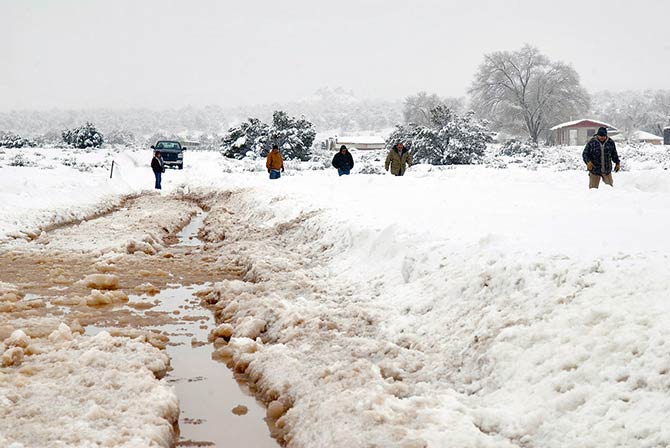
(Special to the Times - Donovan Quintero)
Robert E. Owens, heavy equipment operator with the Fort Defiance Chapter, right, walks back to the backhoe after assessing how to make the road to the home of Henry Billie, 89, more accessible Jan. 28.
By Erny Zah
Navajo Times
WIDE RUINS, Ariz., Feb. 4, 2010
More than two weeks have passed since portions of the Navajo Nation were blanketed with snow, and one of the fundamental issues that still resonate is residential access to and from main roads.
"One of the most critical components in any country are the roads," said Patrick Sandoval, President Joe Shirley Jr.'s chief of staff. Sandoval was one of more than 30 people who attended a Navajo Department of Transportation staff meeting Tuesday.
Though Sandoval's statement may ring true, road maintenance, including equipment, on the Navajo Nation is tangled in a web of jurisdictions involving the individual chapters, states, counties, Navajo Nation and the BIA, which usually leaves residents to fend for themselves or depend on their chapter.
Some chapters are able to help their members, while others depend on outside agencies to help.
"We couldn't get out for three weeks," said Martha Burns, 73, of Wide Ruins, Ariz. She said snow and now mud are the reasons why she's been homebound.
Her story resonates with one chapter leader.
Wide Ruins Chapter Vice President Cecil Hubbell Sr. summed up his chapter's most immediate need as access because the chapter doesn't own any heavy equipment that could clear entry roads to private homes.
"We got problems in our residential areas," he said, adding that the Department of Water Resources has been using a front-end loader to clear roads for the chapter.
Residents have been digging out through the snow, and now as the snow melts, they're dealing with mud, said Dorothy Baldwin, Wide Ruins community service coordinator.
Some people in the chapter live as far as 17 miles off a main road, she said.
Hubbell said Wide Ruins has about 1,500 residents.
All the roads - collectors, main roads, dirt and paved - are maintained by Apache County, BIA and NDOT, Baldwin said.
"We rely on those people," she said.
But Hubbell acknowledges that residential roads lie beyond the scope of those agencies.
"We left the residential people to get out by themselves," he said.
But not all chapters had limited equipment issues such as Wide Ruins.
Fort Defiance Chapter President Ben Bennett said his chapter owns a grader and a front-end loader, which have been in use since the snow first fell.
"Coal Mine is pretty bad. Some roads are impassable," he said, adding that the chapter has spent about $23,000 since the Navajo Nation declared a state of emergency nearly two weeks ago.
He said the chapter has used all its emergency resources and has moved some money from other budgets to appease the demand for road clearing and other emergency duties.
In addition, because the snow was 4 feet deep in the Blue Canyon area, the chapter rented a bulldozer to use there because a grader would have gotten stuck, he said.
He said that road is usually maintained by Apache County, but the county was clearing roads in harder hit areas like Tsaile, Wheatfields and Crystal.
NDOT stays on main road
"Right now our priority are public roads," said Ray Barney, NDOT program manager, adding that his division leaves residential road maintenance to the chapters.
Nonetheless, NDOT is responsible for about 4,500 miles worth of roads on the Navajo Nation, and that number is going to grow when plans are finalized for it to take over maintenance of BIA roads. Barney said that deal should be completed later on this year.
For now, the division has 24 graders, four front-end loaders and two snowplows to care for NDOT roads, he said.
"We don't maintain paved roads," he said, adding that those roads are the responsibility of the states, counties or in some cases the BIA.
Even so, in the past two weeks, NDOT has paid workers nearly $30,000 in overtime, said Tom Platero, NDOT director.
"We are doing what we can," Barney said, adding that he has 13 heavy equipment operators working all of NDOT's roads.
But when it comes to residential roads, Platero said that for the tribal agency to maintain a road, "about 300 steps" are needed to add that road to NDOT's list.
Barney added that some of those steps include an archeological survey, right-of-way assessment and most importantly, traffic count.
With a low traffic count, Barney said, the road would be put "pretty low" on the priority list of maintained roads, adding that residents should contact their chapter for their personal driveways.
"We prefer all (requests) be routed to the chapters," he said.
 E-mail this story