


A leader with backbone
35 years later, Apache County's first elected Diné supervisor speaks out
By Cindy Yurth
Tséyi' Bureau
CHINLE, Sept. 3, 2009
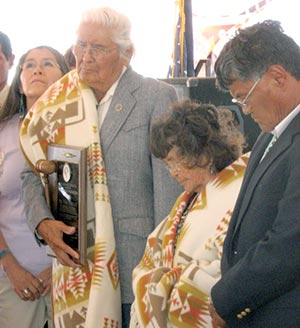
(Times photo - Cindy Yurth)
Flanked by his daughter, wife, and current Apache County Supervisor Jim Claw, Tom Shirley receives a medicine man's blessing at the open house for the new Apache County building in Chinle Aug. 27. Shirley, the first Navajo supervisor for Apache County, was awarded a special recognition plaque by the county along with Pendleton blankets for him and his wife of 50 years, Nellie.
Tom Shirley never meant to be a civil rights crusader.
At 42, he had been a chapter president, a school board member and a delegate to the Navajo Tribal Council.
He liked serving in public office and felt he had done some good things for his constituents. The next logical step in the Lupton, Ariz., resident's political career seemed to be a county office.
In 1972, he filed the necessary paperwork to campaign for Apache County supervisor for District 3. He ran a good campaign and handily beat his Anglo opponent.
He was aware he was the first Navajo to be elected supervisor in the mostly Navajo county, but he didn't think much about it.
Then, just a few days before he was scheduled to take office, he got a letter.
"It said, 'You're not going to take office,'" he told a crowd of about 100 people at the grand opening of a new permanent county office in Chinle Aug. 27, speaking in Navajo. "I thought, 'What did I do?'"
Confused, Shirley called the county.
"What is this about?" he asked, a bit indignant. "I won fair and square!
"They told me I wasn't eligible because I held another office (school board member) and I didn't pay for any land," he recalled.
He also learned his opponent, Thomas A. Minyard, had filed an injunction against him.
Shirley smelled a rat. He had run for enough offices to know that these are the kind of things they're supposed to tell you when you file your paperwork, not after you get elected.
He had also lived in Apache County long enough to know the white Mormons had a stranglehold on the government, and they were not about to give it up.
Shirley called Navajo Tribal Chairman Peter MacDonald and told him he suspected he was a victim of racism.
"He got together an advisory committee, and right away they took action," Shirley recalled.
The tribe hired the best lawyer it could find: a young Phoenician named Paul Eckstein who was making a name for himself in civil rights cases. (Eckstein is still practicing and last year successfully defended state Sen. Albert Hale and state Rep. Christopher Clark Deschene when their opponents challenged signatures on their election petitions that listed only post office boxes rather than physical addresses.)
When the hearing date came around, Shirley looked around the St. Johns courtroom and was gratified to see it packed with Navajos.
"My people came down to support me," he said.
Eckstein knew Shirley wouldn't get a fair trial from the judges in St. Johns and had successfully petitioned the court to have Coconino County Superior Court judges hear the case.
Shirley listened as Eckstein presented his case. It seemed cut and dried: There was already a precedent for a politician to resign an elected office after being elected to another one, and nothing in the Arizona Constitution said elected officials had to be property owners.
Shirley breathed a sigh of relief, sure the crazy battle was over.
When the judges came back with their decision, his confidence turned to incredulity.
"They called it a 'special case,'" he recalled. "They said it was very hard to decide, and they were sending it to the Arizona Supreme Court without a ruling."
Finally, on Sept. 7, 1973, the state Supreme Court ruled in Shirley's favor and he was allowed to take the seat he should have had nine months previously. Minyard tried to take the case to the U.S. Supreme Court, which refused to hear it.
Although the case was overshadowed by the fervor over black voting rights in the South, it briefly made the national news. Shirley was surprised to get calls of congratulations from as far away as Illinois.
But political equity for Arizona's Native Americans was far from a reality. Literacy tests were still being used to weed out Native voters, in defiance of the Voting Rights Act of 1970, and the state's voting districts were gerrymandered to the point of absurdity. Shirley's District 3, for example, had a population of nearly 27,000, the vast majority of whom were Navajo, while District 1 had 1,700 people, almost all of whom were white.
One supervisor represented each district.
Finally, in 1976, a group of Navajo voters challenged a bond election for a new school in the mostly white southern portion of the county. Investigators from the U.S. Justice Department found the election had been a travesty. Nearly half the polling places on the reservation were inexplicably closed; there was no interpretation for Navajo speakers; absentee ballots were in English; and no informational meetings had been held in Navajo.
Attempting to defend itself, the county further shocked the feds by maintaining that the Indian Citizenship Act was unconstitutional.
A three-judge panel in federal court ruled in favor of the Navajos, issuing a consent decree that mandated redistricting, abolition of the literacy test and other sweeping changes that are still in effect today.
It's an embarrassing chapter in state history that most Arizonans aren't aware of, said Peggy Scott, District 1 manager for Apache County, as other District 1 personnel presented Shirley with a plaque and wrapped him and his wife Nellie in Pendleton blankets.
Added Chinle Chapter President and District 1 Operations Manager Leonard Pete, "We were blessed with leaders like Mr. Shirley, and we hope the young leaders coming up today will have that kind of backbone ... That's the reason we invited him here today."
 E-mail this story