


Nash, Mendoza, Anderson named coaches of the year
By Candace Begody
Navajo Times
MESA, Ariz., May 27, 2011

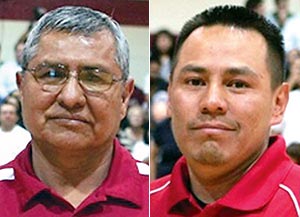
Top: Robert Nash. Bottom, left to right: Raul Mendoza, Dwayne Anderson.
"In receiving this award, I realized that it was given to me because of all the other people involved," said Raul Mendoza, coach of the Holbrook Roadrunners, who has coached for 32 years.
Mendoza was named the 3A conference boys' coach of the year.
"Those on the team are the ones that perform, they put in time and they make sacrifices to make it what it has become," he said.
"I also had a great coaching staff," Mendoza added. "They put in time too but never gets recognized."
Mendoza and the rest of the awardees - St. Michael boys' head coach Dwayne Anderson and Monument Valley Lady Mustang coach Robert Nash - had many people to thank after being honored during the Arizona Basketball Coaches Association All-Star Game last weekend at Mesa Community College.
Family sacrifices
"As I get older, I realize the sacrifice of family," Mendoza said. "We're hardly home, we're on the road, we spend a lot of time away from home, and our wives have to take on the other responsibilities. That's one of the biggest challenges and you have to be very fortunate if you have that."
Mendoza, the Navajo Times boys basketball coach of the year, also thanked the parents of the players.
"They have to be involved and make sacrifices too," he said. "They have to put trust in us to have their kids and get their kids to understand that we are all making sacrifices. Even though most want go on vacation, they're still playing basketball."
Mendoza credited almost everyone but himself.
"All I can say for myself is that I persevered," Mendoza said. "I've been at it for 32 years but I attribute everything to the players. It was because of the young people that I was involved with.
"You have to look at it as something you love doing and not something that is for personal gain," he said. "You're doing it for others and putting time into their lives because in the long run, you want them to learn things that they can apply to life."
Take, for example, the 3A state championship game when Holbrook fought back from a 20-point deficit in the second half to topple Estrella Foothills for the state title.
"The kids didn't get discouraged, they just kept playing no matter what," he said. "I was just waiting because I knew, sooner or later, they would do what they were taught in practice. Those same things are going to happen in life."
In particular, Mendoza said his goal was to instill in his players that playing to their potential would produce a favorable outcome.
"Our season wasn't measured by wins or loses," he added. "As long as they played to the best to their abilities, that was the important thing. We only have control of doing the best we can and the doing the best they could is what I wanted so they didn't have to look back with regrets.
"We accomplished what we could because of the great group of young men I had, our coaching staff, our families and our community," he added.
Credit to community
It wasn't much different for St. Michael boys' coach Dwayne Anderson as he too credited his team, community and family.
"I had some good talent this year," Anderson said. "They were a good group this year and showed the coaches that St Mikes was ready to play anytime."
Assisting Anderson on the bench were John Reece, the athletic director at St. Michael, and volunteer Sam Hardy, father of senior forward Samuel Hardy.
His coaching staff also had much to offer to the Cardinals, a team that put their community on the map by making it to the 1A state final four in 2009 and then to the second round of the state finals in 2010.
"It takes a lot of patience as a coach," Anderson said. "Some kids are impatient and want to do their own thing. The challenge is trying to keep them motivated for the game and keeping them focused.
"Every coach is different and what they bring," he added. "Some yell but I'm not a yeller. I just try to bring my experience to each player on how to get shots and who to stop defensively."
Anderson also thanked the school faculty and administration and his coworkers at the Fort Defiance Indian Hospital, now called Tséhootsoo' Medical Center, where he works full time in the general services department.
"For some games, I had to take personal leave but I'm very glad my supervisor was willing to help me out," he said.
When times were stressful, Anderson said his family stepped up.
"They just know how to calm me down when I get frustrated," he said of his wife and four children.
Sacrifice alleviated by enjoyment
For Robert Nash, who did not make the awards presentation ceremony, the award "was nice to get because it was voted on by the girls coaches who are all part of the Arizona Basketball Coaches Association. Those coaches know more about basketball and know who is deserving of these awards."
Nash said the challenges of coaching are not really challenges at all if you love what you do.
"It takes time away from the family and time a coach has for himself and sometimes family time, personal time and vacations are adjusted around open gym and summer basketball," he said. "But I wouldn't call it challenges because understanding, enjoying what one is doing and how to adjust one's time will alleviate challenges.
"If a coach enjoys what he or she is doing there is really no sacrifice," he added. "If athletes are willing to work hard, willing to develop skills to play the game, those so-called sacrifices almost become meaningless."
He's been a basketball coach for over 21 years now and his wife, Lucinda Nash, who recently retired, put in over 30 years as the volleyball coach at Monument Valley.
"You have to care about your ball players," he said. "Tell each player they are more than welcome to be on the team. A coach should always have the time to talk to athletes and has to realize that every athlete on a team is important.
"Caring comes in wanting each player to be successful," he added. "It doesn't matter if it's on the basketball court, classroom or in their own life. If an athlete sees that in a coach, most of the time a team will be successful. A coach also has to see talent and see how best it can be used on a ball team."
Over the year's Nash's coaching style has changed.
"It changes a lot because as a coach in a rural area I have to adjust to players who show up," he said. "I have to make teams out of those players who show up and as a coach I see players as is and work with that.
"I see what I have to work with, try to develop that and go from there," he added. "Most of the time it takes a lot of work and time. It takes patience and sometimes headache pills to develop what I have."