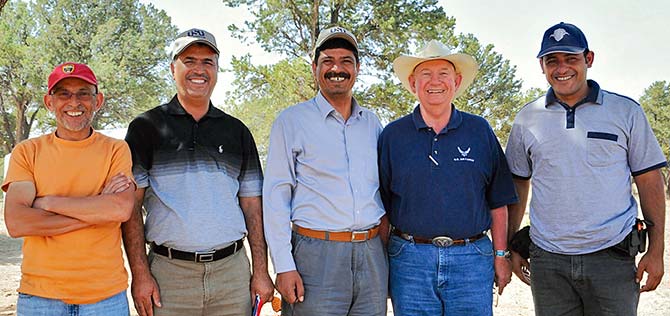
Iraqi shepherds view Diné methods

(Times photo - Shondiin Silversmith)

Iraqi sheep herders and their translator and host, left to right, Hafed M. Elgandoz, L. Hameed Al-Graa, Hussein Huidi Jassim, Lyle McNeal and Hayder Hussein Mohammed attended the Sheep is Life Celebration held at Diné College on June 24 and 25.


By Shondiin Silversmith
Navajo Times

TSAILE, Ariz., July 14, 2011

Text size: A A A


Sheep herding is one of the world's oldest professions.

Dr. Lyle McNeal of the Animal and Veterinary Science Department at Utah State University believes the skills of the sheepherder are the same regardless of locations and race.

McNeal has worked with sheep and wool growers on the Navajo Nation and throughout the U.S. for over 40 years, and on June 24 and 25 he brought three sheepherders from Iraq to the annual Sheep Is Life Celebration so they could compare notes with their Diné counterparts.

"They're victims like the Diné were," McNeal said, referring to war-torn Iraq. "Whether it was Kit Carson or the livestock reduction, they've had similar experiences losing their animals."

L. Hameed Al-Agraa, Hussein Huidi Jassim and Hayder Hussein Mohammed are from southern Iraq. They were accompanied by a translator, Hafed M. Elgandoz, from Libya.

The four men are spending three months exploring different parts of the United States, visiting sheep camps and learning more about the surrounding cultures.

Back home they all manage large herds of Awassi sheep, the dominant breed in Arabic countries and one with many characteristics in common with the Navajo Churro.

Mohammed said he has at least 400 head. Jassim said his flock is over 250 head. Al-Agraa said his flock is at least 200.


Sheep herding has been a part of their families for over 50 years, Elgandoz said, but their visit to the Sheep is Life fest is the first time they've ever attended a celebration dedicated to sheep.

Al-Agraa said they have celebrations in their country, but nothing compares to the Sheep is Life Celebration.

"This reminds them of the old ways," Elgandoz said. "It's a mixture of past and future."

"The Navajo people are friendly and domestic people," Al-Agraa said.

McNeal said he was asked to host the delegation by the U.S Department of Agriculture after leading a similar agriculture exchange project in Armenia, and because of his long involvement with sheep in this country.

The choice of which Iraqis were able to participate was decided by the U.S. Embassy in Baghdad.

"I was asked to do this project, I didn't apply for it and I'm not getting paid for it," McNeal said. "I'm doing it because I want to help their country."

Since meeting his guests, he said, "I've learned we have a lot in common. The only barrier is the language. Even though we come from different parts of the world I want them to learn that we can apply things from here to there and vice versa."

McNeal has taken the Iraqis to different sheep camps as well as ranches in Montana and Idaho to get an idea of the variety of approaches to sheep raising in the U.S.

They also visited the Center for Action and Contemplation in Red Mesa, Ariz., where they worked with Navajo Churro sheep. While there, the Iraqis assisted in castration, vaccination, and tail docking - a new one for them.

"They learned our techniques because in America we have tails on our sheep. In their country they don't have tails on their sheep. They have fat tails so they don't have to clip the tails," McNeal explained.

The Iraqis shared their ways with sheep, but when it came to castrating the sheep, they were surprised to witness McNeal's personal technique.

"I use my teeth," he said. "My mouth is cleaner than my hands so I bite them off."

It hasn't been a nonstop field trip and they've also taken classes at the Utah State, McNeal said.

"We're going to have more classes with people who will talk about poisonous plants," he said.

The Iraqis will learn which plants kill sheep, and which ones kill horses and cows but sheep can eat.

"It's kind of a mixture of things we're doing," McNeal said. "I want them to see the western sheep culture."

According to Elgandoz, the Sheep is Life Celebration has been the most fun the Iraqis have had since they arrived in the U.S. in early June.

The showcase of fiber arts was an eye-opener, he said, because in Iraq wool is strictly utilitarian, used for mattresses and pillows but not in artistic ways.

Asked if butchering a sheep has significance like it does in Navajo culture, the Iraqis said no, because it's more of an industry and they choose to take their animals to a local slaughterhouse.

But they do use the fat of the sheep as oil and creams like some Navajos have learned to do.

After everything they witnessed at Sheep is Life, the Iraqis said they would try to introduce some of those traditions back home.

"Thanks for everything, we're glad we came," one said.

McNeal also plans to show them the rest of the Four Corners to broaden their understanding of what the Navajo people have to offer.

Last week they are in southern Colorado to visit an organic slaughterhouse as well as a Churro sheep camp.

"I think by the time they go home they're going to be rich, but so am I from what I learned from them," McNeal said. "We all have stuff in common when you work with sheep."

According to Elgandoz, "We've enjoyed everything 100 percent."

Back to top ^