


For K-5, science fair a time of discovery
By Noel Lyn Smith
Navajo Times
WINDOW ROCK, March 4, 2010
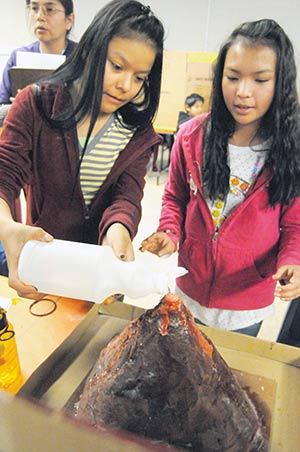
(Times photo - Leigh T. Jimmie)
LaShawna Melchor, left, pours distilled vinegar into the top of her model volcano with project partner Mikah Brown to create an eruption with baking soda and vinegar in their team project to assimilate a volcano eruption at the Navajo Nation Science Fair at the Navajo Education Center in Window Rock on Friday, Feb. 26, 2010.
Light snow started to fall as the students from Tuba City Boarding School walked into the Diné Education Center, some carrying large pieces of cardboard or models made from Popsicle sticks.
The sea of students, grades kindergarten to fifth grade, filled the main lobby of the building while parked outside were buses from as far away as Kayenta, Piñon, Ariz., and San Juan County, Utah.
All the commotion signaled that it was not going to be a typical day at the center. More than 200 students from schools across the reservation participated in the 2010 Navajo Nation Science Fair last week.
Inside the conference center, students were divided into categories based on the science experiments they had done for the event.
Sitting among the team projects were Nionna Phillips and Ben Hansen, fourth-graders from Montezuma Creek Elementary School in Utah, with a project on water evaporation.
"It either was going to be magnets or evaporation, we decided on evaporation," said Hansen, 10.
The team members had three ideas about what would cause water to quickly evaporate, according to the hypothesis explained at the top of their display. During testing, they put water in three different environments to find out which one would vaporize the most water. In the end, it was applied heat that caused the fastest evaporation.
This is the second time the two had teamed up to participate in the fair.
"We learn interesting stuff," said Phillips, 9.
Nelda LaPahe, a first-grade teacher at Montezuma Creek, said 43 students left the school at 5 a.m. in order to reach Window Rock by 8 a.m.
Among the parents in attendance was Virginia Tso-Jim, who chaperoned the Montezuma Creek students. She had two daughters, RueQuanna and RueShunda, participating.
"With the rain and snow we had to go through, we got here," Tso-Jim said.
Looking around the room, Tso-Jim said it is important for children to pursue science careers because it can benefit communities like Montezuma Creek, which is located in a region rich in natural resources.
One of the outstanding projects came from Cottonwood Day School fifth-grader Riley Naize and his "Robot Polar Bear."
The robot's base was made from a discarded toy that Naize, 11, found near his home. A 6-volt battery enclosed by a plastic bottle powers its three wheels. Naize used the head of a plastic honey bear bottle and two red straws for its arms then covered the robot in cotton.
"Does your robot actually move?" asked Isabelle Nelson, a teacher from Tóhajiilee Community School.
"Yeah, want to see?" Naize said, flipping the operating switch.
"Cool," Nelson said as she watched the robot travel across the table.
In Naize's hypothesis, he wrote, "I think the robot will travel the farthest on the tile floor because the tile is smooth and not bumpy."
He tested the robot five times in 5-second intervals. His results showed that on average the robot traveled 54 inches on tile, 51 inches on carpet, 38 inches on concrete and four inches on dirt.
"I was right about the robot going fastest on the tile floor," he wrote in his conclusion.
For Naize, testing his robot on the tile floor was the most fun.
"It kept going, it circled, then it fell over," he said.
Some projects focused on the cultural teachings of Navajo life, such as the four sacred mountains, traditional herbs and cradleboards. And some students dressed traditionally to add flare.
Other projects were fun, like the homemade snow globe by Caliyah Woody, a first-grader at Tuba City Boarding School.
The 6-year-old glued a small doll onto a jar lid, then filled the jar with water before sprinkling glitter into the water and placing the doll inside. When she shook her creation, it covered the doll in a glittery snowstorm.
After visiting Naize's booth, Nelson, the teacher from Tóhajiilee, checked on her 11 students. This is the first year that Tóhajiilee students competed in the Navajo Nation Science Fair, although the school has traveled to other fairs in New Mexico.
"The kids love making experiments, they have a high curiosity," Nelson said. "They get excited when they figure out what their project is doing."
One of Nelson's students, first-grader Jayme Moore, was happy to demonstrate her rainbow project. Moore, 6, had four small plastic containers filled with colored water. When she held a small flashlight to each container, it shined the reflection onto white index cards and produced a small rainbow.
"What colors do you see?" Moore asked after shining light into the blue-colored water. In Moore's findings, she recorded that blue water produces a spectrum of red, yellow, blue and violet.
"My mom said it doesn't matter if you win or lose," Moore said. When asked if she wants to win, she nodded, "Yes."
Another Tóhajiilee student, third-grader Dominic Jojola, found out how many cups of snow it takes to fill up a gallon jug. There are 16 liquid cups in a gallon.
The difficult part of Jojola's experiment was waiting for Mother Nature to produce snow.
"I had to wait for four weeks," the 8-year-old said.
In his hypothesis, Jojola thought it would take 30 cups of snow to fill the plastic container, but it took 48 cups, meaning it took about three cups of snow to produce one cup of water.
"I felt surprised, I thought it was going to take shorter amounts," he said about the results.
That's the beauty of science, adding to what is already known and sometimes producing unexpected results.
 E-mail this story