


Yes or no?
Leaders make the case for, against council reduction
By Jason Begay
Navajo Times
WINDOW ROCK, Dec. 10, 2009
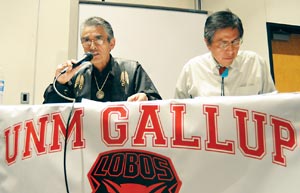
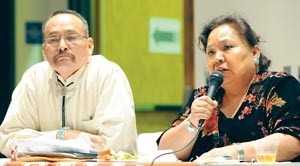
(Times photos - Leigh T. Jimmie)
TOP: President Joe Shirley Jr. and Delegate Leonard Tsosie (Whitehorse Lake/Pueblo Pintado/Torreon) speaks at a forum at the University of New Mexico-Gallup on Dec. 2 in Gallup.
BOTTOM:
Delegates Katherine Benally (Dennehotso), right, and Leonard Chee (Birdsprings/Leupp/Tolani Lake) answered questions at forum Dec. 2 at the University of New Mexico-Gallup.
With Tuesday's special election days away, Navajo Nation leaders are urging the public to vote. Of course, they'd like you to vote a certain way, but we'll get to that in a bit.
Voters will be asked whether to reduce the Navajo Nation Council from 88 to 24 delegates. A second question asks whether to grant the president the authority to veto portions of council-approved spending bills, called a line-item veto.
Early voting, which began Nov. 16 at Navajo Election Administration offices in each agency, ends Friday, Dec. 11. Absentee ballots are due by Dec. 15. The mailing date is not important and in order to be counted an absentee ballot must reach the election office by Election Day even if it means hand-carrying it, said Edison Wauneka, NEA director.
In another significant development, Navajos in the Phoenix and Albuquerque areas will not be able to vote at a nearby site, as they usually do in elections. Funding came in too late for the election office to staff off-reservation polling sites, election officials said.
Anyone who wants a say in this election will have to cast their vote by absentee ballot or vote in person in their home chapter.
The questions on the ballot are a part of President Joe Shirley Jr.'s government reform initiative and will immediately help curb spending and hold delegates more accountable, he claims.
In the long term, Shirley says his plan could lead to even more changes in Navajo government.
"What's going on is history in the making," he said. "Never before has people voted on an initiative where the people make the laws."
Lawrence T. Morgan (Iyanbito/Pinedale), now in his fourth two-year term as speaker of the council, opposes the changes but has remained mostly silent during the campaign. He has chosen to stay out of the debates intentionally, he said.
Officially, though, he is pulling against the council reduction.
Morgan sees the election as an attempt to divide the Navajo Nation, pitting elders against the youth. There does seem to be a strong support for council reduction among off-reservation populations, college students and military service members.
The feeling among older Navajos is harder to gauge, though opponents of reduction clearly feel they have the votes in this group to defeat it - provided the elderly turn out to vote.
"The elders, they will be affected if we go to 24," Morgan said. "They will be left out."
If council reduction passes, most chapters would be consolidated into at-large districts of five or more chapters. Delegates would be stretched thin and would likely wind up neglecting issues in some communities, Morgan believes.
"It might work one day in some areas, but not in all areas," he said.
Shape of things to come
Little has been said of how the initiatives would take effect.
Shirley said the line-item veto would go into effect immediately. He would begin using it and if the council challenged it, he would let the courts decide.
Less clear is what would happen when the council votes to override a line-item veto. This too, was specified in the signature petitions - they stated that the line-item veto would be exempt from override - but the NEA left that line off the ballot and Shirley did not appeal the decision.
As for council reduction, work on redistricting would have to begin immediately in order to be in place for the 2010 elections.
Shirley's petition set a timetable. The council would have four months to draft a reapportionment plan, a map outlining the reservation's new voting districts, and if it fails to do so the president would then do it.
However, the ballot language approved by the Navajo Board of Election Supervisors omitted this portion of the petition and Shirley's office did not appeal the language.
Still, Shirley stands by the language, saying it is the plan that the public signed up for when they supported the initiative.
This could also be resolved in the courts, if need be, he said.
Leonard Tsosie (Pueblo Pintado/Torreon/Whitehorse Lake), a vocal supporter of Shirley's initiatives and former New Mexico state senator, said he could have legislation implementing a reapportionment plan for the council by its winter session in January.
Both Shirley and Tsosie said the NEA has already drafted a 24-district map. The NEA drafted several plans in 2000, when the tribe originally discussed reducing the council to 24 delegates. Although voters supported the plan, the council overruled the vote on technicalities.
"We already have those maps," Tsosie said. "All we need to do is crunch numbers and see if it still fits with current (census) data."
Tsosie said there are several options. For instance, the tribe could revise the boundary lines of the five agencies to equalize the population between regions. With 110 chapters, that would require 22 chapters in each agency.
Another plan calls for creating a sixth agency, possibly centered in Dilkon, Ariz. Under this plan, the six agencies would each elect four delegates for representation.
"Dilkon is already set up to receive an agency headquarter," Tsosie said. "They already have courts and police there."
However, Morgan said reapportionment is a process that is scheduled to occur on its own, based on the 2010 U.S. Census. If the tribe were to realign boundaries and district lines, it would have to wait for the 2010 Census results to show how many voters live in specific areas.
In any case, Shirley said, the tribe could have a plan describing how the council would be reduced by March.
"This is just a tip of the iceberg," Shirley said. "But it's a good beginning."
New approach?
Shirley envisions a future where the council and its subcommittees are not the sole oversight of so many government offices, in particular the election administration and controller. Instead, the tribe should elect a treasurer and secretary as well as its attorney general, each to function independently.
"Then they would be working for the people," Shirley said. "A treasurer elected by the people could really safeguard how the money is used."
In fact, Shirley said the council committees would be cut severely. In particular, the Education Committee could be eliminated now that the tribe has established a Navajo Nation Board of Education to oversee schools and education policy.
The Intergovernmental Relations Committee could also be eliminated, considering it performs the same duties as the president, which is to work with outside governments, Shirley said.
Morgan counters that the Navajo Nation government is built on a system of representation and the more representatives serving the public, the better.
He said the council is open to change and, in fact, governmental change is inevitable. However, such change should come after extensive, inclusive talks between the three governmental branches, Morgan said.
"Whether it's 24 or 88, immediately after the election, the legislative branch will be working on changes," Morgan said. "We'd have to work together to make these changes to a degree."
Morgan also insists the council is not misusing money. In fact, delegates are doing their job and providing a much-needed service for their cash-strapped communities, he said.
"We are going to the local people who are in need and have no money," Morgan said.
Delegates with discretionary funds have helped pay for propane and electric bills as well as school clothes, firewood and emergency supplies.
"Show me where there is misspending, I don't think there is any," Morgan said.
However, the speaker's office as well as the president's office has refused to release any information about how discretionary funds are spent and who receives the money.
Recent stories by the Navajo Times are based on documents left at the newspaper's offices by anonymous individuals.
 E-mail this story