


Honoring the miners
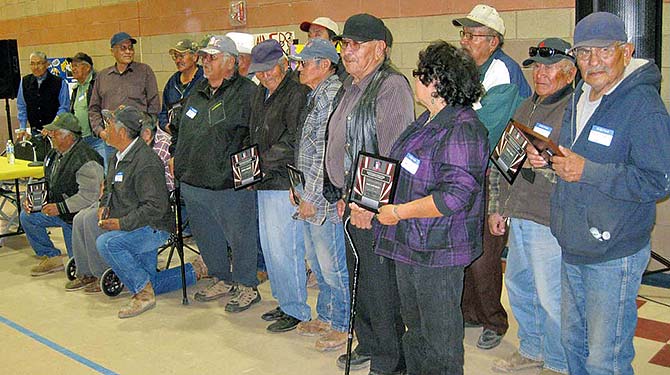
(Times photo - Cindy Yurth)
Former uranium miners from Cove and Red Valley chapters received certificates of recognition Nov. 9 at a ceremony hosted by the students of Red Valley/Cove High School, whose mascot is the Miners.
Red Valley/Cove High School students give recognition to uranium miners, families
By Cindy Yurth
Tséyi' Bureau
RED VALLEY, Ariz. , Nov. 21, 2011
Elsewhere in the country, the economy was crashing, but in this tiny, picturesque hamlet on the Navajo Nation, where most people had only a grade school education if that, there were well-paying mining jobs close to home.
Inside the mines, it was quiet and beautiful, with walls of layered rock: red, blue, black and yellow.
In bare hands and moccasins, a generation dug the yellow ore. In steel-toed boots and helmets, their sons followed. Their grandsons had ventilation systems and protective clothing, but weren't always educated on the importance of using it.
It wasn't until middle age that most miners started to notice the health effects of spending decades handling radioactive ore.
For some, it started as joint pain and shortness of breath. Others noticed they couldn't get over a cold or flu.
By the 1950s, they had a name for it: cancer. Not only miners were developing it. Their wives who hand-washed their dusty work clothes, their children who played in the tailings, grandmas and grandpas who asked their children to fetch them some of the cool, clear water that ran in a rivulet through the mine - nearly ever family was touched by the disease.
"When my dad and grandpa started out, nobody knew what uranium was or what it was used for," recalled Lawrence Marshall, who followed his forebears' footsteps into the mines and later mined in Colorado in the 1970s. "But people were putting two and two together. They knew people didn't have all this sickness before the mines."
It's a history so close and so recent that it's only the present generation that has started to appreciate its significance.
And, studying it, Tom Riggenbach's social studies students at 3-year-old Red Valley/Cove High School (home of the Miners), decided they wanted to do more than just collect oral histories. They wanted to honor the elders who had sacrificed their health so that their descendants could have a better life.
On Nov. 9, former uranium miners, families and widows of miners were invited to the beautiful new school's gymnasium to hear a program, share their stories, and receive certificates of appreciation.
Doug Brugge, who collected miners' stories for his recent book "The Navajo People and Uranium Mining," delivered the keynote address. Sen. Tom Udall, D-N.M., whose father Stewart Udall had written the Radiation Exposure Compensation Act, sent in a video urging the students to keep the history alive.
Myles Harrison, a student, presented an original song about his miner grandfather and the other "Cold War Patriots."
Miners teared up as they shared their stories, recalling things like hugging their children in their dusty clothes, not realizing they were poisoning them.
Activist Phil Harrison, who helped lobby for RECA, updated the crowd of about 150 on present efforts to extend and increase compensation, and took the Shelly administration to task for not renewing the contract of the lobbyist who was pushing for the amendments in Washington.
But the highlight was watching the elders accept the certificates from their grandchildren, recognized at last for their sacrifice.
For former miner Keeswood Russell, 65, who has to use a nebulizer because of lung damage, the fact that the teens had put together the assembly meant more to him than the RECA compensation he is still waiting for.
"They should know these stories," he said. "I'm glad they want to know."
Like many in the audience, Russell is a third-generation miner.
"My dad died from uranium," Russell said. "My mom died when I was 8 years old. My wife had breast cancer. So did my daughter. My auntie, same thing."
Russell is a medicine man and says many of his colleagues have asked him to offer prayers on their behalf, for their compensation - up to $100,000 depending on their job and when they were employed - to come through.
He prays for them, but he doesn't pray for himself.
"I'm on a waiting list somewhere," said Russell, who started mining at age 12 or 13. "If it happens, it will be nice. But it won't bring my dad back. It won't bring my health back. Money is not a cure."