


Mariano Lake celebrates Treaty of 1868
By Andi Murphy
Special to the Times
MARIANO LAKE, N.M., June 25, 2009
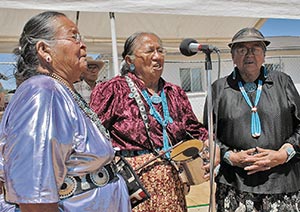
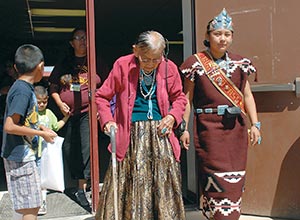
(Times photos - Paul Natonabah)
TOP: Singers from Church Rock, N.M., from left, Beatrice McDonald, Elizabeth Whitman and Sarah Howe, were among the many performers providing entertainment at the Treaty Day celebration June 19 in Mariano Lake, N.M.
BOTTOM: Leona Becenti, the 2009-10 Miss Borrego Pass School princess, escorts her great-grandmother Hasbah Silargo, 94, during the Treaty Day celebration June 19 at Mariano Lake Chapter.
The Treaty of 1868 was commemorated June 19 with music, dancing, games and food.
The 6th Annual Navajo Treaty Commemoration Day, better known as Treaty Day, started with a pony express re-enactment with a group of horseback riders carrying the treaty from Crownpoint to Mariano Lake for a first-ever reading of the treaty in Navajo.
There was also a health run/walk and a few speakers before the activities started.
"Something new is added every year," said Leandra James, coordinator of the event. "All of it is just a huge community effort."
This year the Treaty Day committee added a wild horse race. Numerous student workers helped make the day go smoothly.
Three bands - Shadow Remain, The Brown Bombers and The Wranglers - played country and rock south of the chapter house.
A gourd dance group sang their songs north of the chapter house and a traditional song and dance was set up.
Another country band played in front of the chapter house and a Christian group sang under a tent in the middle of it all.
The elderly did the two-step arm in arm, veterans stomped with rattles in hand and a group of cowboys line-danced and kicked up the loose red dirt.
The bingo games just about matched the energy of the two-on-two basketball tournament and the horseshoe competition.
At noon the whole community was invited for a free lunch.
Most of the activities were supported by volunteers, James said.
"This type of set up should be promoted," said Cecil Lewis Jr., a faith-based counselor for behavioral health services.
The social activity and atmosphere is very good for a community, Lewis said, it brings neighbors together, establishes camaraderie and helps those who might be dealing with the downturns of life.
Community fun is a good investment because socializing in a healthy environment keeps drugs and alcohol abuse out, he said.
"It's an extreme thing for the youth to be involved in their communities," Lewis said. "If there's no connection with the youth, the communities will grow stale."
"I feel good being a Navajo," said Leona Becenti, 13, the Borrego Pass junior princess.
Becenti's favorite part about Treaty Day was visiting everyone, dancing and getting to know new people, she said.
On June 1, 1868, a treaty was signed between the United States and the Navajo people, which released the Navajos from Fort Sumner and they returned to their four sacred mountains. The treaty established a reservation and made promises to provide services such as education.
"That's why our traditional teachings are fading away," said Robinson Tom, a behavioral health services representative.
Tom sees the good and bad parts of the treaty and says boarding schools were the cause of the Navajo's "deculturalization" in the early 1900s.
But at least the government is holding up their end of the bargain by funding the tribe and its many programs, he said.
The Navajo people were rounded up and forced to walk to Fort Sumner after their homes and livestock were destroyed. Along the way many stragglers were shot and it was "probably blood, sweat and tears," said Yolanda Charley, Miss Navajo Nation.
"It's very emotional," Charley said. "It brings tears back to your eyes knowing that our great ancestors went through all of this."
But Charley is glad Treaty Day is still going because it's a way to say thank you to the leaders who signed the treaty and ended the people's suffering and brought them home.
It's a way of honoring those who suffered during the Long Walk, she said, and, from her first experience at Treaty Day three years ago, Charley is proud to see the event grow from barely any attendees to a couple of hundred on June 19.
"It's a very neat event," Charley said. "I really like it ... it's a day to think about what happened back then."
It's important for the youth to know about the treaty, Navajo history and how they will inherit the land, said Carol Mariano, who had two children in the kids' rodeo.
She says it's important to listen to stories from the elders because they're a great source of facts. She learned a great deal of history from her grandparents' and parents' stories.
That's the gist behind Treaty Day - to educate the youth about the treaty, said the coordinator, Leandra James.
The youth should not lose that part of history, she said, and they should understand how history affects them.
If the youth know about their history, they'll want to maintain it, she said.
"The whole event was very emotional and we want them to know that," James said.
 E-mail this story