


Building bridges between old and new
By James R. Kristofic
Special to the Times
GANADO, Ariz., Nov. 25, 2009
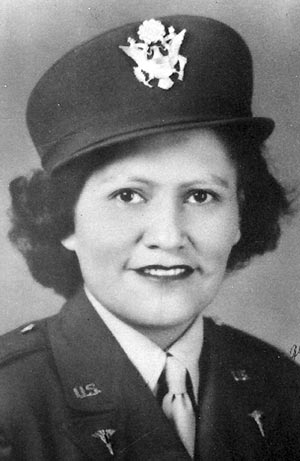
(Courtesy photo)
Charlotte Adele Slivers
Charlotte Adele Slivers spent her youth in the early 1920s playing on wooden horses with the Hubbell children and dodging between touring cars in front of Hubbell Trading Post, where her father, Dahanna Nez, worked as a cook.
In the evening, Slivers followed him home to their hogan over the hill.
When they got home, if someone had their wagon parked outside their hogan, Slivers knew they were going to ask her father to conduct an 'ii'náájí, a Lifeway healing ceremony.
As her father aged and became blind, Slivers led him to the patches of herbs he picked for the ceremonies.
During the 'ii'náájí ceremony, she watched her father crush up herbs in little cups and administer them to his patients. Slivers became interested in healing, and her interest led her to the Anglo doctors and nurses at the mission nearby.
Slivers spent nine years in the grammar school at Ganado Mission. Her parents enrolled her in March of 1926, according to Ganado Mission records.
It was a new place. She and the other little Navajo girls who lived in the dorms played in the running water of the sinks like it was some kind of strange magic.
She learned how to sleep in a bed, curl her hair, and play a piano. She picked up English quickly.
Her intelligence impressed the Mission superintendent, who referred to her as "the bright girl."
That "bright girl" graduated from high school in the Los Angeles area, but was soon called back to Ganado Mission by the new superintendent.
He wanted Slivers to help him try something that had never been tried before.
He wanted to train Navajo women to be nurses. More than that, he wanted them to help him build a bridge between the old ways and the new ways, between Navajo and Anglo cultures.
Unpopular idea
Most of Salsbury's peers didn't like the idea.
"Most Anglos still thought of the Navajos as stupid savages, and could not imagine technical training for them," Salsbury wrote later in his autobiography, The Salsbury Story.
"A lot of people said girls with red skins would never be able to handle the academic subjects, could not master the surgical techniques, and most emphatically would never touch a dead body," Salsbury noted. "I was told a thousand times that Indians were just not temperamentally suited to be nurses"
Still, he started what would become the first and only nursing school for American Indian women - a school that had been so successful that the affiliated hospital (Sage Memorial in Ganado) and Ganado Mission recently received recognition as a National Historic Site.
Salsbury knew his first graduates would need to be strong candidates. He turned to Ruth Henderson, a young Navajo woman from Window Rock, as a prospective floor nurse.
To help him during his surgeries, Salsbury picked Adele Slivers.
Slivers agreed. She enrolled in the School of Nursing in November of 1930.
Over the three years that followed, Slivers and her fellow nursing students rose by 5 a.m., gave their devotional prayers at 6 a.m., ate breakfast, and marched together through the morning frost to their classes at the hospital.
They wore the plain blue dresses and stiff white aprons they'd spent their first two days making themselves.
They studied "Grey's Anatomy." They got to know their model skeleton (who they named "Jimmy") and their anatomical model ("Hyacinth").
The hospital nurses and doctors taught lectures and lab studies in obstetrics, gynecology, anatomy and physiology, practical nursing, ethics, drugs and solutions, gym, and history of nursing.
Slivers went to school with two other Navajos. The other seven students were Pima, Haida, Eskimo, Sioux, Mohave, Paiute, and Spanish-Americans.
20 hours per week
Each girl worked more than 20 hours a week in the hospital and kitchen. Between covering shifts for the other hospital staff at a moment's notice, the girls had to maintain an 80 percent grade point average.
And - between explanations of medical diagrams - always they were drilled in Salsbury's maxim: "A human being counts only in so far as he is able to serve."
The final meditation prayers for the day often reflected on the words of Jesus: "Inasmuch as ye have done it unto one of the least of these, my brethren, ye have done it unto Me."
Slivers and her classmates became heroes to the Ganado Mission schoolgirls.
Smaller girls ran around taking temperatures, using pencils and toothbrush handles for thermometers. They checked pulses, used toy trays for feeding, and put their "patients" on liquid diets of lime Kool Aid.
High school girls made nurses' hats out of newspaper and wore all white clothes.
The rest of the country began to pay attention to Slivers and her classmates.
By 1937, only three student nurses were Navajo. There were more applicants than the school could accept. Ten years later, Salsbury turned away 32 Anglo and non-Indian applicants hoping to enter the prestigious school.
Slivers continued to work as a surgical nurse. On her off-days, she worked as a field nurse, setting out with a driver to nearby hogans in Klagetoh, Cornfields, Kinlichee and Steamboat.
As a student surgical nurse in the operating room, Slivers impressed her instructors.
"I would not ask for a more satisfactory girl for this most important and exacting place," wrote Salsbury in a staff evaluation.
Others noted she had a keen sense of humor, that she was a "leader," who was neither "domineering nor submissive" and had a "bearing that commanded respect."
"Besides being a bright, attractive girl of strong Christian character, Adele is... quick, well-poised, and unflustered in emergencies and yet anticipates your every move when operating. She is systematic and has everything well-planned," Salsbury wrote.
Perfect graduate
When Adele graduated from the School of Nursing in November of 1933, she was 23 years old, a fit young woman at five feet, three inches tall and a trim 115 pounds. But her high cheekbones, thin nose, and slim eyes made her look taller than she actually was.
She could play piano, lead a choir in singing, and she didn't smoke or drink.
She was the perfect graduate for the Presbyterian mission.
On her nursing application, she stated her reasons for seeking a job in Sage Memorial, which was at that time a Christian charity hospital: "I am an Indian graduate nurse and want to help my Indian people to learn about Jesus as well as about Health."
Just before she graduated, Slivers had an appendicitis operation. Salsbury and his wife drove through the night from a fund-raising trip they'd taken to Tucson so they could be at Slivers' side when she recovered.
During the graduation ceremony, Slivers was accompanied by the local medicine man, Hastiin Lezhaghii (Red Point).
The old man was dressed in the traditional green velvet trousers, purple velvet shirt, yellow headband, deerskin moccasins, silver belt, beads, earrings, rings, and bowguard.
Slivers wore her white uniform.
Her brother, Ned Slivers, teased her the day after, saying that he wanted to Slivers to start butchering sheep for him since she was a surgical nurse. That way, she could tell him each part of the animal.
Within a year of graduating from the School of Nursing, Salsbury had appointed her the supervisor of student nurses at Sage Memorial. She was now Miss Slivers, R.N.
He wanted his prize student inspiring the future nurses in his "pet project school."
Slivers had done the impossible, and he hoped some of her spirit would rub off on the other girls.
Thinking on her feet
In her first few months on the job, Slivers was on the front lines between modern medicine and Navajo tradition. And she often had to think on her feet.
When Sage Memorial hospitalized Navajo women, they wouldn't eat eggs because they believed it would make them give birth to too many children. Slivers served them eggnog instead.
One day, Slivers walked in to check on a mother and her newborn baby. Slivers found the window and screen open. The newborn was missing.
After talking with the mother, Slivers learned that the baby's grandmother had taken the baby from its crib, believing the hospital wasn't safe for the child.
Slivers sprinted across campus to get Salsbury in his office. She and the doctor raced after the grandma in Salsbury's Buick. Slivers spotted the elderly woman on horseback far down the road with the baby propped up in front of her.
The woman galloped away from the road, over the desert sage and sand. But Salsbury was able to outmaneuver her, jumped from the car, and grabbed the horse by the reins.
Slivers - speaking rapid Navajo and English between the old woman and Salsbury - convinced the grandma to bring the baby back to the hospital.
But by the end of the first year, the stress between the two cultures was showing in Slivers.
Salsbury noted Adele had a "stubborn streak," along with a "quick" temperament.
But he knew she was an excellent nurse. The following year, in October of 1935, Salsbury put Slivers in charge of the operating room.
Yet Slivers was still having run-ins with the staff. She didn't answer her supervisor's questions. The long hours and over-worked weekends were taking their toll.
Salsbury - once again - cited her quick temperament.
"Adele was that type," said her niece, Caroline Holmes. "Once she put her foot down, she meant it."
Another year later, in 1936, Salsbury described her temperament with one other word: "Navajo."
To the military
After five years at Sage Memorial Hospital, the place that taught her modern medicine, Miss Adele Slivers, R.N., was ready to leave.
By the summer of 1940, Slivers had taken a higher-paying job at a government hospital. She didn't bother to pick up her final paycheck from Sage Memorial.
But, after she went on to a distinguished tour of duty as a 2nd Lieutenant in the Army Nurse Corps in the Pacific theater of World War II and a successful career as a nurse, the bridge she had helped to create in Ganado - between the old ways and the new ways, the Navajo ways and the Anglo ways - remained.
And when she returned to Sage Memorial for treatment almost seven decades later, she was tended by Navajo nurses and EMTs in her final hours.
Holmes and her family wrapped her in a traditional shawl and placed a small gold cross around her neck. They buried her in a modest ceremony at the family sheep camp.
After the funeral, Holmes remembered what her shádí had said to her just a few weeks before.
"Sister, when I go, don't cry," Slivers said. "I did everything. I went all over the world. I've seen everything. I've lived my life."
Kristofic is an oral historian studying the impacts of Ganado Mission on the Navajo Nation.
 E-mail this story