


Kilgore: First Nations vets must speak as one
By Marley Shebala
Navajo Times
WINDOW ROCK, Aug. 13, 2009
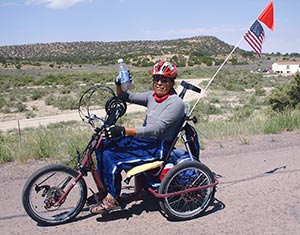
(Times photo - Althea John)
On his way to Washington, D.C., Nathan B. Kilgore Sr. rides his tricycle along State Route 264 Tuesday. Kilgore is making the trip to advocate for medical benefits for Native American veterans.
The way Nathan B. Kilgore Sr. sees it, his current mission could kill him.
But for Kilgore, a 48-year-old paraplegic veteran of three service branches - Army, Navy and Marines - the mission is priority 1.
The mission, according to his pamphlet on it, is "to capture and redirect funds that are allocated to the U.S. Department of Veterans Affairs to each of the First Nations veterans of this nation."
And to bring attention to this quest, he is traveling from the Navajo Nation to Washington, D.C., on a Lightfoot handcycle. He plans to cover 90 miles a day riding the Lightfoot, an $8,000 tricycle customized with 24 speeds and a hand-powered drive train. He plans to arrive in D.C. on Sept. 15.
"If it's one of the last things I do in my lifetime, it'll be for veterans," said Kilgore, who is Bilagáana Bééshbich'ahí (German), born for Tl'ízí Lání (Many Goats Clan). Besides his own link to the military, he has three grown children in military service.
Mary, his wife of 10 years, explained, "He's really sick. People look at him and think he's normal but inside our home, it's a very serious medical situation. He has a heart condition, seizures. He might just go any day. Every time I mention it, I cry. Now I have to handle it."
Mary, 47, and her nephew Jonathan Addaikai, 32, are serving as Kilgore's support crew on his cross-country ride. All three are from LeChee Chapter.
Kilgore was disabled in 1996 when, on a combat training exercise, his parachute did not fully deploy. His reserve chute opened but he hit the ground with great force, suffering severe injuries. He underwent a series of surgeries, but did not regain use of his legs.
He retired from the military in 1998 and since then has become a vocal advocate for veteran rights, as well as campaigning for political reform in his home chapter. In 2008 he ran unsuccessfully for LeChee Chapter president.
Kilgore's decision to ride to the national capital was born of his concern that Native veterans are underserved. During the summer session of the Navajo Nation Council, he presented his "First Nations Veterans Initiative" and trip itinerary and asked for the delegates' support.
Several delegates, including Speaker Lawrence T. Morgan (Iyanbito/Pinedale), provided some assistance then, and promised him that more would be forthcoming when he came through town on his way to Washington.
Kilgore started from LeChee at dawn on July 31. But when he and his two-member support crew arrived in Window Rock on Aug. 3, the expected welcome and financial assistance did not materialize.
"We got here and the whole parking lot was quiet," Nathan said. "It was kind of a scary moment."
Morgan, who approves requests for discretionary funds, was on travel that day. By the time Kilgore left on Aug. 4, he had not received any funds.
He did meet with Morgan's chief of staff, James Davis, and Kilgore said Davis told him that many veterans talk about the needs of First Nations veterans, but that none have taken those concerns to the level that he has.
Kilgore acknowledged that Morgan had provided some funding during the summer, which he combined with donations from other sources to purchase the "trike," including a trip to Conrad, Mont., to get fitted for it and bring it back to LeChee.
But as for the delegates, he said, "I'm kind of disappointed in the Navajo Nation Council. Veterans are always dependable in elections."
Among the exceptions was Delegate Leonard Tsosie (Pueblo Pintado/Torreon/Whitehorse Lake), who paid for two days of lodging and meals for Kilgore, Mary and Addaikai when they were in Window Rock for the council session.
Kilgore recalled that after he addressed the council, Tsosie challenged the delegates to put their money where their mouths are. And some did at the time.
Kilgore said he was surprised to see the female delegates, especially Lena Manheimer (Navajo Mountain/Ts'ah bii Kin) and Katherine Benally (Dennehotso), take the lead on the council floor to support him.
"When you talk veterans, you have to always remember that it's the female that give birth to warriors," he noted.
But other delegates who'd said they would use some of their discretionary funds to help finance his trip were nowhere to be found when he came through Window Rock again.
On Aug. 7, Davis said Kilgore had received money from some delegates, but Davis didn't know their names or the amount they provided.
Kilgore also paid a visit to the Navajo Times and said, "Why am I doing this? I'm trying to bring all the First Nations veterans under one banner because we're pretty much forgotten.
"There's not enough of our people that are educated to get around the federal bureaucracy," he said. "They give up."
Kilgore believes it's going to take all the Native veterans coming together under one organization and speaking as one voice to grab the attention of President Obama and Congress. The goal is to obtain the funding and enabling legislation required to address their unique needs.
"Once funds are redirected, we need to be ready," Kilgore noted. "We're not."
He again urged the council and President Joe Shirley Jr. to establish a tribal Division of Veterans Affairs, which could administer the federal funds.
That said, Kilgore had some advice regarding the proposal most recently under consideration to do that: Revise the proposed budget because it is top heavy with salaries, especially for the new position of deputy director.
As Kilgore sees it, the proposed budget drafted by Leo Chischilly, director of Navajo Veterans Affairs (a department in the Division of Human Resources), reflected "Chischilly's need to keep his job instead of providing services to veterans."
"He's very outspoken," Mary smiled. "He's the type you can't say no to."
Kilgore looked at his wife, who is in need of a hip replacement, and said that would be their first priority once they return from D.C.
Kilgore said an account has been set up at the National Bank of Arizona in Page to accept donations, adding that they are still very much needed.
In addition, he needs assistance from a tech-savvy person to create a Web site for the First Nations veterans' initiative.
Kilgore can be reached by cell phone (928-608-7486). He'll be unable to answer while he is on the trike, but promises to return all messages.
Supporters can also send e-mail to [email protected].
 E-mail this story