


Turmoil in Window Rock
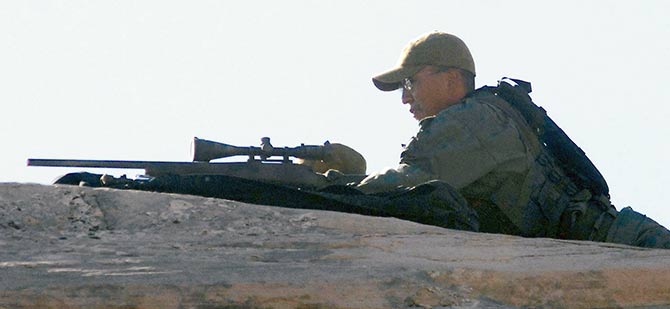
(Special to the Times - Donovan Quintero)
A Navajo Nation law enforcement officer places his rifle in front of him Monday during the council's special session in Window Rock. A tribal official said the heavy police presence may have been overkill.
OnSat inquiry: Evidence of fraud, conflict of interest, favoritism
By Marley Shebala
Navajo Times
WINDOW ROCK, Oct. 29, 2009
There is "substantial" evidence against President Joe Shirley Jr. and Chief of Staff Patrick Sandoval for alleged violations of the Navajo Nation's ethics law, according to the executive summary of a report that was part of the basis for placing Shirley on leave with pay.
Titled "Legal Violations of Navajo Nation Officials and Employees Arising from the Nation's Contractual History with OnSat," the report is the result of an investigation commissioned by the Navajo Nation Council in January.
The council requested the investigation following a tribal audit of OnSat. Sacks Tierney, a law firm based in Scottsdale, Ariz., was hired to investigate whether any of the actions of tribal officials might violate the tribe's laws.
The executive summary, a copy of which was obtained by the Navajo Times, states that "the evidence is substantial that President Shirley and Sandoval appeared to give preferential treatment to OnSat and appeared to compromise their independence and impartiality which gives rise to liability under (ethics law) section 3745(B)."
That section of the Navajo Nation Code prohibits "engaging in conduct that appears to give preferential treatment to special interests or to compromise impartiality."
Shirley, in a telephone interview Wednesday, said there was no preferential treatment for OnSat.
"Everything was on the up and up," he said. "I live in a glass house. Everything I do is scrutinized. My philosophy is always to do right for the people."
The 10-page executive summary is one of three reports, two concerning OnSat, that formed the basis for the tribal council's decision Monday to place Shirley on administrative leave. Attorney General Louis Denetsosie must now decide whether a special prosecutor is needed to investigate and possibly prosecute wrongdoing in business dealings the tribe had with OnSat.
The executive summary says the full report was presented to Denetsosie and Speaker Lawrence T. Morgan (Iyanbito/Pinedale) on Oct. 14.
The summary notes that the investigators did not have subpoena authority, and so could not guarantee that their findings represent the full picture, but what they did find was significant evidence that laws were broken.
'Deeply embedded'
OnSat CEO Dave Stephens "embedded his company so deeply into the inner workings of the Navajo Nation government that he became more than a vendor," states the summary.
The summary goes on to highlight the evidence that OnSat established a monopoly and, in doing so, drew tribal officials into violations of the ethics, procurement, and law and order sections of the tribal code.
Evidence indicates that Shirley and Sandoval helped OnSat "to become the nation's monopoly Internet service provider under an illegal E-Rate funding scheme, by, among other actions, helping it secure and get paid for, nation contract modifications to be funded by E-Rate."
Sacks Tierney cites a 2008 investigation of OnSat's use of E-Rate funds, which states that the original OnSat contract was amended so much that it became "nearly impossible for the nation to track payments, services, and eligible services." (See separate story)
The E-Rate program provides 90 percent matching funds so that underdeveloped areas can improve telecommunications services like the Internet.
OnSat avoided the tribe's procurement laws, which would have required that bids be solicited from several providers, by using "statements of work" to expand its original contract far beyond its original focus on providing Internet service to the chapter houses.
"Not surprisingly, Stephens claimed that the intent of the master contract was to make OnSat a monopoly, like a utility, so that additional Navajo program and departments such as Head Start, the Office of the President and Vice President and the DPS (Division of Public Safety) could obtain services through statements of work, without having to execute additional contracts or go through the nation's procurement process," the summary states.
"There is evidence that Patrick Sandoval, the president's chief of staff, pressured the controller (Mark Grant) and attorneys at the Department of Justice to approve OnSat contract modifications."
The E-Rate study found evidence that Stephens and Ernest Franklin, then executive director for the Navajo Nation Telecommunications Regulatory Commission, allegedly "perpetrated a fraud in connection with the Head Start requests for E-Rate funding," the summary states.
OnSat's work with DPS is similarly suspect, the summary states, referencing investigations by the Navajo Nation and FBI that indicated "Stephens and DPS officials may have altered funding requests in violation of Navajo Nation law."
Close to the prez
The Sacks Tierney investigation also looked at the close relationship that developed between OnSat and Shirley's office.
"OPVP helped OnSat promote itself for millions of dollars in international business," the summary states.
Both Franklin and Shirley traveled far and wide to tell the story of how OnSat helped the Navajo Nation get wired for the Internat age, and cited agreements that Shirley inked with international entities including the Brazilian government, that furthered OnSat's business interests.
In one such agreement, Shirley agreed to have the Navajo office manager of a supposedly independent new program report to OnSat's vice president of global operations.
At one international conference, Shirley sent OnSat's vice president to "represent" the Navajo Nation, while Stephens requested $25 million from Brazil as an "advisor" to Shirley, the summary states.
In summarizing the evidence of potential violations of the tribe's ethics law, Sacks Tierney states, "President Shirley and Sandoval went to extraordinary lengths to ensure OnSat's continued viability at the (Navajo) nation, and to acquire future multi-million dollar business for OnSat, knowing that a company owned by as yet unidentified Navajos would assume both aspects of that extremely lucrative business in the year 2010."
Among the officials facing the greatest evidence of conflict-of-interest violations is Franklin, the former director of the tribe's telecom commission. His brother Farrell already was in business with OnSat and Ernest Franklin is now listed at the contact point for Farrell's business venture with OnSat, Nativo.
The summary repeatedly states that the investigators ran into obstacles from Navajo Nation offices that refused to provide requested documents, and states that it was hampered by its lack of subpoena power.
Nevertheless, it cites the E-Rate report in detail in discussing alleged forgery and fraud in OnSat's contract to provide Internet service to Head Start classrooms around the reservation.
"The evidence we found supports liability against Navajo officials for numerous legal violations of the (tribe's) Law and Order Code," the summary states. It says the evidence against Franklin is strong, and not so much so against Sandoval and former Head Start Director Kaibah Begay.
The summary also accuses OnSat of subverting the tribe's original intent to develop a network of landlines to supply high-speed Internet. Instead the company worked to keep the chapter houses, in particular, dependent on the much more expensive and less reliable satellite connections.
"With a ready source of annual funding by E-Rate, the actions of OnSat undermined the original intent of the nation ... for the chapters to utilize satellite connectivity on a temporary basis," the summary states, noting that OnSat stood to lose customers as the chapters switched to line-based Internet.
The executive summary of the Sacks Tierney report closes by warning that if the tribe delays further in acting, particularly in prosecuting fraud violations, the five-year statute of limitations may expire and give the guilty parties a free pass.
 E-mail this story