


Through Diné lens
Photographer goes all out with book project to photograph rez, people
By Chee Brossy
Navajo Times
(Times photo - Stacy Thacker)
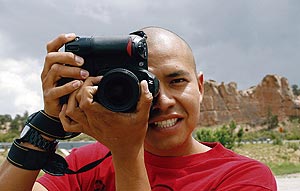
Don James, a photographer for the Albuquerque Magazine, is on a one-year journey to photograph Diné subjects. His card reads, "One Year One Nation."
Outside Diné College on a Saturday night, a heavy metal band from the college's annual music fest blasts music for a handful of enthusiastic fans and another handful of more subdued audience members.
A photographer shoots the scene and its players. A Navajo scene shot by a Navajo photographer.
Don James of Prewitt, N.M., trained in photography at the University of New Mexico, has set out to spend a year photographing scenes around the reservation that illustrate Navajo life through the lens of someone inside the culture.
He hopes to compile his photographs into a book. On his business card James titles his endeavor, "One year, one nation."
Earlier the same day, James walked to his SUV to stow his gear after giving a demonstration of his craft at a youth leadership presentation at the college. Parked outside the Ned Hatathlie Center, where the music fest would take place later, James talked about the advantages of living out of your vehicle.
"I'll be parked right here tonight and I'll be able to get some shots," James said. "Then I'll be able to just step right over to my truck and go to sleep for the night."
But there are also some drawbacks, he acknowledged, like the heavy metal music - not his favorite - that would play late and loud right next to where he'd be sleeping.
He's lucky, the music ends at 10:15 p.m. this year.
When James says "truck" you might picture a rundown jalopy with orange beginning to show through the chipped paint job, but he's driving something a little newer and roomier.
His 1998 Ford Expedition is a roomy SUV with seats that fold down to create a flat space on which to throw your sleeping bag. From the outside, with a spare tire chained to the roof, it almost looks like a mobile fortress.
But the SUV's thirst for gas, and James' self-imposed $100-a-week budget, means he must choose each day's route carefully.
And hygiene is an improvised affair. He generally stops at a chapter house or wellness center, where you can get a shower for as low as 75 cents, he says.
"The most expensive has been three dollars - three bucks? I only take five minutes!" James said.
Every cent counts when you're trying to travel and live off $100 a week.
Grant funding
Where does that money come from? James is funded by the publication Albuquerque The Magazine, which he helped start after graduating from UNM, and that hopefully will help him publish his book.
Now at the halfway point of his yearlong quest, James has photographed a variety of scenes and people in Navajoland, from sheepherders in Klagetoh, Ariz., to a day in the life of the tribal president.
Recently he photographed a Navajo trading family at Totsoh Trading Post in Lukachukai, Ariz., where the family lives and works.
James is Tsénahabilnii (Sleep Rock Clan), born for T—d’ch'’i'nii (Bitter Water Clan). His chei is Tsénj’kin’ (Cliffdweller Clan) and his nál’ is Nakai (Mexican).
The key to James' project is to portray the Navajos through the eyes of a fellow Navajo.
Photographic studies of the Navajos abound, some beautifully produced as "coffee table books."
But, he said, "There's nothing from the Navajo perspective. There's lots from bilagáanas or Asians, but nothing from us."
Traveling the rez, living out of a truck and doing nothing but taking pictures for a year - James admits it's a dream job for him now, at this time in his life.
"I'm not married, I have no kids, and no mortgage," said James, 25. "Five years down the road I'll probably have a steady girlfriend. I know if I don't do it now, I'll look back and say, 'I had a chance to do it and I didn't take it.'"
James is taking a completely unstructured approach. Photo subjects and shoots seem to come and go as they please, adding to the spontaneity of each shot.
"There's nothing scheduled," he said. "That's not how I work. I'll meet people just by running into them on the street and I'll talk with them, and maybe they'll invite me to their home when they see what I'm doing."
That's not hard to imagine, given James' outgoing personality and enthusiasm.
"I'll meet a person, spend the day with them, and try to bring out the good and positive in my photos of them," he said.
Many faces
James has photographed Jonathea Tso, the reigning Miss Navajo Nation, but in keeping with his aim to get at the inner subject, he did it without the blankets, yucca-studded background, and rug dress attire that feature in all her official photos.
"I wanted to see who she really is," James said, and for him that means stripping away the layers of formality.
James also took his cameras to the Bennett Freeze area, where he found some families in dire straits.
"Man it's sad out there," he said. "People are just poor out there."
But that brought him to another of the themes he wants to show in his book.
"It's amazing the resilience of Navajos," he said. "We still live in Third World conditions, but we're still happy and able to persevere through that and live.
"There are Navajo doctors, lawyers, pro golfers, and then there are also people who are very poor, like in the Bennett Freeze area, but they are living their own lives, too," James said. "The diversity of our people is just amazing."
Though many Navajos have welcomed his interest, not all have been receptive.
"There is an equal amount of rejection, even after I explain what I'm doing," James said. "Some people come right out and say they just don't want me around, and they'll chase me away."
Part of that could be a suspicion of strangers wielding cameras.
"As soon as I break the camera out, people are like, 'Are you from the Navajo Times? The EPA?'" he said. "At a community branding in Cottonwood they thought I was an official trying to capture horse thieves. They were nervous because their horses weren't branded yet. They thought I was from the BIA."
James also found that he has to be careful when asking to photograph women and girls.
"I get that, too, girls think I'm trying to hit on them or something," he said with an incredulous look.
But in both situations, once he begins talking with the people in his solicitous, outgoing manner, they soon ease up and let him take pictures, he said.
At this point in his journey through the reservation in search of what it means to be Navajo, James is pleased with what he's been able to see and photograph.
When he began, in February, he photographed a group of Red Mesa High seniors, and plans to end his project by photographing the same people one year later. First, however, he'll have to track them down.
Even as a Navajo taking pictures of Navajo people, his subject is elusive, James admits.
"I could work on this till I die and not capture Navajos," he says.
But he'll be as close as anyone's come.
 E-mail this story