


Book takes yearlong look at Diné
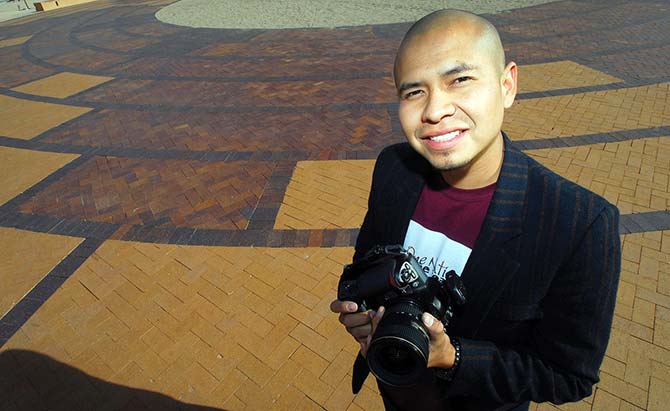
(Special to the Times - Donovan Quintero)
Photographer Don James has published about his travels around the Navajo Reservation titled "One Nation One Year."
By Cindy Yurth
Tséyi' Bureau
GALLUP, May 20, 2010
Perhaps you even let him take your picture for a book he said he was working on - a portrait of the Navajo Nation through the eyes of a Navajo photographer.
Well, Don James' book is finally out. "One Nation One Year" is definitely worth a look. And if your hogan has a coffee table, better clear it off, because this book deserves an honored spot there.
While the Navajo are some of the most-photographed people on the planet, and photo books of the reservation abound, this is perhaps the most complete, contemporary look at Navajo life - and the only one by a professional Diné photographer.
James, Tsé Nahabilnii (Sleep Rock Clan), born for Tódích'íi'nii (Bitter Water Clan), is a staff photographer for Albuquerque The Magazine who also freelances liberally in the advertising world. Many of the billboards you see driving on I-40 between Albuquerque and Gallup feature his work.
James' talent was so obvious he was snapped up by Albuquerque The Magazine before he even finished his bachelor's in fine arts. He has no regrets about going commercial - "It's been a good living for me," he said.
But a project kept floating around in the back of his mind, and it wouldn't go away. More of a journey than a project.
"I wanted to spend a year on the reservation with no particular goal in mind, just drifting around, photographing what I saw," he said.
Long before he had even refined the concept, he had the title: "One Nation One Year."
$100 a week
James procrastinated, worried that no publisher would bite. Could the market handle one more book about Navajos? Would publishers yawn in his face?
Since he already knew they liked his work, he started with his own bosses at Albuquerque The Magazine, armed with a well-researched presentation on all the books out there and how his would be different. He didn't need it.
"They loved the idea right away," he said.
Rio Grande Books, a small publishing company in Los Ranchos, N.M., which specializes in regional titles, agreed to co-publish.
So James was off. He was 24. A frugal, Bohemian type, he had saved up enough to live fairly comfortably for a year. But he decided to limit himself to $100 a week.
"I knew it was going to force me to become resourceful," he said. "It was going to force me to meet people. If I spent all my time in hotel rooms, I'd never meet anybody."
He drove his Ford Expedition, which doubled as his motel room on nights it was too cold to sleep outdoors and nobody had offered to put him up. When he ran out of money for gas, he hitchhiked.
"At first I was going through my week's budget in two days," James said. "By the end of the year, I had money left over."
James found he was much happier living simply. Now he's back in Albuquerque, but his apartment isn't much bigger than his Expedition. He doesn't own a TV or a microwave.
"The only problem is dating," said the 27-year-old bachelor. "I have trouble convincing girls I'm doing this on purpose. They think I'm just poor."
As he predicted, the bare-bones budget did help him meet people. The nicest kind of people. People who didn't make any more than what James were budgeting offered him a space to sleep on their floor, a shower, and even packed a lunch for him the next day.
He was invited to a traditional wedding (which he photographed, of course) and a Kinaaldá, where he was drafted as the fire chief.
"I think being a Navajo who was raised on the reservation (his family is from Blackwater, near Prewitt, N.M.) really helped," James said. "I wasn't an outsider. People put me to work."
James drifted where the wind blew him or where he could get a ride, and ended up traversing the 27,000-square-mile Navajo Nation several times.
He snapped veterans, sheepherders, musicians, cowboys, farmers, preachers and some folks who pretty much defied categories, like the five buddies in Whippoorwill Chapter who have created a five-hole golf course and never miss a day on the green ... er, brown.
He made sure to get the folks with "Navajo star power": President Joe Shirley Jr., the reigning Miss Navajo, James and Ernie, rodeo cowboy Derrick Begay, Code Talker Joe Vandever, Natasha Johnson of "Turquoise Rose" fame. But he also got plenty of Navajos nobody ever heard of, until now.
There are pictures of each of the four sacred mountains, and the last few pages are devoted entirely to hogans - 69 of them, all ages, colors, states of repair and materials.
"That could have been a book in itself," James said.
Many stories
The book is 126 pages long but the hard part was deciding which of the 105,000-odd photographs James had collected to leave out.
"I work for a magazine, so I understand the concept of editing," he said, "but in this case, I had made so many intimate connections with people. When I left someone's picture out, I felt like I was saying, 'Sorry, you don't get to have your story in here.'
"So it was really tough,' he said. 'I might have to make a Web site or something just for the photos that didn't make it in the book."
The text is minimal. James mostly lets the pictures speak for themselves. But he does identify almost every one of his subjects, and Diné writer Karyth Becenti fashioned his notes into a descriptive paragraph for each photo, sharing tidbits of Navajo culture to add context for non-Navajos who buy the book.
Of the hundreds of photos that did make the book, James' personal favorite is on page 52. A young teenager, Urina Bitcinnie, is planting corn with an old-fashioned planting stick.
She's wearing stylish plaid shorts and Converse tennies, and around her neck hang the unmistakable white wires of iPod earphones. She's intent on her work, but her full cheeks crinkle in a beautiful smile.
"She looks so happy," James said. "To me, that picture says it all. We're traditional people, but we love the modern conveniences when we can get them. We've survived by adapting, but yet the old traditions, the really basic things, live on.
"That's the story I wanted to tell. It's the story I think a lot of the other books have missed."
"One Nation One Year" is available for $24.99 from http://nmsantos.com/ (where you can also vote for James to get a Pepsi grant to frame and exhibit his photos). It's also on amazon.com and at the Navajo Nation Museum gift store.
James is planning an official launch party at the museum on Aug. 28, and he's inviting all the people he photographed on his journey.
"I would love to get them all together in one room and see what happens," he said.
As for future projects, he's thinking of a sort of "The Making of One Nation One Year."
"Every one of these pictures has a story attached," he said. "How I met the person, what I did with them ... I was telling one journalist about it while she was interviewing me, and she said, 'That's as interesting to me as the pictures. I would love to write about that.' So we'll see."
For James, anything that helps him relive 2008 is welcome.
 E-mail this story