


Humor, satire enliven MV film fest
(Courtesy photo - Heather Rae)
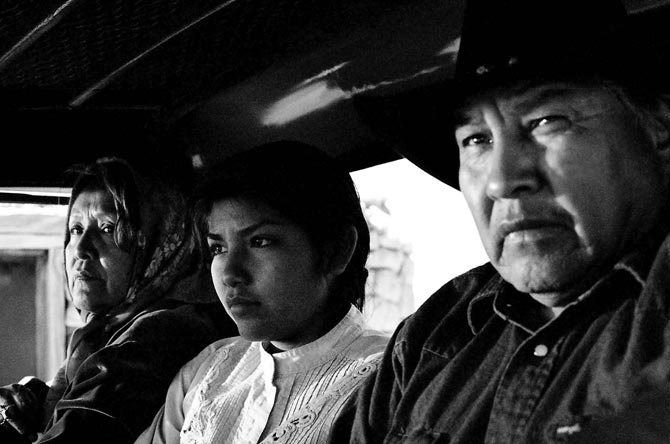
Blackhorse Lowe's film "Shimasani" pits tradition versus Western society in 1934, where two sisters are separated with one going back to school after running away. Noelle Brown, center, of Gallup, is filmed here with Carmelita B. Lowe, left, as masani and Larry Lowe, right, is Sonny.
By Jan-Mikael Patterson
Navajo Times
KAYENTA, Sept. 25, 2010
More than 30 films by Native Americans were screened Saturday and Sunday and the best part, of course, was free admission.
Andee and Shonie De La Rosa, owners of Sheephead Films, founded the festival.
The De La Rosas are well known for their own award-winning work in film: "G: Methamphetamines on the Navajo Nation" and "Mile Post 398," which were screened at film festivals nationwide and internationally.
With Monument Valley such a popular location for Hollywood filmmakers, the De La Rosas thought Kayenta, where many film crews stay, would be the perfect place to hold a festival to introduce Native talent.
Below are some highlights from last weekend's non-stop screenings.
- "The Dead Can't Dance," directed by Rodrick Pocowatchit, 102 min.
In this hilarious yet intense sci-fi flick, Native Americans are immune to a deadly airborne virus that has killed off everyone else.
The story centers on a Choctaw father, son and uncle who are traveling to drop off the youngster for his first year of college. Along the way they run out of gas and start encountering dead bodies everywhere, which they pretty quickly learn are undead.
The film is a cheesy remake of horror classic "Dawn of the Dead" but with a Native American twist involving the blood quantum. Worth watching.
- "Open Season," directed by Raquel Chapa, 15 min.
Although short, this documentary is very informative about sexual and domestic violence against women. It is superbly crafted, giving voice to coalitions, organizations and victims of abuse.
Their gripping stories, bolstered by national statistics, make this a must-see.
- "Shimasani" - directed by Blackhorse Lowe, 20 min.
A black-and-white film shot in vignettes, "Shimasani" features the acting talents of Gallup-based comedienne Brigadier Brown and her sister Noelle, who play sisters living a with their grandmother (Carmelita Lowe) in 1934.
Noelle's character has run away from school citing abuse. After the two sisters spend some time together, Brigadier's character develops a desire to leave their grandmother's traditional home and get an education.
Lowe captured the conflicts of tradition versus modern perfectly.
- "b.Dreams" - directed by Blackhorse Lowe, 20 min.
The premise of this amusing shorty is an Anglo filmmaker who learns Navajo using language tapes and then uses it to flirt with a Navajo woman. After a couple of meetings, she takes him home to meet the family.
The language and story are hilarious.
- "Hey Indian" - directed by Blackhorse Lowe, 19 min.
An Anglo man gets dumped by his Native girlfriend and wallows in misery. He then seeks out a Native to obtain a ribbon shirt hoping that will make him "Indian" enough to win her back.
Misery is only temporary and the expression "plenty of fish in the sea" rings true.
- "The One About Bike" - directed by Blackhorse Lowe, 13 min.
It's all about a guy who loves his pink bicycle. He really loves his bicycle. It's so bad that he literally makes out with the seat of the bike like they're lovers. The bike is his world and everything revolves around it as he rides around his neighborhood. Until he comes across a bevy of flirtatious, teasing beauties.
- "River of Renewal" - directed by Carlos Bolado, 55 min.
A documentary that digs into the issues of resource use in the Klamath River Basin. It is a collection of protests and civil disobedience by tribes, farmers, and commercial fisherman because the river basin is the source of their way of life.
All parties involved are shown literally how their decisions impact their lives from the traditional uses and beliefs surrounding salmon for the tribal people, the water used for irrigated farming, to fisherman hindered by the scarcity of fish.
Everyone is impacted but they finally reach a consensus. The film shows the conflicts, including racist remarks from farmers upset with changes in water management to protect and restore the salmon.
- "Cold Feet" - directed by Blackhorse Lowe, 4 min.
A black and white silent film that echoes from the 1890s where a young Navajo man is set for an arranged marriage that he tries to get out of. The film is beautifully crafted and will make you laugh all the way to the end.
- "The Last Great Hunt" - directed by Shonie De La Rosa, 7 min.
A short satire about a supposed vanished civilization (noted in the opening scene where a road is obviously visible), featuring a Native warrior sporting tighty-whities under his breechcloth, black tennis shoes and suction tips on his arrows.
The warrior is hot on the trail of a rabbit and comes to the point where there is a stare down between a rabbit (a plush toy) and the warrior.
The film is obviously meant as satire, employing film stereotypes in amusing ways, such as dubbing a hawk's scream whenever a random bird, from crows to pigeons, is in sight.
Definitely a chuckle.
- "Obama Likes Frybread" - directed by Sydney Freeland, 10 min.
With the world after Osama Bin Laden, two sheepherders on the Navajo Reservation stumble across a camp where Bin Laden is hiding out.
The film was intended to depict Navajos but the actors aren't Navajo and attempts at the Navajo accent were far from authentic.
It is, however, a hilarious effort. Although the film is funny, the two-minute outtakes shown as the credits roll are even funnier.
 E-mail this story