


Paiwan find plenty to like in Dinetah
By Noel Lyn Smith
Navajo Times
WINDOW ROCK, Nov. 21, 2011
(Special to the Times - Donovan Quintero)
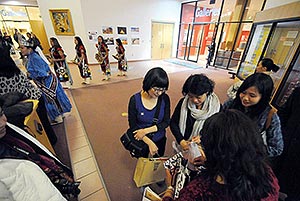
Wei Chen Yu, left, associate curator for the National Taiwan Museum, and other members of the Paiwanese delegation speak with Navajo Nation Museum curator Clarenda Begay Nov. 8 as members of the Dineh Tah Navajo Dancers from Albuquerque get ready to perform.
On the evening of Nov. 8 the aboriginal people from southern Taiwan, an island in the eastern Pacific, were at the Navajo Nation Museum, enjoying the culture, sounds and foods of Navajo.
The Paiwan are Taiwan's third largest indigenous group among the 14 tribes recognized by the Chinese government.
Their visit is part of the "iShare: Connecting Museums and Communities East and West" project, which uses computer technology to bring together the Navajo Nation, the Paiwan Tribe and the National Taiwan Museum in Taipei, the island's capital city.
By using the Internet application iShare, the project will allow members from both tribes and the public access to museum collections and to share information about their cultural heritage.
"The more information we get out there, people will learn more about the Navajo," said museum curator Clarenda Begay.
Project partners hope to have the application available online in the near future.
Chen Wenshan is a curator for the Laiyi Indigenous Museum in southern Taiwan and was accompanied by Chaoling Kuo, who works for the National Taiwan Museum and served as translator for the interview.
"He feels that the people here are very friendly and are very welcoming of people from the outside," Kuo said. "Also the landscape here is amazing and different than what we have in Taiwan."
The group was scheduled to be in the United States for about a week and because time is so short, Wenshan wants to skip sleep in order to learn more, Kuo said.
In Wenshan's right hand was his cell phone, which he has been using to post information and photographs to Facebook - much to the delight of tribal members back home.
"They cannot wait to hear any news from here," Kuo said. "They want it immediately."
Wenshan was a little nervous about traveling to the Navajo Nation but soon felt at ease.
"The first day he arrived here he felt very comfortable because he feels that he is in his tribe because the people look similar," Kuo said.
Besides physical features, Wenshan said there are some aspects of the Paiwan culture that are similar to the Navajo way.
A Paiwan's last name is determined by the place of his birth and his first name is taken from his ancestors, which Wenshan said that might be similar to the Navajo clan system.
The Paiwan also were forced off their traditional lands - because of community development and natural disasters - making it difficult to trace portions of their heritage.
Wenshan wore a black shirt adorned by traditional glass beads of orange, green and yellow, which formed patterns that resembled faces and people.
The shirt's design is related to the social status of the individual and the patterns are used to explain history and culture because the Paiwan have no written language, he said.
About the iShare project, Wenshan thinks it is an important opportunity for Taiwan. It is also the first time the Paiwan have established communication with another indigenous tribe outside their country.
"He envies something about Navajo because he thinks Navajo has great arts and crafts especially textile, the weaving skill," Kuo said.
The group arrived Nov. 7 and among the stops was Hunter's Point Boarding School, where Wenshan and the others watched students learning how to weave.
"He feels it is important to hand the skills and the traditional heritage to our next generation and it is very difficult to have these kinds of education in Taiwan," Kuo said.
The weaving skills of the Paiwan tribe are being lost, Wenshan said.
The group started Nov. 8 with a morning prayer inside the hogan located on the museum grounds. Then they toured the Navajo Nation Council Chamber and met with President Ben Shelly at his office.
Miss Navajo Crystalyne Curley escorted the group throughout their sightseeing tour.
Shawn Price and Dineh Tah Navajo Dancers from Albuquerque performed for the group Nov. 8 and Price explained the role of the Navajo basket in Dine culture.
During the event, Begay told the audience that she visited Taiwan last December and again in June.
"The people there are so awesome, very giving people," she said. "I'm happy to have them here."