


A celebration of the late Gus Bighorse
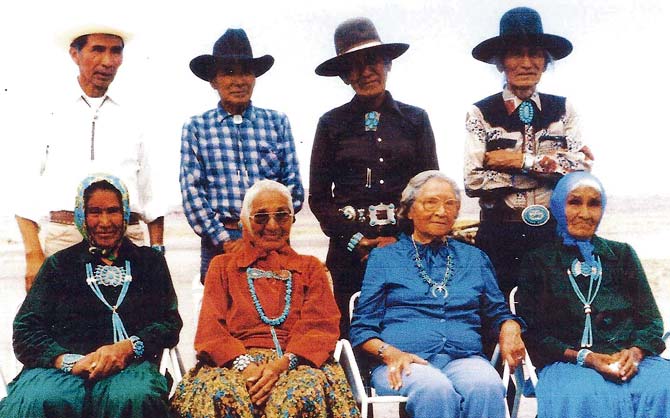
(Courtesy photo)
The sisters of the late Gus Bighorse were, right to left, Mae Dugi Yellowhorse (Feb. 25, 1990), Alice Dugi Sakiestewa (Jan. 1, 2005), Blanche Dugi Benally and Fannie Dugi Seschillie (June 24, 2002); and his brothers, right to left, Kenneth Dugi (May 4, 1994), Sherman Dugi, Authur Dugi (Dec. 31, 1997) and Virgil Dugi (Sept. 17, 2007).
Navajo Times
June 4, 2009
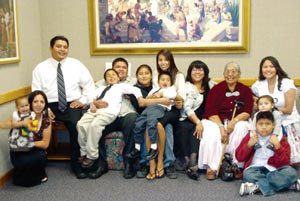
(Courtesy photo)
The descendants of the late Gus Bighorse include the family of Marie Singer, including, left to right, Angel Singer (granddaughter), Lillian Singer (daughter-in-law), Darrell Singer (son), Chandler Singer (grandson), the late Deric Singer (son), Xylenia Singer (daughter), Nyle Singer(grandson), Lavon Singer (daughter), Marie Singer, Louise (Bighorse) Boone (mother, aka Grandma Boone), Leighton Singer (son), Jordann Singer (granddaughter) and Valerie Singer (daughter).
Gus Bighorse was born about 1844 near Mt. Taylor, N.M.
His mother was Asdzaa Lii Yiishchiih (Woman Who Tames Horses). She was Tsé deeshgizhnii (Rock Gap Clan). His father was Hosteen Tabaahi (Man Edge Water). He was Tabaaha (Edge Water Clan).
He lived and survived many harsh events throughout his life. One of his first experiences occurred during a time when the Navajo people were suffering greatly under unsympathetic treatment from the U.S. government.
When he was just a teenager he hid with a group of Navajos around Navajo Mountain, Utah. For many years, this area served as a refuge for the group while other Navajos were forced on the Long Walk.
This experience made him an excellent naataanii and he soon became a leader of one of the bands that protected Navajos not captured by the government.
Years later, when the Navajo people were allowed to return from the Long Walk to their homes and families, they discovered all of their possessions had been taken or destroyed. Due to the circumstances of their return, Gus took it upon himself to help them rebuild.
This need motivated Gus to obtain materials and resources essential for survival, horses being one of the priorities for everyday living. Thus, he led a group of Navajo men to southern Utah where they captured the much-needed horses and he earned his name Bighorse from the large horses.
Mexican raiders
According to his youngest daughter, Tiana Bighorse Butler, author of "Bighorse the Warrior," Gus Bighorse lost his father and mother to Mexican raiders when he was an adolescent.
Later, as told by his son Juan Horse (Bighorse), he and his sisters were kidnapped by a similar group and taken to what was then Old Mexico.
Bighorse spent approximately seven years there before a young man he had befriended warned him that he was about to be sold as a slave the following day. The young man then helped Bighorse escape from his captors, but he had to leave behind his sisters, whom he never saw again.
One of his granddaughters, Rena Posey Begay, recalls the loss of his sisters was very difficult for him throughout the rest of his life. He always wondered what had become of them and wished that he could have rescued them.
After his escape, Bighorse returned to the land of his birth near Mt. Taylor, but his family had been scattered. With no anchor holding him to his homeland, he headed towards the Navajo Mountain area, eventually settling near Tuba City.
There he worked as a mail carrier for the Pony Express, hauled wood and coal, and helped local schools.
In addition to his work, Bighorse spent a great deal of his time with his large family. He had many children scattered throughout northern Arizona. He was always traveling to visit them all.
He was tenderhearted towards his grandchildren and when one of his daughters passed away, he was eager and ready to raise the grandchildren.
A hard worker
Bighorse had a great love for his posterity. He lived in a time when the Navajo was changing and he sensed the white man would continue to bring change. He wanted his children to do great things and to have the very best.
With all of his family responsibilities, Bighorse was always a hard worker, which made him healthy and strong throughout his life. His good health kept him going during the influenza outbreak of 1918. He helped others who fell ill by feeding them and making sure they had enough water and wood.
Bighorse was blessed with strength up until the time of his death. Though he was blind for the last few years of his life he refused to be fussed over. To maintain his independence, he had his family place a rope from his hogan door to a spot away from his home that served as an outhouse.
His nephews enjoyed playing tricks on him and loved to move the rope toward places where it shouldn't have been. In spite of irritations, Bighorse continued to rely primarily on himself until the end of his life.
At the age of 93, Gus Bighorse made what would be his last family visit.
On Dec. 17, 1936, while visiting his family in west of Tuba City junction, he passed away. The family buried him in an unmarked grave and the location was unknown for many years.
Recently, however, the burial site of this great man was discovered, and now descendants will be reuniting to bring his grave and memory out of obscurity.
Family reunion
Bighorse's granddaughter, Rena Posey Begay, feels a great love for her grandfather and a desire to celebrate his life. She was the inspiration for the special event, a family reunion, that will honor Gus Bighorse.
If he were here, Gus Bighorse would no doubt be moved by the great love for his family. He would have loved to meet and know each his descendants. This reunion will in some way make that bond possible, as the descendants of Gus Bighorse will come together to love and celebrate the man whose life was big as his name.
To honor their remarkable father, grandfather, and great-grandfather, the descendants of Gus Bighorse will be gathering this summer to celebrate his legacy.
His descendants are abundant, as family records indicate that he had at least four wives. They are: Mae Bah Manygoats Whitehair, Asdzaa Bah Bilii Nitsxazi (Woman Bighorse), Asdzaa Bah Bilii Nitsxazi (Woman Bighorse sister) and a Hopi woman of unknown name.
The event celebrating Gus Bighorse will be a wonderful time for sharing information and clarifying family history.
Since Bighorse remarried various times and because the government often assigned names to the Navajo people in the early 1900s, many of Bighorse's descendents may not realize that he is their progenitor.
His sons and daughters include: Bilii Ni Dal Tzi Dii (His Horses are Afraid), Bilii' Lizhini (Black Horse), Emma Juan Horse, Da gahii be Asdzaa, Azdaa Bil (Billi' lani) Manyhorse, Billy Sawyer (Old Judge), Hasteen yazhi, sister Asdzaa Yellowhorse, Author Rock, Minnie, Dan Edwin, Glen, Tiana, Bessie, Floyd, Logan Dallas, Deenasts'aa (Ram), and Biglegs Wife.
Gus Bighorse's last child, Floyd Bighorse of Tuba City, was born when he was 79 years old.
Gravesite dedication
On Aug, 14 and 15, the entire posterity of Gus Bighorse will meet to celebrate the life of their great forefather. The event will be held near Tuba City, and signs will direct people from Tuba City junction to the campsite, which will be a respectful distance from the grave.
Those who are very traditional are invited to participate in campsite activities and need not feel pressured to attend the gravesite dedication.
On Aug. 14, descendants will meet at the campsite around noon to meet and visit with other relatives. Families will need to bring their own food for that day but are free to enjoy the company and spend the night.
The second day, Aug. 15, will begin with a trip to the gravesite of Gus Bighorse, for those interested. At the site, a monument with information about Gus Bighorse will be dedicated.
After respects are paid at the gravesite, the family will reunite at the campsite for a meal provided by the host family and a program.
The program will include entertainment and will also spotlight the oldest living member from the families of each of the four wives. For example, in the Manygoats Whitehair branch, one of the Gus's sons is stilling living and will be the spotlight family member.
Volunteers are needed both to share their talents (such as singing, storytelling, or presenting skits) and to give the family presentation, which could include pictures and stories. If no one is willing to present, a poster with information can be set up at a booth so family members can learn more about Bighorse's surviving posterity.
Those who attend are also invited to bring their genealogy or family history to share. Several members of the Bighorse family are working to assemble family records, and there will be a time and place designated for the exchange of family information.
Because the campsite is outside of town, portable bathrooms are necessary, and the meals on the second day will also be provided from this fund.
Additionally, the family plans to build a fence around the gravesite and also setup a monument in honor of Gus Bighorse. Contributions to this family project are needed and appreciated.
Information: Marie Singer, mariegsinger@live.com or by phone at 520-449-1222.
Based on a submission by Marie Singer and family.
 E-mail this story