


The trick-riding sisters
Chinle sisters made mark by performing stunts on horseback
By Quentin Jodie
Navajo Times
CHURCH ROCK, N.M., June 23, 2011
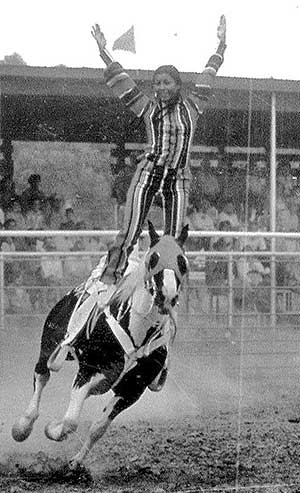
(Courtesy photo)
In 1971, trick rider Ruth Grant-Bitsui performs the liberty stand on Bear, a Tobiano paint horse, in Montana.
On Saturday night, the Corrales, N.M., cowgirl maneuvered her sorrel horse Ereka around the cloverleaf pattern at Red Rock State Park during the 63rd annual Lions Club Rodeo and picked up a first-place win in the incentive barrel-racing event with a time of 16.297.
"I just love coming back here," she said after completing her run.
But her affection goes much deeper than that. As a youngster, Ruth and her three siblings Gloria Grant-Means, Joy Grant-Manus and Mark Grant, all originally from Chinle, dazzled the local community with their trick-riding skills.
Trick riding consists of stunts performed on a horse at galloping speeds.
"This was one of our favorite places," Bitsui recalled of the Gallup area. "At the end of the summer we used to come back and perform in the Gallup Ceremonial and as a child it was a whole lot of fun."
The old days
Back in those days, things were different Bitsui said.
"We used to perform at the old Gallup Armory," she said. "It was a big attraction because there used to be a lot people."
In recent years, though, the annual Gallup Inter-Tribal Indian Ceremonial has lost some of that luster. But according to Grant-Means, the annual event was a time when most Navajos would congregate and catch up on the latest news.
"It was a social gathering," she said. "I mean people used to set up camp and stay for the whole festivities."
Of course, their trick riding was immensely popular. According to Grant-Means, the 1972 Ceremonial was their last and best performance as a group.
"We were featured in the 'Western Horseman Magazine,'" she said. "And growing up we were billed as the 'The Grant Sisters, The Only Indian Rodeo Trick and Fancy Riders in the World.'"
The sisters credit their father, Leon Grant, Omaha, from Nebraska and a former saddle-bronc rider, for introducing them to trick riding.
"Ever since I was five years old, I have been a trick rider," Grant-Bitsui said. "My parents used to buy paint horses and my dad taught us how to trick ride. I used to always admire him for squeezing in horses in our budgets even though we didn't have a lot. He always made sure we had trained horses to work with so we could fulfill our contracts."
A risky profession
In an email response, Grant-Means said they went through so many horses, but she listed five horses - Arizona, Cody Bill, Bear, Pawnee and Cochise - that made their jobs easier.
"Some of our tricks were extremely dangerous because we've been bucked off, stepped on and dragged in the public eye, so we have been humbled by them," she said. "But at the same time, we had some great horses that took us around the country."
For Grant-Bistui, that was her favorite part of trick riding.
"It was sort of like a working vacation," she said. "We would hit a lot of rodeos up north and it paid for our vacations. It was also a means of support for us to buy our school clothes."
At these events, the sisters said they performed 10 to 13 stunts while younger brother Mark did vaults.
"We did what they call strap tricks," Grant-Bitsui said. "There are many variations and we all had our own styles."
Her specialties included the one-foot stand, shoulder stand and the half- and full-fender drags.
As for Gloria, she perfected the "Liberty Stand, the Russian Drag, and Stroud Layout."
Physical demands
All of these tricks required a lot of dedication and hard work, Grant-Bitsui said. She went on to say that while growing up they had to be mentally and physically tough since the work they did required "poise, grace and balance."
"We had to be physically fit and it was really hard on our bodies," she said.
In order for them to perform, Gloria also said they had to keep a watchful eye on their equipment.
"Our saddles were truly one-of-a-kind soft, white saddles," the Grant-Means said. "The equipment my father designed was specially made for each horse. He was an expert at making straps and knots.
"The saddle and the straps were constantly checked ... and if your saddle was loose you could have a serious accident," she added.
Grant-Means said their mother, Silvia Gorman Grant, worked tirelessly on their typically white outfits and "wore wrestling shoes because that's what trick rider rode. If you wore boots, you risked getting hung up."
"When we rode safety was the most important factor," Grant-Means said, adding that every now and then she said their straps would "get brittle."
"When we would sweat they'll get really brittle and they'll just pop," she said.
Personal growth
The hazards of trick riding obviously had its consequences, but for Grant-Means she saw it in a different light.
"Really it's been a source that strengthens my own faith," she said. "You can't do this kind of riding because it's so dangerous and you know the Lord has to have it in your plan.
"I think He's really blessed us," she said.
The blessing went far beyond the rodeo arena. Because of their high-flying act, Grant-Means became a finalist in the Miss Rodeo USA in Oklahoma City while Grant-Bitsui won the Miss Congeniality in the Miss Teenage America pageant.
"I was 15 years old at the time and the pageant's committee wanted me to bring film of my trick riding since I couldn't perform there," she said. "We took some shots in Canyon de Chelly and that was kind of the beginning where I realized that I could meet a lot of people through trick riding."
Travel abroad
As time went on, Grant-Bitsui became a regular act with the Rodeo Cowboy Association, known today as the Professional Rodeo Cowboy
Association. She did this line of work by invitation even after starting a family with husband Edison Bitsui, the current commissioner of the International Indian Finals Rodeo.
Besides performing at state fairs and special functions, her trick riding also took her abroad.
"One year we took a group of young kids with us to Argentina," she said.
Her travels didn't end there as she performed in Helsinki, Finland, as well as the Palais Omnisports de Paris-Berse, one of Paris' famed arenas.
"It was a lot of fun," she said. "I got to see so many different countries and I met a lot interesting people."
But in 1991, Ruth decided it was time to hang up her spurs.
"When we were in Paris, I told Edison this was going to be my last performance because I was literally black and blue," she said. "I was 38 years old at the time, but I realized I couldn't do it anymore."
Change to barrel racing
Even though she called it quits, Grant-Bitsui felt the urge to get back into the arena, so she turned to barrel racing.
"It's something that you can do a lot longer," she said. "It's not as physically demanding as trick riding, but it's still demanding."
Currently she competes in both the AIRCA and the National Barrel Racing Association with her two horses, Ereka and Scooby Doo.
"Right now I have a full schedule with my barrel racing," she said.
Looking back, Grant-Bitsui said trick riding opened a lot of doors for her and her siblings. But the willingness to improve their skills was what inspired them to be better people.
"It taught us a lot about who we are," she said, "but I think it also taught us to be responsible and be more disciplined."
An advocate for education, Grant-Bitsui earned her master's degree in business administration from Northern Arizona University. Last December she retired from Sandia National Laboratory in Albuquerque after 30 years of service.
Both Grant-Means and Grant-Manus are principals with the Window Rock and Chinle school districts while Mark is the controller for the Navajo Nation government.
"My parents stood for education," Bitsui said. "And so we all went to college and we all got a degree. I do think that is really important because you can do a lot if you have options.
"Experience is good, but sometimes you need that piece of paper," she said.
comments powered by Disqus