


Candidates faulted for vague answers
By Erny Zah
Navajo Times
FORT DEFIANCE, Oct. 18, 2010
(Special to the Times - Donovan Quintero)
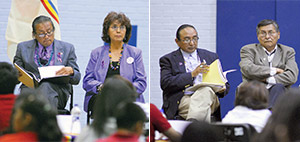
TOP PHOTO: Navajo Nation president and vice president candidates Earl Tulley and Lynda Lovejoy (left panel) and Navajo Nation president and vice president candidates Rex Lee Jim and Ben Shelly (right panel) wait for the youth forum to begin Tuesday evening in Fort Defiance.
BOTTOM PHOTOS:
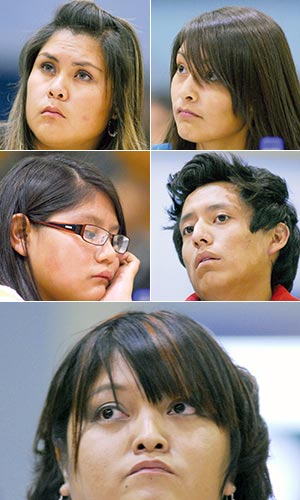
(Four smaller photos, clockwise, starting top left): Hannah Yazzie, Naanibah Begay, Jaron Kee, Brooke Becenti. At bottom of collage: Amber Cook.
She was one of more than 100 young people who listened through over two and half hours of statements by Navajo Nation presidential and vice-presidential candidates Tuesday night.
The Presidential/Vice Presidential Youth Issues Controlled Debate was held at Veterans Memorial Fieldhouse with nearly 500 people in attendance. All four candidates - Lynda Lovejoy, Ben Shelly, Rex Lee Jim and Earl Tulley - took part.
The candidates were limited to three minutes each in answering questions developed by the students, but only managed to get to seven of about two dozen questions composed for the event.
Halona wishes the candidates had talked more about their solutions to reduce gangs and gang violence "because a lot of kids at the high school usually just join gangs because a lot of people pick on them, so they just join (gangs) to be equal with everyone else," said the junior.
As they had during a similar forum held Oct. 1 at Navajo Preparatory School, the candidates emphasized parental responsibility over government policy to solve the problem.
Presidential candidate Ben Shelly said gangs prey on youth who don't have a strong family home, adding that a home with strong family values could combat gangs.
Young people are looking for love and gangs provide that type of stability, he said.
"That's what gangs key on," he said.
To combat the appeal of gangs, homes need to begin to love their young ones, Shelly said.
His rival Lynda Lovejoy also focused on the role of adults, saying, "Gangs learn from adults that model bad attitude, poor attitude."
To combat gangs, Navajo people need to "redevelop our value system," she said.
Dylan Goodwill, 15, a sophomore at Window Rock High school, agreed that the gang problem is to some extent linked to family problems, but said another issue could contribute too.
"It is true that it (stems) from the home but I think it could be from like inside the school as well," she said, noting that she felt the candidates' responses about gangs "could've been a little better."
However, Goodwill did like the candidates' plans to create summer youth employment, saying that both Lovejoy and Shelly seemed "sincere."
But when asked how they could expand youth employment when funding for it is decreasing, both candidates tried to lower expectations about the role of tribal government.
"(Youth) need to spend more time with elderlies," Shelly said, not offering any specific answers about funding. "You need to know your self; you are Diné."
Lovejoy said early budget planning could create more funding but called for youth not to be overly dependent upon the Navajo Nation for employment. Instead, young people should look around them, see what needs to be done, and offer to do it for a reasonable fee.
Babysitting and yard work, for instance, are ways youth can gain work experience, she said.
The evening started with an opening statement from each candidate, after which they answered questions. But Brianna Lee, a WRHS senior, said none of the four candidates fully answered the questions.
"They didn't really pay attention to their questions, and some of (their answers), they beat around the bush," Lee said.
Shelly admitted that he had a hard time hearing the questions, and some of the questions were embedded in lengthy statements, making it difficult at times for the respondent to track them.
For example, the first question of the debate stated a problem with limited jail space and asked if that was a problem and how would it be addressed. This was followed by a statement making the point that the shortage of jail space makes some teens feel they won't be punished if they commit a crime.
Lovejoy said laws need to be modified to protect families.
Shelly said Diné Fundamental Law and statutory law make some laws difficult to enforce.
Moderator Jason Allison, also known as DJ Abel, asked the question again, emphasizing the point that teens commit crimes because they feel invincible.
Lovejoy and Shelly had one minute to respond.
"Laws are not being enforced," Lovejoy said, adding that some facilities on the reservations aren't being used, but she gave no further specifics.
Shelly said young people need to stay busy and engaged in activities to avoid getting into trouble.
"To be honest, I think you both didn't address (the question)," Allison said.
The vice presidential candidates were asked how they feel about a woman leader, given that some Navajos believe it goes against traditional teachings.
"I feel excellent about it," Jim said, adding that he believes all Navajo people, regardless of gender, should become the best of who they are.
Lovejoy's running mate, Earl Tulley, said to the young woman who asked the question, "You are a lead. You are a Navajo woman leader."
Jim, a medicine man, added that Navajo stories have different translations.
Allison gave the two another minute to address the point that having a woman leader was against "our traditional ways."
"I believe I was very clear," Jim said, and reiterated some beliefs about the sanctity of womanhood.
"I have never come across this story," Tulley said about the taboo on women in public leadership positions. He speculated that the story may have come from different clans.
None of the candidates impressed Trey Jim, 17 (no relation to Rex Lee Jim).
"I think ... the candidates kind of like beat around the bush and tried to avoid the point of the questions," he said.
Though the evening centered on topics generated by young people, "when it really comes to campaigning and campaigning about themselves, they really talk about more Navajo Nation issues than youth issues," said Brianna Lee.
"They say that youth comes first, but they really don't put youth first," she said.
 E-mail this story