


Descheenie links U.S. action in Venezuela to history of imposed rule
Special to the Times | Donovan Quintero
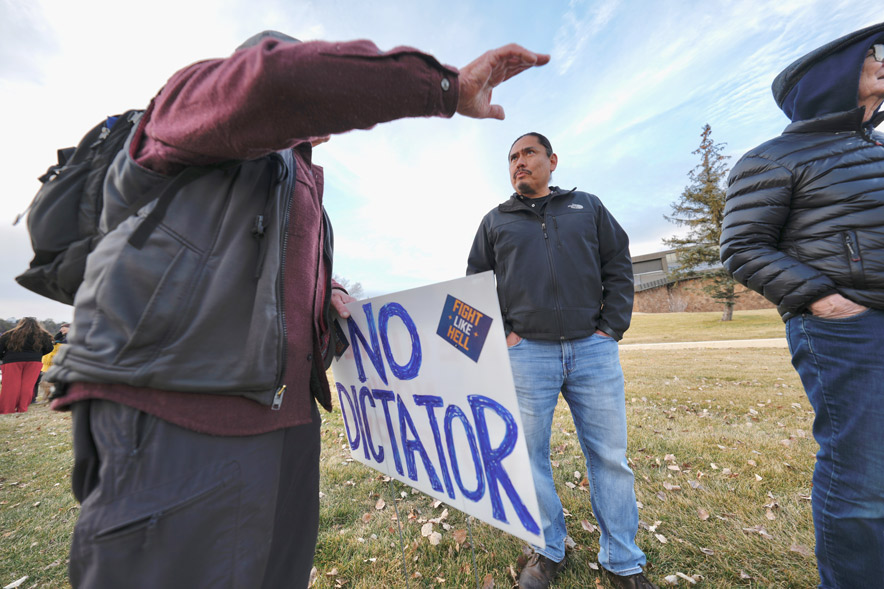
Eric Descheenie, a candidate for Arizona’s 2nd Congressional District, listens to a demonstrator outside Flagstaff City Hall during a protest on Saturday, Jan. 3, 2026. The demonstration focused on U.S. military action in Venezuela.
FLAGSTAFF
Arizona Congressional District 2 candidate Eric Descheenie stood among protesters in downtown Flagstaff on Saturday afternoon and sharply criticized U.S. military action in Venezuela, arguing that the operation reflects a long-standing pattern of American intervention rooted in resource extraction, imposed governance and disregard for Indigenous voices.
Descheenie’s remarks came as President Donald Trump claimed U.S. forces carried out a U.S.-directed military operation in Caracas, Venezuela’s capital, that resulted in the capture of Venezuelan President Nicolás Maduro and his wife, Cilia Flores. Trump said the couple would face prosecution in the United States following federal indictments related to alleged drug trafficking and narco-terrorism.
Descheenie did not comment on the legal filings or Trump’s operational claims, instead focusing on what he described as the deeper historical context behind U.S. actions abroad.
Special to the Times | Donovan Quintero
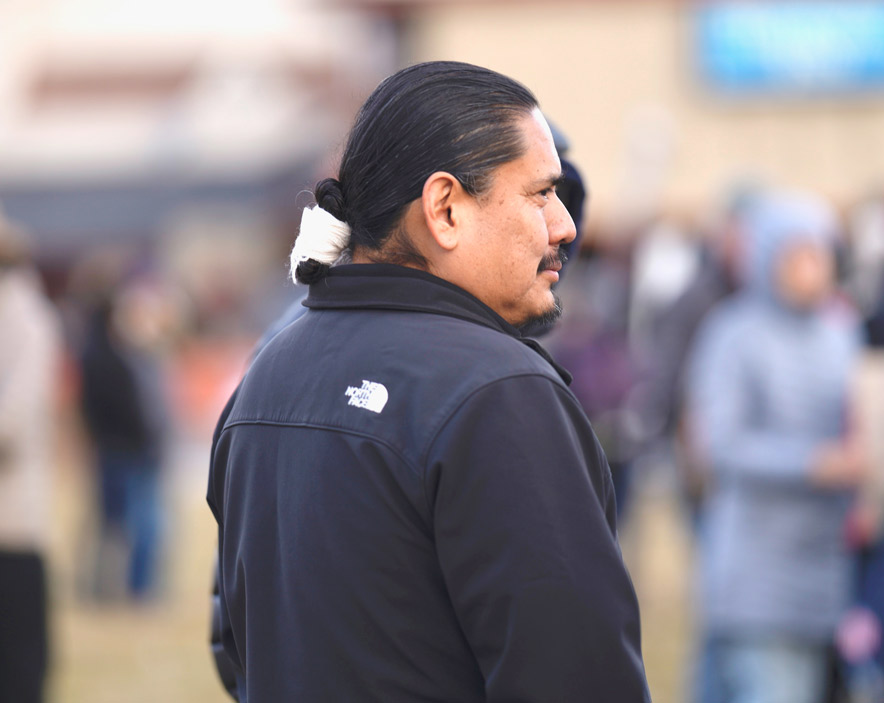
Eric Descheenie, a candidate for Arizona’s 2nd Congressional District, stands among demonstrators during a protest outside Flagstaff City Hall on Saturday, Jan. 3, 2026.
“This is par for the course for the United States,” Descheenie said. “Seeking out places where there’s natural resources, which translates to riches, and trying to install a government you can coerce or strong-arm to achieve those resources at a cheap rate. That’s been our history.”
He described the Venezuela operation as “manifest destiny on steroids,” saying the same logic has been used for generations to justify U.S. interference both internationally and within Indigenous nations.
“The Navajo Nation knows this all too well,” he said, pointing to federal involvement in shaping the modern Navajo Nation government.
Familiar pattern of imposed governance
Descheenie said historical records show Washington-based attorneys played a direct role in drafting governance systems that displaced traditional Diné principles and values.
“If you want access into somebody else’s home, the fastest way is to change how the rules are written so they match how you operate,” he said. “Once you do that, you have leverage.”
He said Venezuela’s vast reserves of oil, gold and natural gas make it a predictable target and warned that Indigenous peoples in Venezuela are likely being excluded from decisions that will shape their future.
“There are Indigenous peoples all over the world,” he said. “What are their experiences? What are they saying? Is their voice even in the mix? Because it should be.”
Trump, speaking earlier in Washington, described the mission as “one of the most stunning, effective and powerful displays of American military might,” claiming U.S. forces used “air, land and sea” to overwhelm Venezuelan defenses.
He asserted there were no American casualties and said the United States would temporarily oversee Venezuela’s transition, stating, “We’re going to run the country until such time as we can do a safe, proper and judicious transition.”
Trump also said U.S. oil companies would be directed to help rehabilitate Venezuela’s oil infrastructure, a point Descheenie cited as further evidence of profit-driven intervention.
Military force, long-term costs
Special to the Times | Donovan Quintero
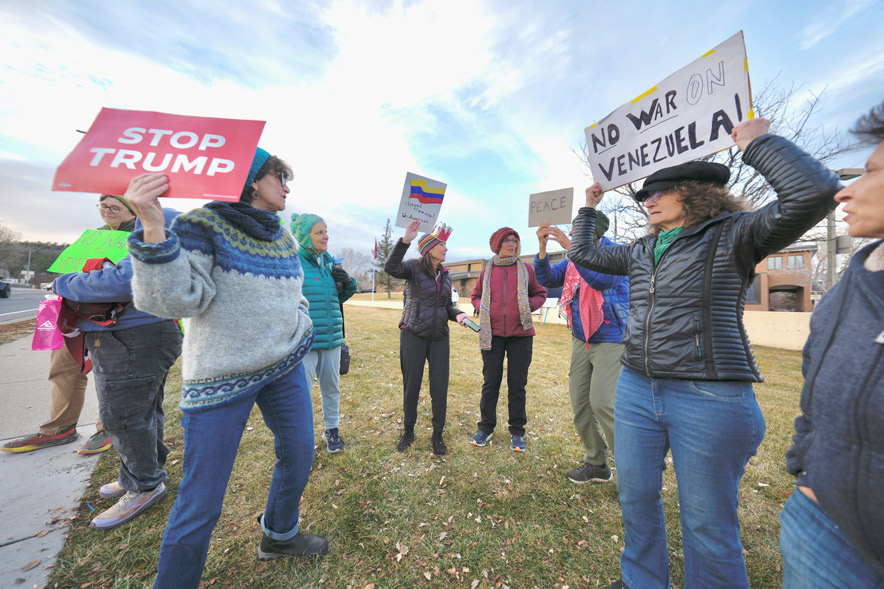
Demonstrators hold signs reading “Stop Trump” and “No war on Venezuela” during a protest outside Flagstaff City Hall in Flagstaff on Saturday, Jan. 3, 2026.
Descheenie warned that military interventions justified by criminal allegations or national security rhetoric often worsen global instability, accelerate climate change and deepen inequality.
“This is what contributes to climate change,” he said. “This is what contributes to poorly functioning governments, which then translates into economic injustice, social injustice, environmental harm and broken public systems.”
Asked what Navajo people should take from events in Venezuela, Descheenie pointed to Navajo veterans, many of whom he worked with while serving in the Arizona House of Representatives. He said their service was grounded in protecting family, homeland and the right to self-determination, not enriching powerful interests.
“Our servicemen and women did not sign up so oligarchs could get wealthier,” he said. “They signed up to protect their people and their future.”
Arizona Sen. Mark Kelly, a former U.S. Navy combat pilot, echoed some of Descheenie’s concerns while acknowledging the seriousness of allegations against Maduro.
“Nicolás Maduro is a brutal, illegitimate dictator who deserves to face justice,” Kelly said in a statement. “But if we learned anything from the Iraq war, it’s that dropping bombs or toppling a leader doesn’t guarantee democracy, stability, or make Americans safer.”
Kelly criticized Trump’s remarks about oil and governance, saying the president “doesn’t understand the risks and costs involved with these poorly thought-out decisions” and warned Congress should act to reassert its constitutional authority. He also thanked U.S. service members involved in the operation, saying he was grateful no Americans were reported killed or seriously injured.
Legal authority, local parallels
Special to the Times | Donovan Quintero
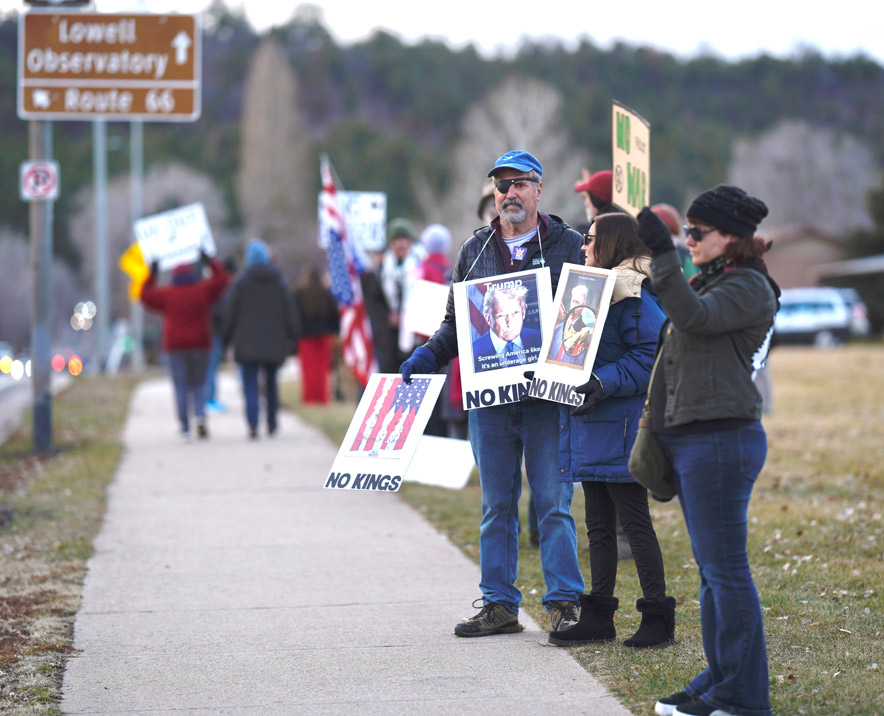
Demonstrators line a sidewalk near Flagstaff City Hall holding signs during a protest on Saturday, Jan. 3, 2026. Participants gathered to voice opposition to U.S. military action in Venezuela.
Descheenie said the legality of the operation remains a serious concern, particularly in the absence of clear congressional authorization.
“If there’s respect for the Constitution, you follow the law,” he said. “There’s no compromise on that.”
He also connected events in Venezuela to local Native American struggles in northern Arizona, including water rights disputes and opposition to wastewater-based snowmaking on the San Francisco Peaks. He said the same dynamic of ignored Indigenous voices plays out at home.
“There are people living right next to Navajo communities who don’t even know our narratives,” he said. “That’s no different than what’s happening to Indigenous peoples elsewhere.”
The U.S. Embassy in Bogotá, Colombia, on Jan. 3, 2026, warned U.S. citizens not to travel to Venezuela. For U.S. citizens currently in the country, the embassy advised they “should shelter in place.”
“Venezuela has the highest Travel Advisory level – Level 4: Do Not Travel – due to severe risks to Americans, including wrongful detention, torture in detention, terrorism, kidnapping, arbitrary enforcement of local laws, crime, civil unrest, and poor health infrastructure,” the embassy said in a statement.
A Dec. 3, 2025, travel advisory urged all U.S. citizens in Venezuela “to depart immediately.”
Since 2019, the U.S. Department of State has withdrawn all diplomatic personnel from the U.S. Embassy in Caracas and suspended operations.
“The U.S. government has no ability to provide emergency services to U.S. citizens in Venezuela,” the embassy stated.
As the situation continues to unfold, Descheenie said the events in Venezuela highlight the need for greater vigilance, community preparedness and collective action.
“The world is becoming more unstable,” he said. “We need to stop deferring to others to make decisions in our best interest. We need to care about something enough to do something we’ve never done before.”
He said Navajo traditions of preparedness and mutual aid, ensuring neighbors have food, firewood and support, offer a path forward in uncertain times. He emphasized that sovereignty is ultimately lived and practiced by communities, not granted by governments.
“Sovereignty isn’t found on paper,” Descheenie said. “It’s found in our homes, our families and our willingness to act.”
Organizers said demonstrators plan to return Sunday, Jan. 4, 2026, for a second protest scheduled for 1 p.m. outside the Flagstaff City Hall.
Get instant access to this story by purchasing one of our many e-edition subscriptions HERE at our Navajo Times Store.

 Highway 264,
 I-40, WB @ Winslow