



Partial federal shutdown brings limited impact to Navajo Nation services
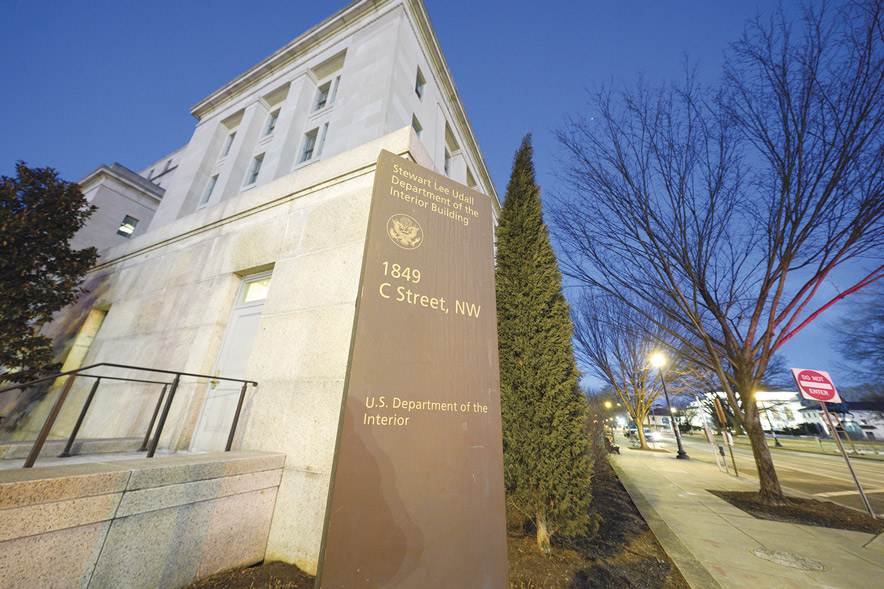
Special to the Times | Donovan Quintero
The U.S. Department of the Interior building in Washington, D.C., in January 2025.

PAGE
A partial federal government shutdown went into effect early Saturday after the U.S. Senate passed a revised funding package, but the U.S. House delayed its vote until Monday. The shutdown is the second in four months, but Navajo Nation Speaker Crystalyne Curley said it will not have the same reach or severity as the one in October.
“This partial shutdown is not nearly as severe,” Curley said in a statement, referring to the 43-day standoff last fall that disrupted key services. She said many essential federal programs serving the Navajo Nation have already secured funding for the fiscal year.
According to Curley, the Bureau of Indian Affairs, Bureau of Indian Education and the Supplemental Nutrition Assistance Program will continue operating. Hospitals operated by the Indian Health Service are also protected after receiving advance appropriations.
The Navajo Division of Transportation has received its full annual allocation and will continue its projects without interruption, the Navajo Nation Washington Office confirmed.
Still, uncertainty in Congress leaves the door open for broader impacts if no agreement is reached.
“If Congress does not reach an agreement soon, then we might see additional impacts in areas such as housing vouchers that help Navajo families that live in border towns, impact aid funding for students, rural job training programs and others,” Curley said.
The House is scheduled to vote Monday evening on HR 7148, the Consolidated Appropriations Act of 2026. If the bill passes and is signed into law, most federal operations are expected to resume as early as Tuesday. However, the outcome is not guaranteed.
Most programs funded while immigration debate stalls DHS budget
The Senate approved the funding package Friday night in a 71–29 vote after separating out money for the Department of Homeland Security. Democrats and the White House agreed to fund DHS for two additional weeks while lawmakers negotiate restrictions on Immigration and Customs Enforcement.
Proposals under consideration include a ban on mask-wearing during enforcement, mandatory use of body cameras and stricter limits on roving patrols.
The compromise emerged after the death of Alex Pretti, a nurse killed in Minneapolis during an encounter with federal agents. Democratic leaders said the shooting highlighted the need for stricter oversight of ICE operations. Republicans agreed to delay debate over DHS funding in exchange for votes on unrelated provisions, including one targeting sanctuary cities.
“We continue to closely monitor how our Navajo citizens may be impacted by ICE in urban areas as well,” Curley said.
She also raised concern about longer-term consequences if the political stalemate continues. While key services are currently funded, programs like housing assistance, school support and job training could be strained without additional appropriations.
Senate negotiations continue while the House prepares vote
Senate Minority Leader Chuck Schumer said Democrats will continue pressing for changes to immigration enforcement.
“This is not America,” Schumer said after the vote Friday. “And when you see those images, know that something is dramatically wrong and it must change.”
The agreement keeps most federal agencies funded through September. DHS remains on a temporary extension, with less than two weeks for lawmakers to finalize a longer-term deal.
Sen. Lindsey Graham lifted his opposition to the bill after securing a commitment from Senate Majority Leader John Thune for future votes on separate measures, including one targeting sanctuary cities and another limiting how federal investigators access phone records.
In the House, Speaker Mike Johnson is expected to bring HR 7148 to the floor under suspension of the rules, a procedure that requires a two-thirds majority to pass. If the bill clears that threshold, it will go to President Donald Trump for his signature.
Curley closed her remarks with a message to Diné families.
“Please continue to watch over your children and elders during this winter season,” she said.
Get instant access by purchasing one of our many e-edition subscriptions HERE at our Navajo Times Store.

 Highway 264,
 I-40, WB @ Winslow