







Amber McCrary’s poetry bridges language, memory and culture
Special to the Times | Karen Francis
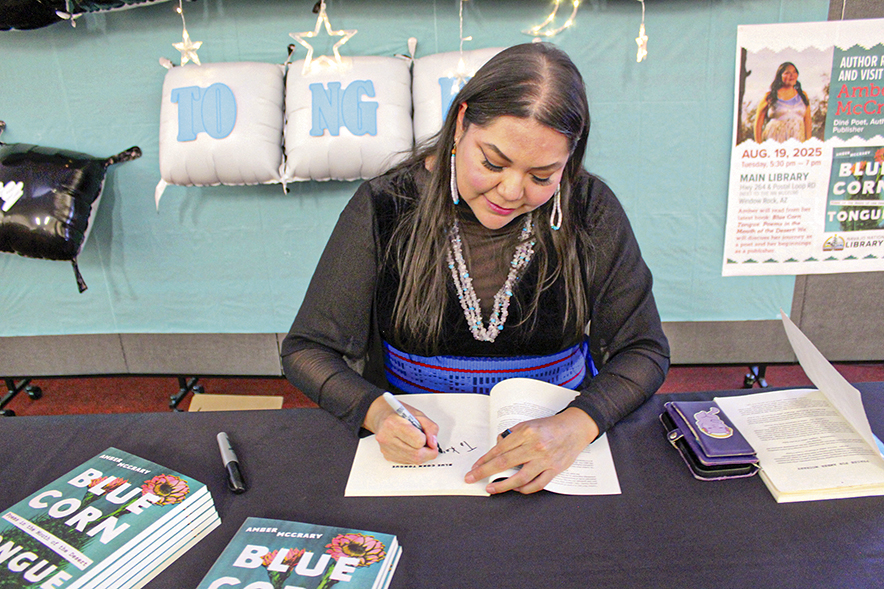
Amber McCrary, a Diné poet from Shonto, Arizona, signs copies of her poetry collection "Blue Corn Tongue: Poems in the Mouth of the Desert" during a reading and celebration at the Navajo Nation Library in Window Rock on Aug. 19, 2025.
By Karen Francis
Special to the Times
WINDOW ROCK
When Amber McCrary was young, she would sit in her room and write in her diary. She said she didn’t think of it as creative writing or poetry at the time, but the practice helped her build the discipline that later shaped her as a collage artist and poet.
Special to the Times | Karen Francis
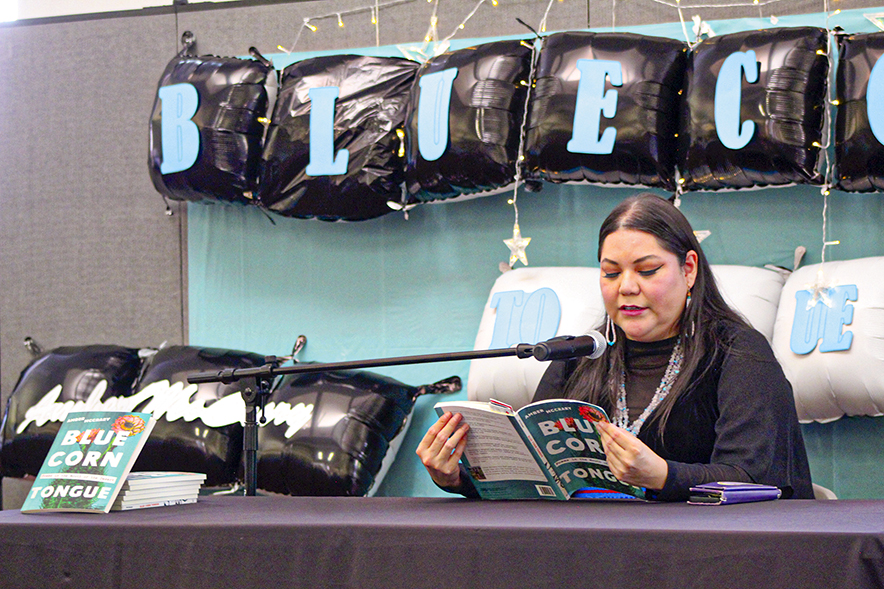
Amber McCrary reads from her poetry collection “Blue Corn Tongue: Poems in the Mouth of the Desert” during a celebration event at the Navajo Nation Library in Window Rock on Aug. 19, 2025.
Those early reflections have since grown into her first book, “Blue Corn Tongue: Poems in the Mouth of the Desert.”
The Navajo Nation Library hosted a public celebration of the release last Tuesday evening in Window Rock, where McCrary read selected works from her new collection.
McCrary is Kinłichíi’nii and born for Naakaii Dine’é. She grew up in Tuba City, later moved to Flagstaff, and now lives in Phoenix. Her mom is from Shonto, Arizona, and her dad is from Hardrock, Arizona.
Where two deserts meet
Published by the University of Arizona Press, the book is divided into four parts by place. “Primarily it’s just about two different deserts coming together, which is the Colorado Plateau area and the Sonoran Desert …. I wanted to focus on those two different deserts because I come from the Colorado Plateau area but now, I live in the Sonoran Desert,” she said.
She writes about plants from each desert as metaphors for people in the collection.
Poetry plays a big role in Navajo society, McCrary said.
“Poetry has kind of always been in Navajo culture like with the songs. The repetitiveness of certain lines in songs, you’ll see that in a lot of Diné poetry. For certain people, they repeat certain lines four times,” she said. “There’s a huge number of Navajo poets these days and I think it’s really great.”
There are now many resources for both established and up-and-coming poets and writers, she added.
“I feel like right now in the Diné community and Native community nationwide, everyone is just really kind of pulling each other up, if they’re really excited about your writing,” she said.
To read the full article, please see the Aug. 28, 2025, edition of the Navajo Times.
Get instant access to this story by purchasing one of our many e-edition subscriptions HERE at our Navajo Times Store.

 Highway 264,
 I-40, WB @ Winslow