
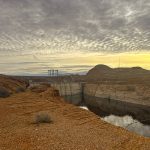


Letters | Water and land are one
Editor,
The definition of principle is so defined as “an accepted or professed rule of action or conduct” or a “fundamental, primary, or general law or truth from which others are derived.”
The principle of a law outlined in a ruling began in 1905 that took place in 1908 called Winters Doctrine implies that Native Peoples have aboriginal rights to the water. The case started when the United States wanted to enforce water rights, which implies that whoever has the most users of water can claim it.
The Fort Belknap Indian Reservation in Montana fought the United States for the use of the Milk River which was essential to the way of their livelihood.
The ruling confirmed that when the federal government created reservations it implicitly reserved water rights for those reservations.
Treaty of 1868. Article 10. “No future treaty for the cession of any portion or part of the reservation herein described, which may be held in common, shall be of any validity or force against said Indians unless agreed to and executed by at least three-fourths of all the adult male Indians occupying or interested in the same; and no cession by the tribe shall be understood or construed in such manner as to deprive, without his consent, any individual member of the tribe of his rights to any tract of land selected by him as provided in article [5] of this treaty.”
This scenario and its purpose is reaffirmed in Article 10 of the Navajo Tribal treaty of 1868, it says there will be no cessions, pertaining to a person’s land.
This statement is taken from the Treaty of 1868: “and no cession by the tribe shall be understood or construed in such manner as to deprive, without his consent, any individual member of the tribe of his rights to any tract of land selected by him as provided in article 5 of this treaty.”
Article 5. If any individual belonging to said tribe, or legally incorporated with it, being the head of a family, shall desire to commence farming, he shall have the privilege to select, in the presence and with the assistance of the agent then in charge, a tract of land ….”
In Article 5, when the topic discussed farming and the right to a square footage of land. The language of farming includes watering his or her own land for crops.
Indicating that the function of a farm would require access to water.
In Article 10 of the treaty of 1868, it says there will be no cessions, pertaining to a person’s land which includes water, according to the treaty’s definition of farming.
The definition of cession is: To yield or formally surrender to another.
It states three-fourths of the Nation’s interest members must be in agreement of such a change or cession.
Fundamentally If the land indicates that there must be a decision of three-fourths of the Nation’s interest members.
Then Navajo Nation Council cannot change the land or the water since both are in supportive of one another in the language of this treaty and the establishment of the reservation held in advocacy by the Bureau of Indian Affairs.
Neal Riggs
Winslow, Ariz.
Fix Tolikan road
Editor,
My name is Marian L Yazzie, I’m a resident of Tolikan, I live 4.5 miles west of Tolikan Chapter, my concern is the dirt road going west from the end of pavement, this road is also a bus route.
As a PEP worker, me and my co-workers have been trying to fill up huge dirt potholes along a 2 mile stretch toward the Walker Creek Bridge. I myself have discussed this with our officials but I don’t think they’re doing anything about it, just because they don’t utilize the road.
I have attached some photos; this should be brought to either BIA or NDOT attention ASAP.
Marian L. Yazzie
Tolikan, Ariz.
Standing with Sam
Editor,
I grew up Navajo, from Tsa’yátóh, N.M., to Shiprock, from Montezuma Creek, Utah, to Gallup. My family has farmed, prayed, and worked these lands for generations. I’ve seen the struggles firsthand: broken roads, underfunded schools, health care out of reach, promises made in Santa Fe and Washington that never reached our people.
But I’ve also seen our resilience. I’ve seen families sacrifice so the next generation can dream bigger. I’ve seen young Navajos step into classrooms, Council Chamber, and campaigns determined to change the story. We are still here, and we are not done fighting for what we deserve.
That’s why I chose to work with Sam Bregman. Some people asked me why. Why would a young Navajo man commit his time and energy to this campaign? My answer is simple: because Native voices belong at the table where decisions are made – and Sam Bregman makes sure we are heard.
Sam listens. He shows up. He doesn’t just talk about Native issues during election season. He asks what we need and backs it up with action. That’s leadership. For far too long, Native communities have been used as talking points without real results. Sam is different. He believes in accountability, not empty promises.
I’m a senior at the University of New Mexico, studying Political Science and preparing for law school. I want to serve my people at the highest levels of government, and this campaign has been a step toward that dream. Working with Sam has shown me that our ideas, our culture, and our future matter in shaping New Mexico.
Representation matters. Too often, Native voices are missing when policy is written, and that silence has cost us. Infrastructure crumbles, water rights are overlooked, and rural healthcare continues to lag. By organizing, mobilizing, and standing alongside Sam, I’ve seen how Navajo concerns can be put at the center of state politics – not at the margins.
This is bigger than one campaign. It’s about building a future where Native students see themselves not just as voters, but as leaders. It’s about proving that a Navajo kid from Shiprock can step into statewide politics and make a difference. And it’s about ensuring that when decisions are made in Santa Fe, they reflect the voices of all New Mexicans: urban and rural, Native and non-Native alike.
Politics isn’t easy. It can be messy and even bruising. But change doesn’t come from staying on the sidelines. It comes from showing up, from speaking out, and from refusing to let our communities be ignored.
Sam Bregman is the kind of leader who shows up. And I’m proud to stand with him. Because when we fight for our future together – when Navajo voices are respected, not silenced – then we move New Mexico forward.
We are still here. And we’re not going anywhere.
Brandan Shakey
Gallup, N.M.
Udall question
Editor,
This is Kathy Billie of Castle Butte, near Dilkon Chapter. I had a brain stroke as of February 2020.
I think more research needs to be done on the Udall family. I did a little. Isn’t that the family who helps the Hopi people? To begin the JUA plan against Navajo people?
I think our people think that a grazing permit accesses many acres by land for animals to graze and herd sheep.
The Navajo people think they own the land instead to take care and exercise land replenishment. The permittees aren’t helping, and the grazing officials do nothing.
These Navajo people don’t realize we can’t take care of the land but take away. They need to be told how.
Please research the Udall family. They were of the Mormon faith. They have experience in how to make a bill and walk it through to overthrow to get needs done.
Have Navajo legislators work on it. The Udall family, Eli Udall, and the judges. Who are they?
Katherine Billie
Castle Butte, Ariz.
Get instant access to this story by purchasing one of our many e-edition subscriptions HERE at our Navajo Times Store.

 Highway 264,
 I-40, WB @ Winslow