






New homes rise in the Former Bennett Freeze Area
Submitted | Rick Abasta, Navajo Housing Authority
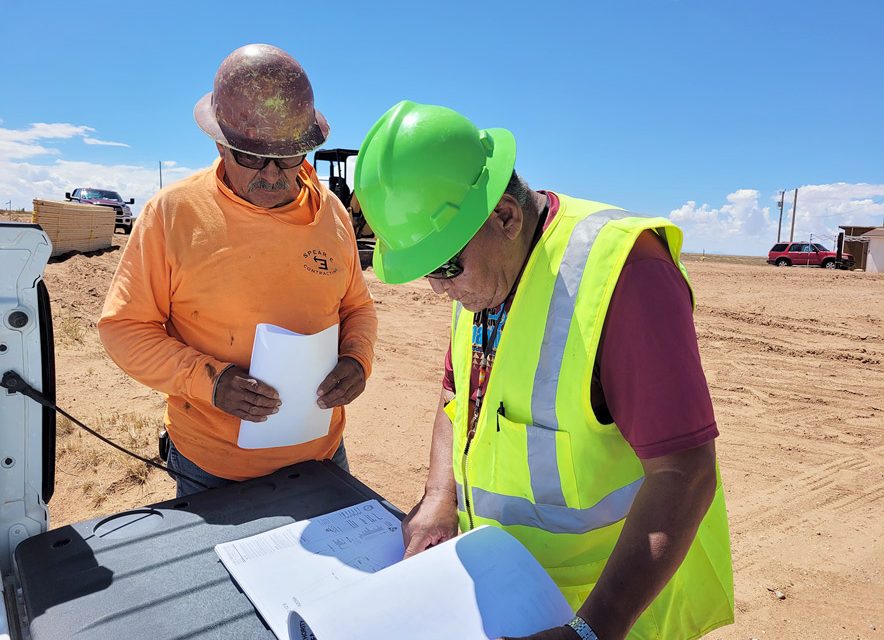
NHA Project Manager Edison Johnson, right, reviews blueprints for a three-bedroom home for the Alex family in Coalmine Canyon as crews prepare earth pads and trench the foundation. The design-build home is being constructed by LAM Corporation of Gallup.

By Rick Abasta
Navajo Housing Authority
COALMINE CANYON, Ariz.
Edison Johnson stood at Navajo Housing Authority Site No. 8, the Virgil Alex homesite, on the edge of the Former Bennett Freeze Area. He looked across the horizon, waiting for LAM Corporation’s crew to continue shaping the earth pads that will support seven new homes for Navajo families.
Johnson, a project manager with NHA’s Civil Engineering Department, knows the weight of this work. For more than four decades – 1966 to 2009 – Navajo and Hopi families were barred from repairing homes or building new ones under a federal development ban.
That changed last spring. NHA marked the completion of six homes in the FBFA with a ribbon-cutting on May 8, 2024, according to an NHA announcement. Phase I gave Navajo families, including elder Jimmie Eltsosie, houses with electricity, running water, solid walls, and roofs built to withstand the elements.
Phase II builds on proven prototype
Johnson called the Phase I homes “sustainable” and said the same prototype is guiding Phase II, known as Project No. DB NHA-528 FBFA. This round will provide houses for seven families from Coalmine Canyon, Cameron, Tuba City, and Bodaway-Gap. LAM Corporation of Gallup is handling construction, while architect Loren A. Miller designed the plans. The work is funded through the Native American Housing Assistance and Self-Determination Act.
“The families liked the Phase I homes that we constructed, so we decided to use the same prototype, which means the homes will be constructed with less effort and time,” Johnson said.
Crews are finishing earth pads and trenching foundations, with concrete pours expected to begin by mid-September, Johnson said. The homes are funded under NHA’s 2024 Indian Housing Plan and will roll into the 2025 plan.
For families like Virgil Alex’s, the change is overdue. Johnson said they have long endured harsh summers and frigid winters in a shed-like structure that offered little protection.
Water, permitting delays
Phase II faced early delays because water needed for earth-pad compaction wasn’t available. “We applied for the Navajo Nation permit for water but there was an emergency declaration because of the fire and the drought,” Johnson said. He added that the Hopi Tribe later granted a permit, allowing NHA to haul water from Moenkopi after a six-week stall.
Water and cement remain the biggest hurdles in scattered-site housing, Johnson said, because federal design standards require precise pad compaction.
In all, NHA plans 36 new homes in the FBFA. Phase III is awaiting environmental clearances and funding. “There’s only five applicants right now for Phase III,” Johnson said. “For the other 21 homes, I’m not sure what we’re going to do because the families conceded that they couldn’t afford mortgage payments.”
During Phase I, many families lacked homesite leases, which slowed preparation. NHA’s Land Surveying Department, led by survey manager Anson Carr, helped secure leases – a requirement for NTUA water and electricity hookups, Johnson said.
“These families in the Former Bennett Freeze Area now have the water and electricity that they needed for more than 40 years,” Johnson said. “Broadband, too.”
Among the families in Phase II is Jolinda Black, a single mother of five. Her children attend boarding school in Flagstaff because they could not live with her in the cramped travel trailer she once called home. Her homesite was the first to undergo construction, and the pad is ready for the concrete pour, Johnson said. He added that pads are graded and trenched to the architect’s specifications: “The finished floor is going to be another eight inches from the ground… the pad elevation is the bottom of the subgrade, then six inches of base course and four inches of concrete slab.”
According to MacArthur Jones, the NHA operations branch fiscal analyst, Phase I cost about $2.58 million, averaging $375,000 per home. Jones said Phase II carries a $3.59 million budget under NAHASDA, and Phase III is projected at $4 million from the American Rescue Plan Act of 2021.
Miller, the architect, said he visited each site to plan utility connections before drawing the designs and noted an average of eight construction workers on site at a time. “Whether it’s a private home or a community building that NHA or anybody invests in, take pride in that building or structure,” he said. “The more care and pride you take in it, the more you want to maintain and keep that building up. If they don’t care about it, then it just becomes dilapidated.”
After decades of stalled progress, families once called the “forgotten people” are finally seeing durable, weatherized homes rise from the ground – safe places to live after years of waiting.
Get instant access to this story by purchasing one of our many e-edition subscriptions HERE at our Navajo Times Store.

 Highway 264,
 I-40, WB @ Winslow