







The Little Colorado River is changing and the land is telling the story
Navajo Times | Krista Allen
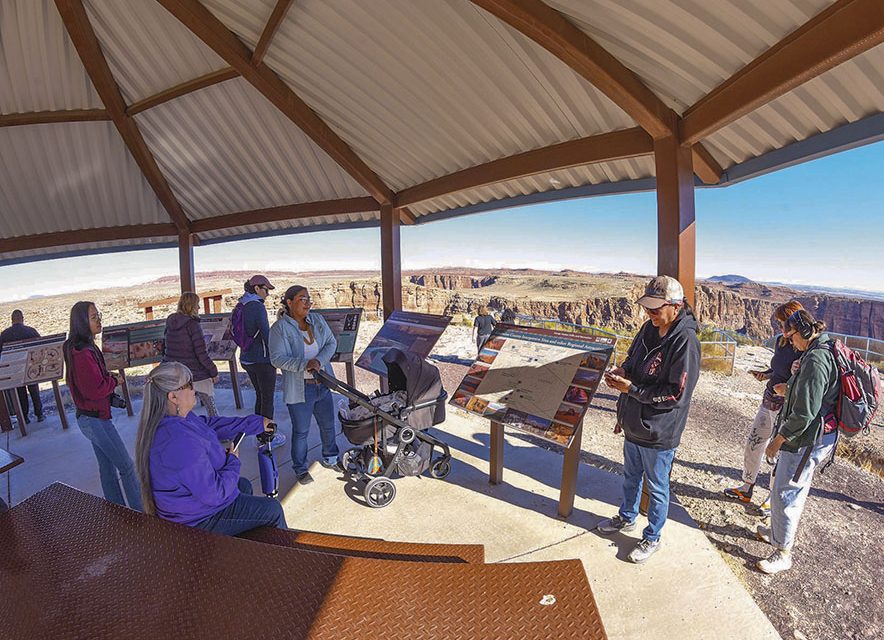
Participants gather beneath the overlook pavilion as Dr. Crystal Tulley-Cordova, the principal hydrologist with the Navajo Nation Department of Water Resources, talks with attendees including noxious weeds coordinator Renee Benally, right, following her presentation at the Little Colorado River Gorge on Nov. 7, the final day of nonprofit Planet Women’s 3rd Annual Women and Water Convening.
GRAND CANYON
Under an outdoor pavilion at the Little Colorado River Gorge Overlook in early November, Crystal Tulley-Cordova asked the group gathered there to think beyond what could be seen from the site.
“When we think about recharges to surface water, people only think about precipitation, snow or rain,” she said. “They fail to think about the contribution, especially in this whole system of the Colorado River Basin, the contributions that come from groundwater recharging the system as well.”
Tulley-Cordova, the principal hydrologist with the Navajo Nation Department of Water Resources, spoke beneath the pavilion near the gorge. Beneath the surface, she explained, another system moves more slowly but just as powerfully.
“There are significant contributors for the recharge of the surface water from both precipitation as well as from groundwater,” she said. “Blue Springs is an example of that.”
The river’s pale blue color, Tulley-Cordova said, comes from travertine and the calcium and magnesium moving through it during steady flows. During heavy storms, the water turns brown and fast moving. When conditions settle, the familiar blue returns.
To read the full article, please see the Dec. 11, 2025, edition of the Navajo Times.
Get instant access to this story by purchasing one of our many e-edition subscriptions HERE at our Navajo Times Store.

 Highway 264,
 I-40, WB @ Winslow