







Two Tséhootsooí nurses stranded in Jordan as US-Iran war shuts down regional air travel
Courtesy | Mechelle Morgan-Flowers
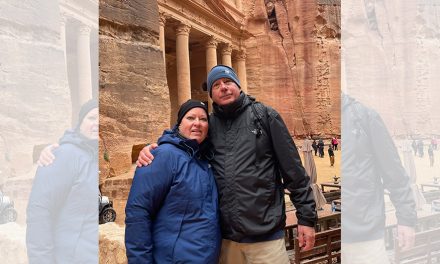
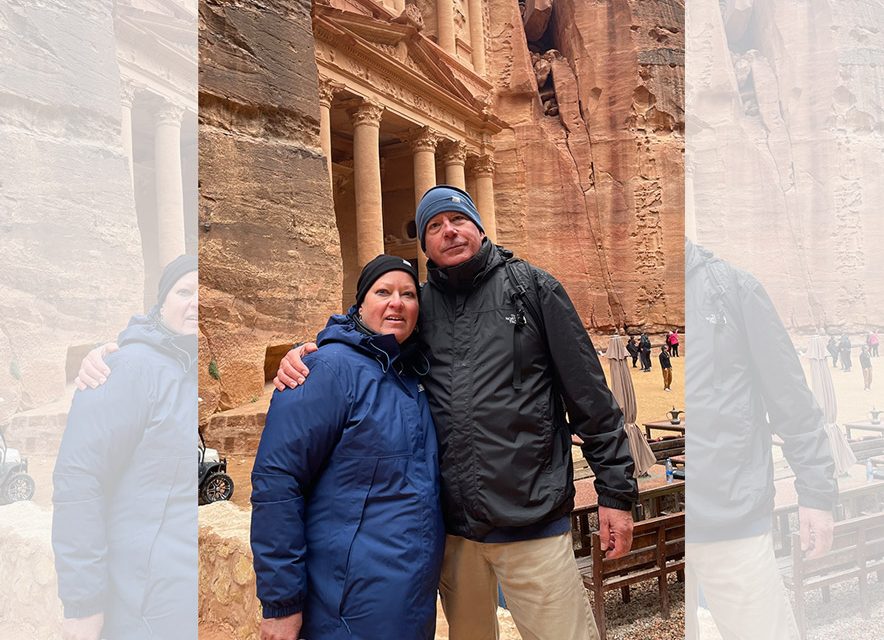
Mechelle Morgan-Flowers and her husband, Mike Flowers, pose for a photo in front of Al-Khazneh, also known as the Treasury, at Petra in southern Jordan during a tour stop in late February. The couple, both nurses at Tséhootsooí Medical Center in Fort Defiance, have been stranded in Amman after their Feb. 28 flight out of the region was canceled.

PAGE
Mechelle Morgan-Flowers and her husband Mike Flowers traveled to Jordan to see Petra. They were supposed to be in Egypt by now or cruising the Nile River. Instead, the two nurses from Tséhootsooí Medical Center have been living out of suitcases in an Amman hotel since their flight out was canceled on Feb. 27, one day before the U.S. launched military strikes against Iran.
“We have nothing else to do,” Mechelle said in an interview with the Navajo Times early Tuesday morning. “We’ve showered, we’ve had breakfast, and now we wait.”
The couple joined a tour group and spent eight days taking in historic sites in Jordan, with plans to continue on to Egypt to see the pyramids and cruise the Nile. It was a bucket list trip years in the making. Mike had always wanted Mechelle to see Petra, the ancient city carved into rose-red cliffs in southern Jordan and one of the Seven Wonders of the Ancient World. They made it there. Egypt, home to the Giza pyramids, is another wonder on their list. That leg of the trip is now in doubt.
On Feb. 27, their travel agency notified them their Feb. 28 flight had been canceled and that it would reschedule them when possible. That call has not come.
“We’ve been stuck here in Amman, Jordan, with no end in sight as far as getting out,” Mike said. “There are so many people now that have been stranded here that there are not enough flights going out because the airport is still under partial shutdown.”
Living out of suitcases
Courtesy | Mechelle Morgan-Flowers
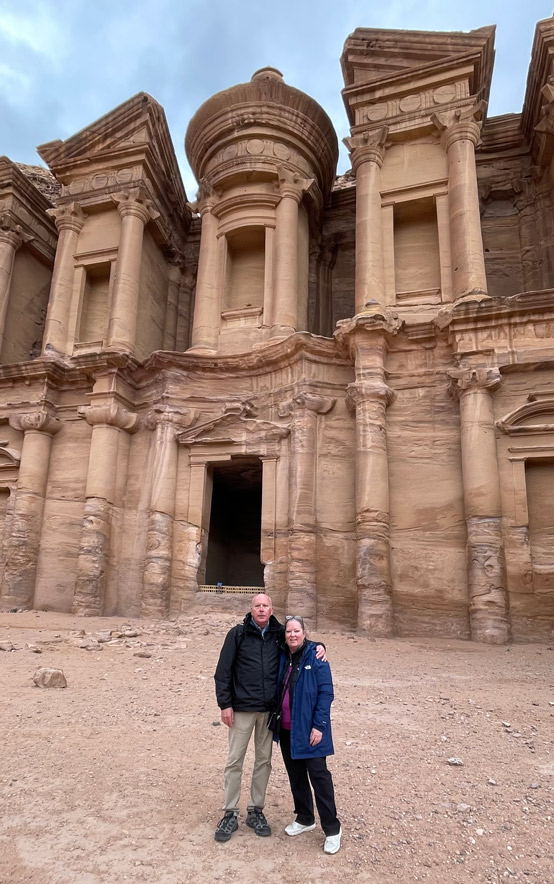
Mechelle Morgan-Flowers and her husband, Mike Flowers, stand in front of Ad Deir, known as the Monastery, at the ancient city of Petra in southern Jordan during their late February visit. The couple, both nurses at Tséhootsooí Medical Center in Fort Defiance, are currently stranded in Amman after their scheduled Feb. 28 flight out of the region was canceled.
Jordan’s airspace has been operating on a restricted schedule, open for part of the day and closed from roughly 6 p.m. to 9 a.m. With few flights coming in to take stranded passengers out, and tens of thousands of travelers trying to leave the region, rebooking has proven nearly impossible.
Their travel agency has put them up at a hotel near the University of Jordan and has continued trying to find seats on outbound flights. Each morning the couple packs their bags and checks out of their room at noon. They wait in the lobby until 3 p.m. in case a flight materializes, then check back in and unpack again.
“We’re packed and ready,” Mechelle said. “Then we unpack and live out of the suitcase and then repack.”
The situation outside is unsettling even if it has not turned dangerous. Jordan’s Public Safety Directorate reported that as of Sunday night, 48 drones and missiles had been shot down over Jordanian territory. The couple said they have heard explosions from intercepted missiles, watched burning debris fall from the sky and heard both drones and fighter aircraft passing over the city. An explosion near their hotel Monday night sent up a large cloud of black smoke. They do not know what caused it.
They sleep through most of it with earplugs.
“We’re relatively safe,” Mike said. “We have food, water, shelter—pretty much everything we need. Not knowing what our future is, is really the thing that’s most concerning.”
Messages from home
Jordanians, for their part, appear largely unbothered. Mike said locals refer to the conflict plainly as “the war between America and Iran” and follow it with a shrug.
“It has nothing to do with us,” he said residents have told him.
Life in the streets has continued much as usual, though Ramadan – the ninth and holiest month of the Islamic calendar, observed by Muslims as a period of fasting, prayer, reflection and community – has added another layer of constraint. Restaurants and shops are closed during daylight hours, leaving the couple mostly confined to the hotel while they wait for word on a flight.
Courtesy | Mechelle Morgan-Flowers
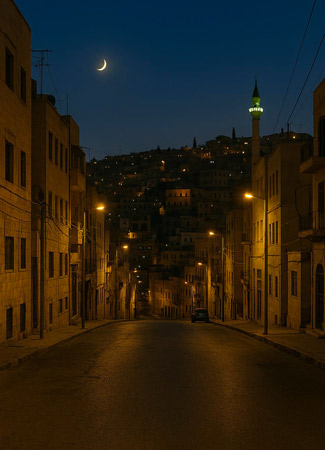
A crescent moon hangs above a quiet street in Amman, Jordan, during the holy month of Ramadan, when the city’s days move slowly and evenings come alive with prayer, family gatherings and the breaking of the fast. Travelers stranded by flight disruptions have found themselves witnessing the rhythm of Ramadan unfold in the Jordanian capital.
Back home in the Navajo Nation, where both Mechelle and Mike have worked as nurses for nearly three decades, colleagues and community members have been following their situation on Facebook and sending messages of support.
“We just want everybody to know that we’re safe and secure and hope to be home soon,” Mike said. “It helps us very much emotionally and spiritually knowing that we have their support.”
Mechelle has been at Tséhootsooí Medical Center since 1996, working as a utilization review nurse. Mike serves as a public health nurse at the same hospital and previously worked in Kayenta and Gallup. Between them, they have given close to 60 years to health care in Diné Bikéyah.
Mike described Jordan as a bucket list trip.
“I don’t know if you want to call it a bucket list, but things that we want to see and do in our life,” he said.
He also noted that despite the adventure, they are missing home.
“Believe it or not, we’re missing the Navajo Nation,” he said.
After Petra, he said, the next stop on that list is the Great Wall of China. Complete that, and they will have visited every surviving wonder of the ancient world.
First, they need to get home.
Get instant access to this story by purchasing one of our many e-edition subscriptions HERE at our Navajo Times Store.

 Highway 264,
 I-40, WB @ Winslow