



Painting Diné Bikéyah, preserving the teachings
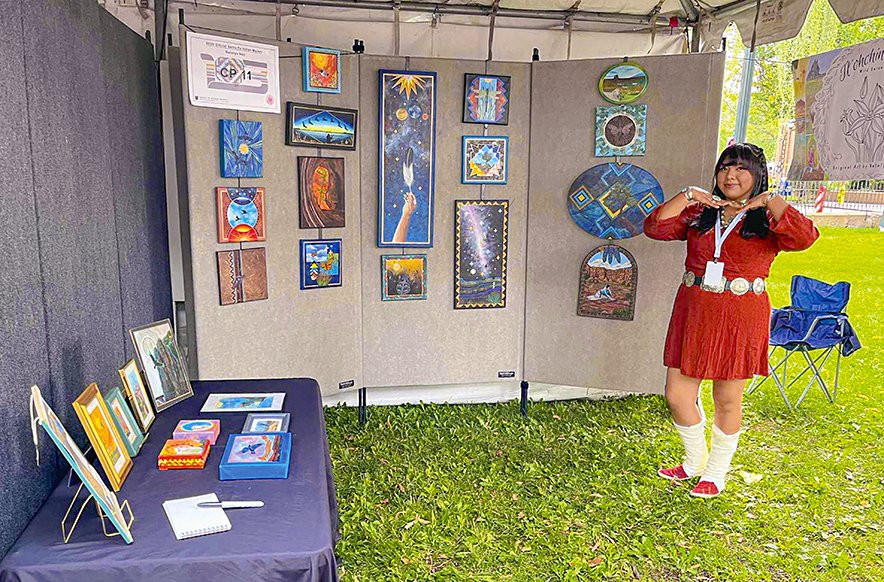
Courtesy | Natalya Nez
Artist Natalya Nez stands in her booth for Tł'ohchiní (“Wild Onion”) Studio at Santa Fe Indian Market. She is Tsi’naajinii and born for Dibé Łizhiní. Her maternal grandfather is Tódích’íi’nii, and her paternal grandfather is Tábąąhá.
By Robert Bettis
Navajo Times
FORT WORTH, Texas
A group of artists gathers monthly with easels and paints, capturing the changing light on canyon walls and mesas. Their mission extends beyond artmaking: they’re building a bridge between generations.
The group, known as the “Dine’h Bikeyah Plein Air Painters,” was formed by established artists Oreland Joe Sr. and Johnson Yazzie and brings together seasoned and emerging Navajo creators to paint their homeland while preserving cultural knowledge.
Circle of painters takes shape
Oreland Joe Sr. is ‘Oozéí Táchii’nii and born for Southern Ute. “We know what it feels like to be out there,” said Joe, from Shiprock, who has 40 years of experience in the art industry. “Why can’t we paint ourselves in the process, learn what certain buttes or hills or mountains are?”
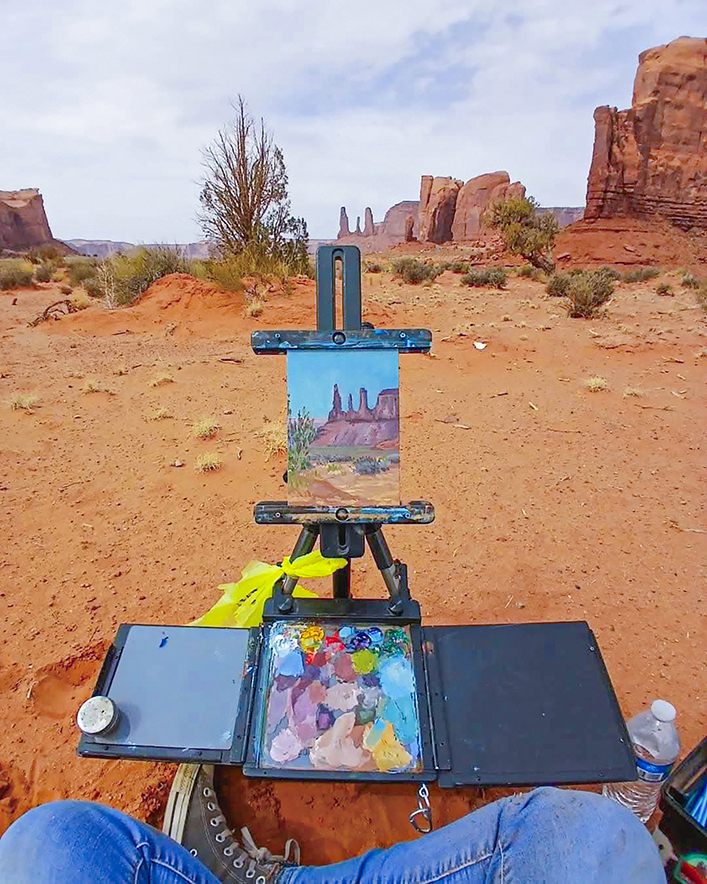
Courtesy | Natalya Nez
A plein-air setup captures Monument Valley’s “Three Sisters” under high desert light.
Joe, who resigned from the Cowboy Artists of America over Native American issues, explained his motivation: “I’ve been through the circuit for 30 years, enough to know who comes to Indian reservations and paints places like Monument Valley and Canyon de Chelly. And then they go out and sell it for five or six figures. I just really don’t like it.”
The group’s practice combines Western plein-air technique – painting outdoors to capture shifting light – with traditional teachings. Elders sometimes join to share stories about the landscapes being painted.
Joe recalled learning that the Carrizo Mountains are male while the San Juan Mountains are female, and that medicinal herbs are gathered from each side depending on who is sick. “A male gets sick, he’s got to go to the female mountain to gather herbs,” he explained.
“The objective is to bring artists, whether they are seasoned or known in the business, or these young ones that are coming up, to one day hand the ball over to them,” Joe said. “It’s not an experiment. It’s for real. We’ve been meeting and painting every three weeks.”
To read the full article, please see the Sept. 4, 2025, edition of the Navajo Times.
Get instant access to this story by purchasing one of our many e-edition subscriptions HERE at our Navajo Times Store.

 Highway 264,
 I-40, WB @ Winslow