


Arizona water future tied to unresolved tribal rights
Navajo Times | Krista Allen
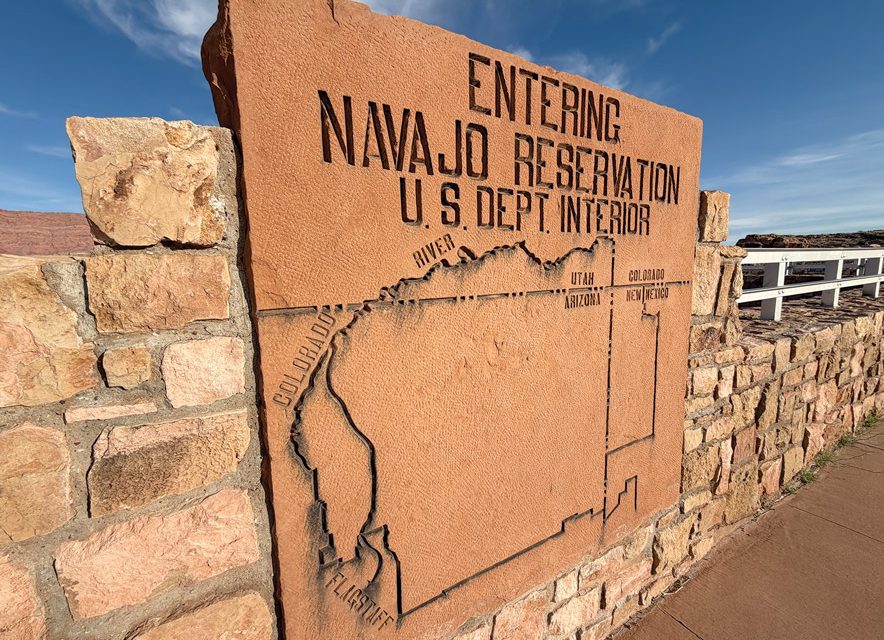
A carved sandstone marker depicting the Colorado River and the Navajo Nation’s reach across Arizona, Utah, New Mexico and Colorado stands at the entrance to the Navajo Bridge near the Navajo Bridge Interpretive Center in Marble Canyon, Ariz., on May 2, 2026.

PHOENIX
The future of Arizona’s water will depend not only on Colorado River negotiations and groundwater policy, but also on long-unresolved tribal water rights, three water experts told attendees at the 99th Annual Arizona Water Conference and Exhibition here on April 28.
Crystal Tulley-Cordova, the principal hydrologist for the Navajo Nation Department of Water Resources, said the Navajo Nation’s water needs remain urgent as many Diné families still live without running water.
“In the Navajo Nation, we are well familiar with being able to not be able to turn on a tap,” Tulley-Cordova said. “We have one in three households that lack access to clean water.”
She said Diné are 67 times more likely than the average American to lack access to clean water or sanitation facilities in their homes, according to federal data.
Tulley-Cordova said the Northeastern Arizona Indian Water Rights Settlement is one step toward addressing that gap. The settlement involves 39 parties, including the Navajo Nation, Hopi Tribe, San Juan Southern Paiute Tribe, the U.S. Department of the Interior, the state of Arizona, the Arizona Department of Water Resources, Salt River Project and the city of Flagstaff.
The settlement would resolve claims involving the upper and lower Colorado River, the Little Colorado River, Cibola allocations, groundwater and supplies tied to the Navajo-owned Big Boquillas Ranch.
To read the full article, please see the May 7, 2026, edition of the Navajo Times.
Get instant access to this story by purchasing one of our many e-edition subscriptions HERE at our Navajo Times Store.

 Highway 264,
 I-40, WB @ Winslow