



Letters | Karson’s life mattered

Karson’s life mattered
Editor,
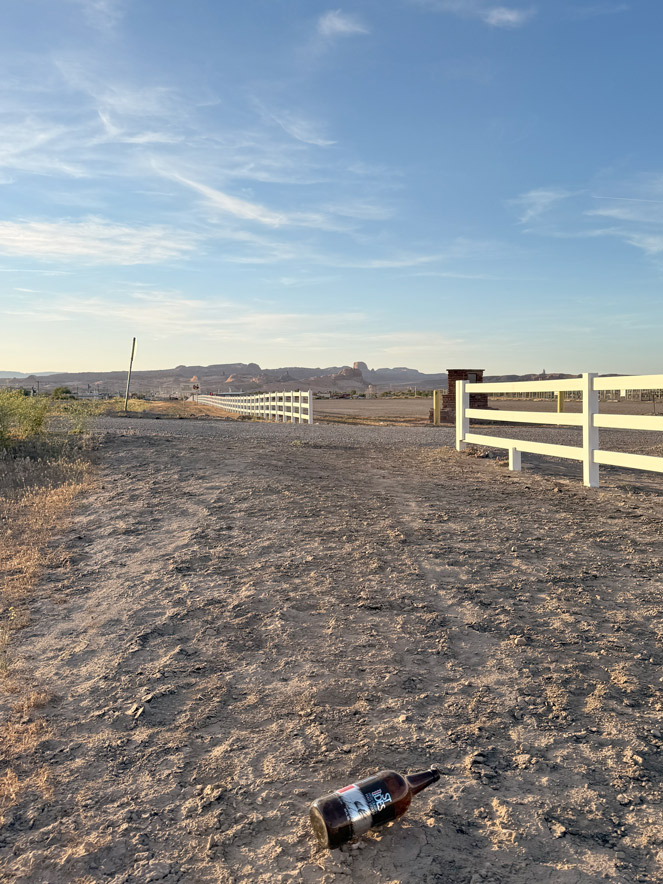
Submitted | Carmelita Apodaca
This was taken Mother’s Day 2026 in Kayenta. It shows the tire tracks of the alleged drunk driver who took my grandson‘s life and changed our lives forever. And to add more insult to injury, there are 40-ounce beer bottles laying around the site where my grandson, 3-year-old Karson, lost his life.
I want to ask you all what would you do if you were in my place. As a mother, I feel so helpless that all I can do is be in the middle of everything to be there for my parents, as my dad heals from the injuries. My daughter is not the same as she was before. Her injuries are nothing compared to the loss of her son. And the most disturbing realization is that this could have been prevented.
There were red flags, perhaps for years and years before all this happened. This is what happens when you ignore unsafe people in your community. My daughter and her family were only guests during that time of holiday. If it’s not talking about making money off of tourism and promoting all these events with no actual safe guard to your community, your guests, and your people, then what’s the point of it all, because I’ve heard the excuses and exchanges of glances with no accountability, nothing. My family matters, especially my 3-year-old grandson Karson’s life definitely mattered. We are left with more questions and zero answers.
Wake up, Navajo Nation, there’s a huge problem that is plaguing our tribe. I don’t want to hear excuses or finger-pointing anymore. What about some accountability? What about strengthening our laws?
Because seeing this, someone knowingly drinking and discarding those bottles at the very site, where flea markets are held every Wednesday and where my grandson lost his life, it disgusts me.
I once had a grandbaby, Karson Apodaca, and his mom, my daughter, and my family deserves accountability. I’m sorry this happened in front of the children, the families who were all present, and who witnessed the horrific incident. Let’s bring this powerful change for our children and prove to them that we can bring a safe culture to our tribe. Thank you for reading Karson’s story.
Carmelita Apodaca
Mystery Valley, Ariz.
Not precedent
Editor,
On the morning of April 1, 2026, the Supreme Court of the United States heard oral arguments in Trump v. Barbara, a case about whether the federal government can end birthright citizenship for children born on American soil to parents without legal status or on temporary visas. I am Navajo. I am a health care professional. I watched those arguments, and I need to say something that nobody in that courtroom said.
The government’s argument depends on us.
Solicitor General John Sauer stood before the Court and argued that the 14th Amendment’s phrase “subject to the jurisdiction thereof” was never meant to guarantee universal birthright citizenship. As proof, he pointed to the congressional debates of 1866 and 1868. He noted that the framers of the amendment explicitly understood that children of tribal Indians were not birthright citizens. He used that exclusion as evidence. He treated it as a clean historical data point, a settled consensus that demonstrates the amendment always had limits, that being born on American soil was never enough.
Neither side pushed back on what that exclusion actually was.
Cecillia Wang, arguing for the respondents, largely conceded the point. The Indian tribal exception, she said, comes from the constitutionally unique status of Indian tribes. Tribes are quasi-sovereign nations. The exclusion was legally coherent. Then she moved on.
I did not move on. You as a Native American reading this should not move on. You as an American should not move on from this.
The exclusion of Native people from birthright citizenship was not a neutral legal judgment. It was not a principled constitutional distinction. It was the legal formalization of theft. The United States government spent the better part of the 19th century simultaneously insisting that tribes were foreign nations when it wanted to avoid treaty obligations, and subject territories when it wanted to take land. Tribes were foreign enough to be excluded from citizenship. But we obviously were not foreign enough to be left alone. The government held both positions at once, because holding both positions like a two-headed snake was useful, and the people, you, me, us, the ones who had been living on this land since time immemorial, paid for that flexibility, and we continue to still do.
By 1868, when the 14th Amendment was ratified, the federal government had already removed the Five Civilized Tribes from their homelands at gunpoint, and our Navajo people had been herded off to Bosque Redondo, where our Navajo treaty was signed. The United States had already begun the systematic destruction of the Plains nations and the buffalo. It had already established the reservation system, which was not a recognition of sovereignty but a mechanism of containment. The “tribal Indian exception,” the solicitor general, cited so casually was born in that context. It was not evidence of a carefully reasoned constitutional principle. It was evidence of what the government was willing to do to the people it wanted out of the way.
That history is now being laundered into precedent.
As a Diné person, I have spent my career working inside the health care system the federal government built to fulfill its treaty obligations to Native people. I have worked with the Indian Health Service directly. I have worked in tribal P.L. 93-638 facilities, where tribes have taken back administrative control of their own health programs under the Indian Self Determination and Education Assistance Act. I work now at an urban Indian health facility, an FQHC serving Native people who left the reservation and found that the federal obligation followed them, imperfectly, underfunded, but present.
The same government that built the “sovereignty” system, the government that calls it Indian Self-Determination while holding the purse strings, stood before the Supreme Court this morning and used the history of our exclusion as an argument for someone else’s exclusion. The logic is breathtaking in its cynicism. We were excluded from citizenship because we were not fully subject to American jurisdiction. That is not sovereignty. That is autonomy on a leash. The government argued we were not fully subject to American jurisdiction because it found it useful to treat us as separate when that served them and subject when that served them. That convenient flexibility, that weaponized ambiguity, is now being presented as a coherent legal principle applicable to a new group of people the government wants to exclude.
What nobody said in that courtroom is this: the tribal Indian exception should never be treated as precedent for anything except the proposition that the United States government will construct whatever legal fiction is necessary to deny rights to people it has decided to exclude. That is not proof that the 14th Amendment has limits. It is proof that the colonial United States finds its justifications where it needs to find them.
The decision in this case will not undo what was done to Native people. Nothing said in that courtroom today will. But if the Supreme Court rules for the government and cites the tribal Indian exception as supporting evidence, it will have taken an old injustice and used it to build a new one. It will have made our exclusion load bearing. And the next lawyer who wants to narrow the Constitution further will cite this case, and the case will cite Elk v. Wilkins, and the chain will run all the way back to the colonizers who took the land and called it jurisdiction.
I have watched the federal government administer its health care obligations to Native people my entire professional life. I have seen what it looks like when the government treats us as a problem to be managed rather than a people with rights that predate the Constitution itself. What happened in that courtroom this morning looked exactly like that. After all, as declared in this nation’s founding document, we are still viewed as the “merciless Indian savages.”
In closing, I speak to every Navajo and Native law student sitting in a classroom right now, every Native legal scholar who knows our history not from a textbook but from their own clan, their own family, their own land, their cornfields, their own tribal clinic, their own community, and their own life ceremony. You are the ones who must stand in that courtroom someday and say what nobody said today. You must argue not just that the exclusion is being misapplied, but that it was never legitimate to begin with. The work is not finished. It was not finished in 1868. It was not finished in 1924 when Congress finally granted citizenship to us by statute rather than by right. It was not finished in 1975 with P.L. 93-638 being enacted. It must not be finished by this pending decision either.
The legal fictions built to take from us are still standing, and they are still being used. Young Navajos and other young Native Americans are the ones who must finally stop moving on, start speaking up, and demand that the law stop using our past to haunt someone else’s future.
Emerson Begay
Crystal, N.M.
Art and discovery
Editor,
May brings a sense of anticipation at the Museum of Northern Arizona as we prepare for a vibrant summer season of exhibitions, programs, and other opportunities to connect with the Colorado Plateau. Before the busy months ahead, we invite you to enjoy a special start to the season with a colorful new exhibition and a day dedicated to celebrating museums as places of discovery and community.
“Artist Hopid Unveiled,” opens May 16 in the Courtyard Gallery and highlights the groundbreaking collective formed in 1973 by Hopi artists Michael Kabotie, Delbridge Honanie, Terrance Talaswaima, Neil David Sr., and Milland Lomakema. Drawn from MNA’s fine art collection, including recent acquisitions, the exhibition explores how these artists created bold contemporary visuals rooted in Hopi life, tradition, and storytelling. Presented in three thematic installations, the exhibition offers fresh perspectives on modern identity and cultural continuity.
We also look forward to celebrating International Museum Day on May 16 with free admission and activities for all ages. From hands-on art and science experiences to touch tables, guided tours, and family-friendly exploration throughout the Museum, it’s a chance to experience MNA as a place of creativity, learning, and connection.
I hope you’ll join us at the museum as we welcome the season ahead.
Mary Kershaw
Executive director and CEO
Museum of Northern Arizona
Flagstaff, Ariz.
Get instant access to this story by purchasing one of our many e-edition subscriptions HERE at our Navajo Times Store.

 Highway 264,
 I-40, WB @ Winslow