


Presidential candidates spar over leadership, government, language
Navajo Times | Sharon Chischilly
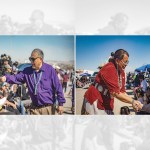
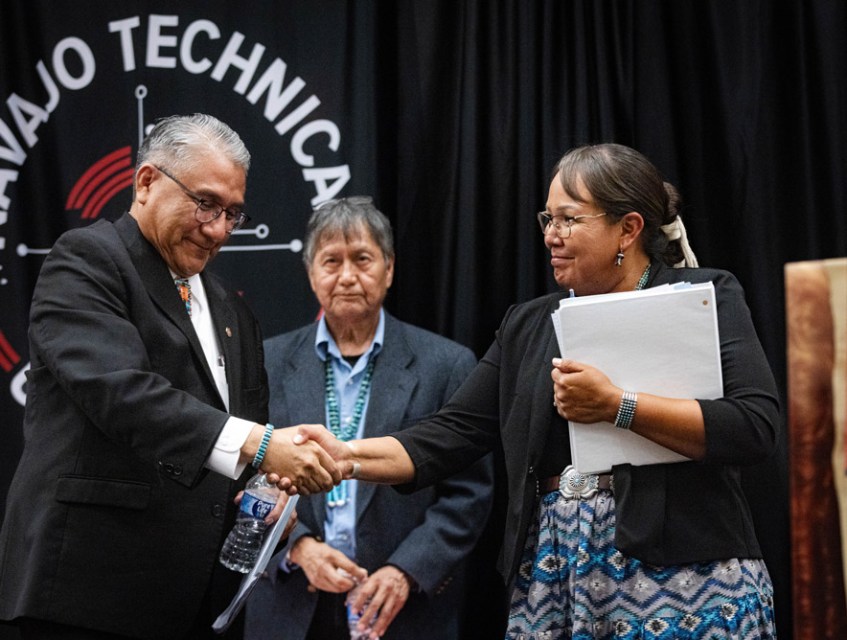
Presidential candidates Justin Jones and Crystalyne Curley shake hands after the Sept. 25 debate at Navajo Technical University as Tim Begaye, the university's dean of graduate studies, looks on.

CROWNPOINT
Candidates for Navajo Nation president and vice president clashed over experience, women in leadership, overdue audits and the use of the Navajo language during a debate Friday evening at Navajo Technical University.
The student-organized forum at NTU’s Wellness Center was broadcast on KCZY 107.3 FM and YouTube, less than six weeks before the Nov. 3 general election. It brought together presidential candidates Justin Jones and Crystalyne Curley and their running mates, Emily Ellison and Chris Deschene, respectively.
“We are proud to present to you the first debate for the Navajo Nation presidential election,” said Tim Begaye, NTU’s dean of graduate studies.
Begaye moderated with Shinaeya Watson, the university’s student senate president.
Deschene, a Naval Academy graduate, former Marine Corps major, attorney and former director of the federal Office of Indian Energy, said he answered a call to service from his “little sister.”
He said he and his running mate share core values of strong, experienced leadership vested in service, love and compassion. Those principles, he said, include protecting the Nation’s land, water, air and people, building opportunities for working families and safeguarding the Nation’s future.
Ellison is the executive director of Battered Family Services, a nonprofit serving survivors of violence. She said she and Jones have campaigned on the same platform since 2022, “Fix the government.”
Their ticket wants to make the government transparent and functional, she said, while protecting sovereignty and water.
“Where’s that (water) settlement at right now?” she asked.
She also pledged to build communities with roads, electricity and broadband.
Experience and leadership
© 2026 Navajo Times Publishing Co. Inc.
Curley cited her experience at the U.S. Treasury Department and in all three branches of tribal government.
“Let’s talk about real solutions today, not the ability to say that a woman can’t lead. It is 2026,” she said.
Deschene told voters to compare resumes.
“You will see the night and day differences,” he said.
“What’s a resume when you can’t even talk to your people or understand them?” Ellison replied.
On sovereignty, Ellison said Navajo Nation Supreme Court decisions must be respected. Deschene disagreed.
“If we have a rogue Supreme Court, then it is incumbent upon us to challenge that,” he said. “Respect is earned.”
Housing, economic development
Deschene said about 2,000 tribal jobs sit vacant on any given day, partly because returning professionals cannot find housing. He estimated 35,000 families still need homes. He pledged a “bring home” initiative, faster homesite leasing and wider use of HUD 184 and VA Native American Direct Loans.
Ellison favored planned communities over scattered homesites.
“What is a house if it doesn’t have a road, if it doesn’t have water, it doesn’t have electricity or if it doesn’t have broadband?” she said.
Curley said less than 7% of jobs on the Nation are corporate or private. She pledged to refocus economic development on startup help and access to capital.
Jones said he would enforce the Navajo Business Opportunity Act and revamp the tax structure for pro-business.
Curley questioned why Jones, an attorney, represents “non-Navajo Bilagáana companies to lawsuit the Navajo Nation.”
“I represent any client against a violator of Navajo law,” Jones replied.
He added that Curley had introduced zero legislation to improve Navajo business.
Ellison said, “not everything is measured by college degrees.” She pointed to vocational training and her ticket’s pledge of free tuition at NTU and Diné College.
Deschene proposed a college savings fund, more scholarships and apprenticeships and rebuilding Camp Asaayi.
Curley pointed to the council’s AI task force. She said students ask her whether AI can already speak Navajo. She also pledged to protect the Nation’s data sovereignty and herbal medicine.
Government accountability, public safety
Curley’s written 100-day plan calls for cutting staff and salaries in the Office of the President and Vice President and appointing an attorney general to investigate $24 million the Navajo Nation Council has questioned. The plan also proposes ending the veterans director’s six-year contract, halting uranium shipments on public highways and clearing the homesite lease backlog.
She also proposed a transparency act, noting the Council now livestreams all committee meetings.
Jones said voters don’t need a written plan.
“You don’t need to read a piece of paper to understand what is the problem,” he said. “You live the problem every day.”
He said no division director in his administration would come from the Nygren Administration or the 23rd through 25th councils. He also said the speaker’s audit is four years overdue and that the Council waived Title 12 in passing the budget.
“We need to know how much money that we have, and we need to know how much debt we’re in,” he said.
Ellison said she sought Council funding for a domestic violence shelter from the Nation’s roughly $2 billion in ARPA money.
“They wouldn’t even give us a little bit,” she said.
Both tickets called for moving watchdog offices out from under the Council. Ellison said the election, auditor general and ethics offices should be independent. Curley proposed a compliance branch and noted the Council cut the citizen initiative threshold from 15% to 7%.
Special to the Times | Donovan Quintero
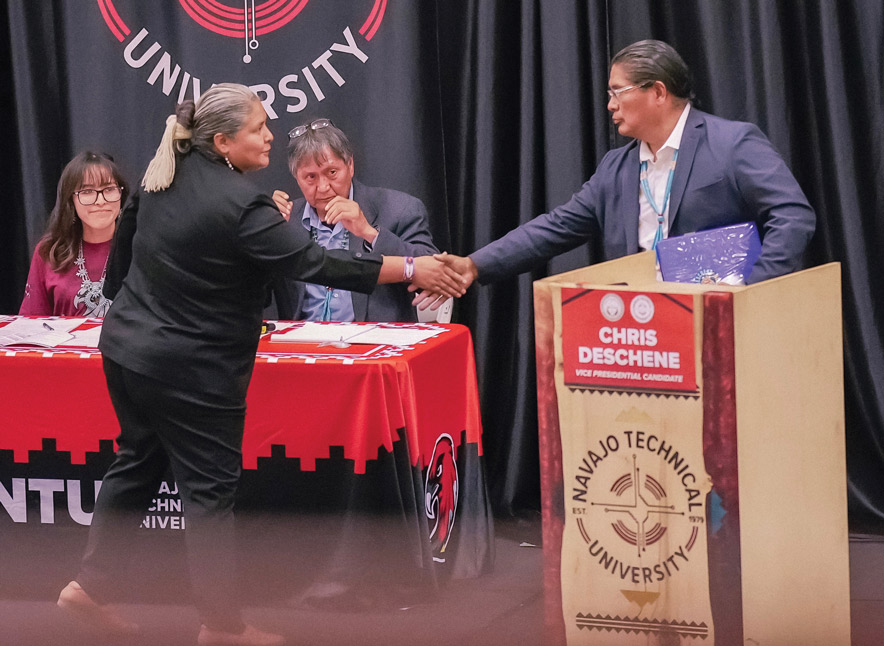
Vice presidential candidate Emily Ellison, the running mate of Justin Jones, shakes hands with Chris Deschene, the running mate of Crystalyne Curley, after the Sept. 25 debate at Navajo Technical University as moderators Shinaeya Watson, the university’s student senate president, and Tim Begaye, the dean of graduate studies, look on.
Addressing missing and murdered relatives, Curley pledged to reestablish a missing persons unit, create a database spanning jurisdictions, fix the 911 system and seek harsher penalties for offenders.
Jones responded on the 911 system.
“You’ve had three and a half years to do this,” he said.
Deschene was removed from the 2014 ballot over Navajo fluency. At the debate, he accused the Jones ticket of using the beauty of the language to “separate, divide, and isolate.”
Curley said she voted for Deschene in 2014.
“Either if you speak Navajo or don’t, you are Diné,” she said.
In his closing, Deschene referred to a documented pattern of abuse. Ellison defended Jones.
“He made a mistake. He corrected it,” she said. “Are we going to judge a person for that?”
Jones said Curley filed four lawsuits against the Executive Branch in the past year and lost each one, at a cost of more than $10 million. Curley said she acted on 70 chapter resolutions.
Jones also said Curley sought his free legal advice last October.
“Everything that I advised you not to do, you did,” he said. “You lost.”
“Your advice was wrong,” Curley replied. “That’s why I didn’t use it.”
After the master of ceremonies reminded the audience to hold applause, Jones called it “a classic demonstration of not following the rules.”
Watson closed with a prayer asking that leaders be given courage to listen to different perspectives.
Get instant access to this story by purchasing one of our many e-edition subscriptions HERE at our Navajo Times Store.

 Highway 264,
 I-40, WB @ Winslow