


Two Diné journalists prepare to share Arizona anchor desk
Submitted | Charly Edsitty
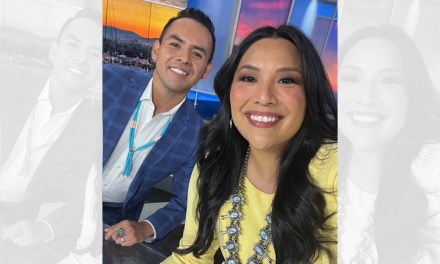
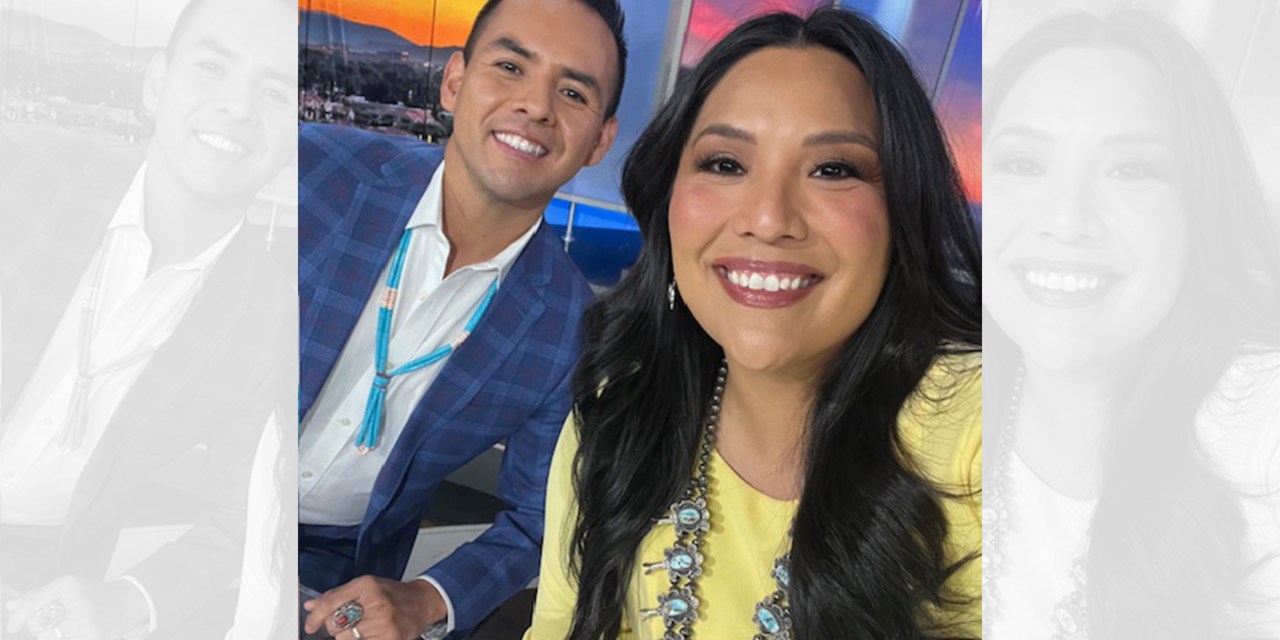
Colton Shone, left, and Charly Edsitty, both Diné broadcast journalists, pose at the Arizona’s Family studio in Phoenix. The two are preparing to co-anchor Good Morning Arizona, becoming the first known all-Native anchor team on a commercial television newscast in the United States. Edsitty joins the station Monday, Oct. 12.

DÁ’DEESTŁ’IN HÓTSAA
Colton Shone and Charly Edsitty have spent years reporting on Diné communities for major television newsrooms, drawing on their upbringing and cultural knowledge to tell stories that might otherwise have been overlooked. Now the two journalists are preparing to share the anchor desk at Arizona’s Family.
Edsitty begins working at Arizona’s Family Monday, Oct. 12, joining Shone as his new co-anchor. The station has not announced when the two will make their first appearance together on Good Morning Arizona. Arizona’s Family announced their pairing Oct. 2. The two have been described as the first known all-Native anchor team on a commercial television newscast in the United States.
The distinction carries meaning for Edsitty, who spent much of her career as the only Native journalist in the newsrooms where she worked. Having Shone beside her, she said, creates an opportunity to bring two Diné perspectives into discussions about which stories receive attention.
“I am very used to being the only Native voice and the only Native perspective in the newsrooms that I’ve worked in, so I’ve had to really toughen up and learn how to speak up, and speak out, and push back, even when I’m usually the minority perspective,” Edsitty said in an interview with the Navajo Times Friday, Oct. 9.
Edsitty is Hashk’ąą Hadzohó and born for Tábąąhá. Her maternal grandfather is Kinłichíi’nii and her paternal grandfather is Kiyaa’áanii. Her mother’s family is from T’iis Názbąs, Arizona, and her father’s family is from Newcomb, New Mexico.
Shone is Tó’aheedlíinii and born for Tódích’íi’nii. His maternal grandfather is Kiyaa’áanii and his paternal grandfather is Tábąąhá. His family connections include Lukachukai and Piñon, Arizona.
Both grew up in the Phoenix area, frequently traveling to Diné Bikéyah to visit relatives. Edsitty, born in Farmington, moved to Phoenix when she was 2 and grew up in Glendale. Her family made six-hour drives several times a month, often leaving after her parents finished work Friday and returning Sunday night.
Shone made similar weekend trips and spent summers herding sheep with his family. Those experiences later influenced his reporting, particularly during the COVID-19 pandemic.
Reporting with Diné perspective
While working in Albuquerque, Shone covered the pandemic’s effect on Diné communities, reporting on the lack of running water in many homes and bringing his understanding of Diné culture into interviews with residents and public health officials. He encountered colleagues unfamiliar with the water infrastructure problems on the Navajo Nation despite working only hours away.
One of the people whose story stayed with him was Valentina Blackhorse, a former Miss Western Navajo from Kayenta who died of COVID-19 in April 2020. Shone interviewed her mother about the family’s loss.
Another experience involved a family that contacted him after a report about a relative who had died. The family initially provided a photograph for the broadcast but later requested its removal after an elder raised cultural concern.
“I mean, I immediately talked to my boss and I was like, ‘We have to take this off. We have to take this down to respect the family,’” Shone said.
Edsitty faced similar questions while working as a bureau reporter in Flagstaff for KPNX 12 News. Among her assignments was the 2016 police shooting death of Loreal Tsingine, a Diné woman killed by a Winslow police officer.
Edsitty covered the case for several months, drawing on her understanding of the community while seeking the perspectives of law enforcement.
“I understand what it’s like to be a Native woman in a border town community. I understand what that feels like,” Edsitty said.
She later spent eight years in Houston, where she found that Native communities and their concerns were unfamiliar to many viewers and colleagues. Her reporting included Reclaimed: The Lifeblood of Navajo Nation, an ABC Audio podcast examining the lack of access to clean, running water in Diné communities.
Edsitty interviewed a military veteran who continued hauling water for basic household needs, including brushing his teeth, washing his hands and bathing.
In Houston, viewers also approached her about stories involving her másání and other reporting on Native communities rather than the crime and breaking news she covered.
Returning to Arizona, Edsitty said she hopes to work with Shone to expand reporting on rural and tribal communities. Shone said decisions about coverage should reflect the needs of people throughout the state, including those who feel their concerns have been overlooked.
“Which stories need to be heard? Which communities need to be covered? I think it’s gonna be something that we have to grapple with every single day,” Shone said.
Edsitty also wants other journalists to develop relationships with Native communities rather than relying on the two anchors to identify stories.
Different paths to television
Shone secured his first on-air reporting position in Phoenix while attending Arizona State University. He later pursued anchoring opportunities in Tucson and Albuquerque before returning to Phoenix, where much of his family lives.
Edsitty initially planned to become a dentist when she enrolled at Baylor University in Waco, Texas. After taking a mass communications course, she changed her major and graduated with a degree in print journalism.
She hoped to work at The Arizona Republic or the Navajo Times but struggled to find a newspaper position during the recession.
Her entry into television came through an unexpected meeting at a memorial service for Andy Harvey, a Diné broadcast journalist who worked at KPNX 12 News in Phoenix and was known for his reporting on Native communities. Harvey, who died in 2012, also mentored aspiring Native journalists.
Edsitty had watched Harvey’s reporting while home from college. At his memorial service at the Heard Museum, she encountered Loren Tapahe, a family acquaintance who introduced her to Mark Casey, a KPNX executive.
Casey asked her to submit writing samples. Months later, he offered her an opportunity to produce three television stories despite her lack of broadcast experience.
Edsitty borrowed station equipment, learned the basics of operating a camera and completed the assignments while working another job. The stories did not meet broadcast standards, she said, but Casey offered her an entry-level planning producer position.
She eventually became an on-air reporter, beginning in Flagstaff.
Harvey also played a role in Shone’s career, serving on the thesis committee for his master’s degree at ASU. Shone identified Harvey and Mary Kim Titla, a San Carlos Apache journalist and former Phoenix television reporter, as mentors who helped him understand the profession.
Edsitty said watching Harvey and Titla when she was younger influenced her decision to pursue broadcast journalism.
“Because I don’t know if I ever would have considered broadcast journalism as a serious career for me had I not seen either of them doing the job,” she said.
New partnership
The two journalists had known of each other for years before becoming colleagues. They participated as mentors during a Native American Journalists Association – now the Indigenous Journalists Association – conference in Phoenix, where Edsitty sought Shone’s help obtaining footage of Harvey for a student project.
They also maintained occasional contact through social media. Edsitty once asked Shone to record a birthday greeting for her aunt, who was a longtime fan of his work.
Their professional connection developed further when Edsitty interviewed at Arizona’s Family. Shone was the first person she met at the station that morning, and the two participated in a test broadcast before she was offered the position.
Edsitty had wanted to return to Arizona but was waiting for the right opportunity. The morning anchor position allowed her to return to the community where she grew up and live closer to family after eight years in Texas.
Shone, a father of two, said he hopes the pairing develops into a lasting partnership. Edsitty will be his 10th co-anchor during his television career.
Both also spoke about the influence of their families and the sacrifices involved in building careers away from home. Shone credited his mother with teaching him the importance of persistence, while Edsitty pointed to the work ethic she learned from her parents and maternal grandparents.
Edsitty said messages from families who consider her a role model for their children have been among the most meaningful responses to her work. She hopes young Diné viewers will recognize that a career in television journalism is within their reach.
“They don’t have to wonder what it would be like. This is actually happening,” Edsitty said.
Get instant access to this story by purchasing one of our many e-edition subscriptions HERE at our Navajo Times Store.

 Highway 264,
 I-40, WB @ Winslow