




Hoofbeats to the yé’ii bi cheii
Special to the Times | Donovan Quintero
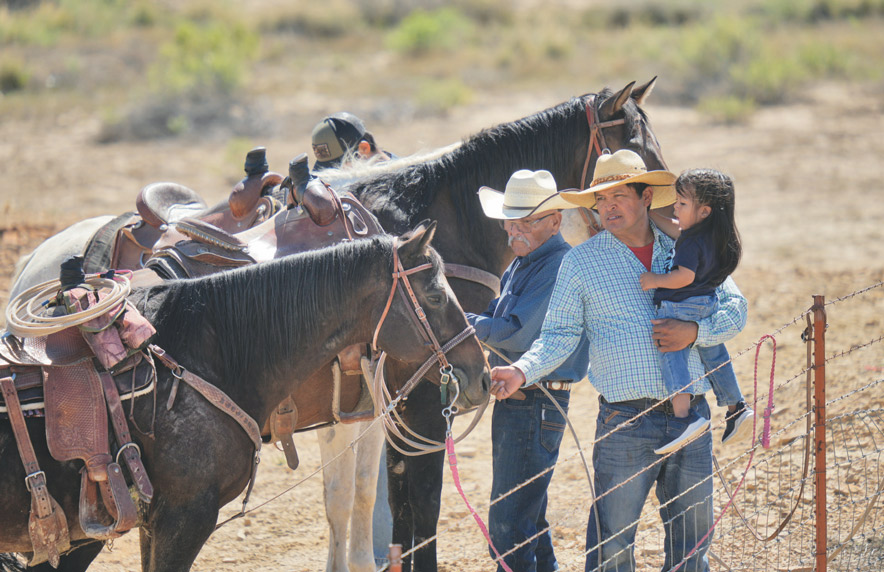
Tee Ryan Duncan holds his 2-year-old son, Colton Duncan, before joining the Four Directions Trail Ride south of Shiprock Friday, Oct. 2. The family rode toward Shiprock for the yé'ii bi cheii at the 113th Annual Northern Navajo Fair.

Naa’ahóóhai | 113th Annual Northern Navajo Fair
One family’s ride into Shiprock connects generations through tradition, language
SHIPROCK
A red-tailed hawk circled high over the desert south of Shiprock Oct. 2. Below it, more than 100 riders kicked up a long plume of dust as they moved toward town.
At the front, riders held the U.S., New Mexico and Navajo Nation flags. Behind them came men in straw and felt cowboy hats, women in bright pink shirts and children sitting tall in their saddles. They rode over the open flats in loose ranks, headed for the yé’ii bi cheii at the 113th Annual Northern Navajo Fair.
Before the ride began, Tee Ryan Duncan stood at a barbed-wire fence with his 2-year-old son, Colton, on his hip. He reached out to steady one of the family’s horses, its bridle trailing a pink lead rope. His father stood beside him in a white cowboy hat. Their saddles, coiled ropes and gear were ready.
“We’ve been riding probably about five years,” Duncan said.
The family started from Table Mesa for about three years. Last year, they rode from the Pinnacle near Red Valley, coming in from the west. That route was flatter, Duncan said, “but there’s hardly any other riders.”
This year, riders moved through the sagebrush and greasewood in groups, with the mesas pale blue on the horizon. Pickups and horse trailers lined the nearby highway.
Along the gravel shoulder, families watched the procession pass, and one man raised his hand to wave.
The ride is known as the Four Directions Trail Ride.

Special to the Times | Donovan Quintero
Riders carry the Navajo Nation, New Mexico and U.S. flags during the Four Directions Trail Ride at the 113th Annual Northern Navajo Fair Friday, Oct. 2, in Shiprock.
“It starts the ceremony,” Duncan said. “For the fall changeover.”
Duncan described riders historically arriving from all four directions for the fair and the yé’ii bi cheii, their wagons carrying corn from their harvest.
“Having this ceremony was giving thanks back to our ancestors and Mother Earth for the food that’s being provided,” he said, “and more blessings to come for the Navajo Nation.”
He measured the changes in travel in miles and days. Today, his family can reach a Bashas’ store in about an hour. A grocery trip once took two days, he said.
“You rode in, had to stay there for overnight, and ride back next day with all your groceries,” Duncan said.
He also challenges descriptions of Native running solely as a sport.
“Yes, running is a big part of our culture,” he said. “It’s not just because Natives were good runners, but when they go from town to town to spread this news, sometimes they didn’t have horses. So then they have to spread it by foot.”
In Duncan’s account, runners stopped at hogans in small settlements, shared the news and received food and water before moving on.
Asked why young people need to learn traditional ways he connected those practices to speaking Diné.
“Along with a tradition that’s starting to lose its ground, it also maintains our language, and that’s a big part of our culture,” he said.
As a kindergartner at a day school, Duncan visited the Shiprock fairgrounds with his teachers.
“It was not necessarily just for carnivals and all the exhibits and get free stuff,” he said. “It was mostly to show each school what progress their kids are making with art.”
Students also displayed their writing in Diné. Duncan entered artwork himself and remembers his teachers explaining the exhibits.
“This is what your grandma and grandpa lived in. This is where our people used to live, in these hogans,” he said. “These sheep, these animals.”
Duncan said schools and elders continue working to keep the Diné language alive.
“But we should always learn back on the history of our language,” he said.
This year, Central Consolidated School District gave students Thursday and Friday off for the fall celebration, according to Duncan. Last year, students remained in school and were bused out to see the ride.
His older son, Traidence Duncan, 13, an eighth-grader at Newcomb Middle School, was able to participate this year.
Before the riders set out, Duncan introduced himself by his clans. He is Tódích’íi’nii, born for Táchii’nii. His grandfathers’ clans are Hooghan Łání and Naakaii Diné.
Clans and family relationships are among the things he wants his children to learn, along with the language and the ride itself.
“It’s something that we’re slowly losing,” Duncan said, “and we’re trying to keep this going.”

 Highway 264,
 I-40, WB @ Winslow
