




‘Naat’áanii yázhí’
Youth council brings a new generation’s voice to government
Navajo Times | Sharon Chischilly
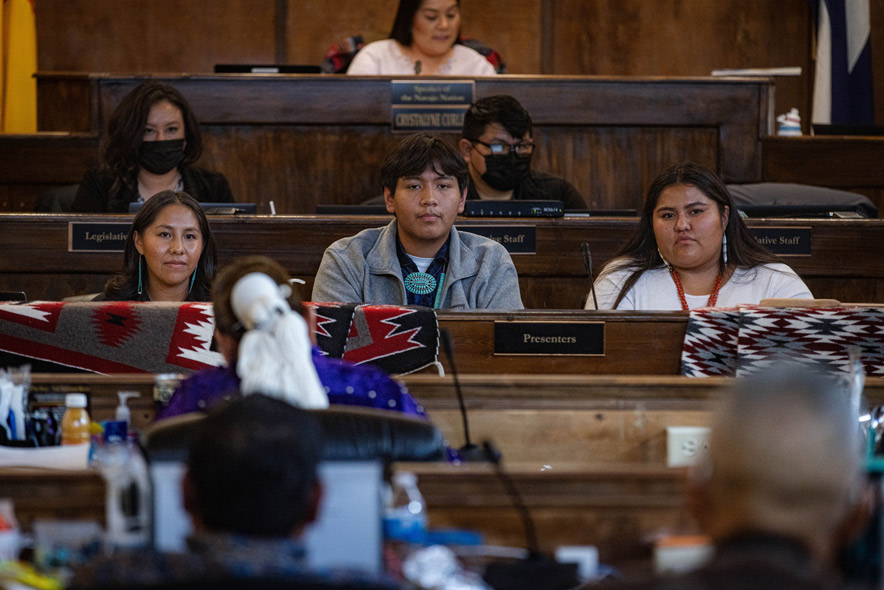
Navajo Nation Youth Advisory Council members Kendri Kinlacheeny, Makyle Dan and Aryiah James, from left, listen to Council Delegate Rickie Nez during the opening day of the fall session at the Council Chamber in Window Rock Monday afternoon, Oct. 19.

WINDOW ROCK
When members of the Navajo Nation Youth Advisory Council need help finding a word in Diné, they turn to Aryiah James. She grew up speaking the language with her family and classmates. Now, as the council’s chair, she helps fellow members use it themselves.
Kendri Kinlacheeny is learning through a college course and questions she brings home to her family. Makyle Dan joined the council partly because he wanted to learn cultural practices, he had missed growing up.
On Monday, Oct. 19, the three presented before Navajo Nation lawmakers during the opening day of the fall session. Speaker Crystalyne Curley gave them time after her report to address delegates.
In interviews afterward, they described the responsibility of representing young people while still attending school, considering careers and learning government procedures. Their work includes cultural workshops and discussions about how to help their peers use the Diné language, experiences that also shape their own education.
James, a Central Agency representative from Wheatfields, Arizona, said members want their experiences considered when delegates make decisions.
“For us to be talking about these situations, they’re seeing that we actually care so much about what is going on around us and that we want that involvement,” James said.
James is Kinyaa’áanii, born for Tó’aheedlíinii. Her maternal grandfather is Naakaii Dine’é, and her paternal grandfather is Tó Dík’ǫ́zhí.
In her fall report, Curley noted that the Naabik’íyáti’ Committee confirmed 12 youth council members in March from a pool of 41 applicants. The group operates within the Legislative Branch, with representation from the five agencies and young Diné living outside the Navajo Nation.
James said members had attended every Council session since their March induction. Monday’s presentation accompanied a longer account of their work than they had submitted for previous sessions.
Learning through service
That work has taken Dan, the youth council’s vice chair, into school workshops where he was learning alongside other students.
A senior at Window Rock High School who lives in Oak Springs, Arizona, Dan initially hesitated to apply because he did not feel closely connected to his culture. He decided joining could help him learn.
Dan is Tábąąhá, born for Bit’ahnii. His maternal grandfather is Tó Dík’ǫ́zhí, and his paternal grandfather is Hashtł’ishnii.
Sheep-butchering demonstrations became one of the most meaningful parts of his experience. He listened as instructors identified body parts and explained why they made particular cuts. He had not known the process before, and learning it helped persuade him to stay with the council.
Members organized workshops at Window Rock, Page and Tuba City high schools. In their quarterly report, included with Curley’s fall report, they reported serving 125 students at Page and 100 at Tuba City. The activities included butchering, bread-making and cooking.
Dan said relationships with staff and fellow members also helped him feel more comfortable before lawmakers. Though he initially found the presentation intimidating, he felt calmer as delegates asked about the council’s activities and what members had learned.
He is taking dual-credit classes while finishing high school and considering business or a career in healthcare. His parents drive him to council events, helping him meet his commitments.
“I’m also doing this for my community and doing this for the youth across the Navajo Nation. I think this is a very important role and a very important kind of thing I’m doing right now,” Dan said.
School and employment demands have already changed the council’s membership. Members reported four resignations in their quarterly report and voted to begin recruiting replacements.
Speaking while still learning
Kinlacheeny said those who remain are still working out communication, meeting procedures and their plan of operations, turning to Legislative staff with questions.
Kinlacheeny is Kinyaa’áanii, born for Tábąąhá. Her maternal grandfather is Tódích’íi’nii, and her paternal grandfather is Tó’áhání.
She came to the council after years of attending government meetings with her mother and other relatives. At first, she went for the food. Eventually, she began listening, asking her mother to explain discussions conducted in Diné and noticing how few young people attended.
Speaking before delegates brought a different responsibility. Kinlacheeny recalled “shaking” during the spring session. Each appearance made the next one easier, and she felt less nervous Monday.
Still, she said, she thinks about how few people have had the chance to speak on the Council floor and the care that opportunity requires.
Kinlacheeny, 16, is a junior at McKinley Academy, taking college courses through the University of New Mexico-Gallup while working toward an associate degree in liberal arts. She is considering law school and a career in federal Indian law, or medical school to become a psychiatrist.
Her coursework includes a Diné language class, but she also wants more of her learning to happen at home.
She asks relatives about words, place names and cultural teachings, sometimes repeating a question several times. Although her grandparents tried to teach her Diné, English predominated in much of her childhood, at school and elsewhere.
Her parents are now speaking more Diné to her 3-year-old sister. Kinlacheeny sees her sister’s experience as a reason to believe more children can grow up learning the language.
She said her own limited fluency did not keep her from speaking before lawmakers. She saw herself as representing young people who are also learning.
The teachings she received in Diné remain part of how she understands her responsibilities. Some began as simple instructions about avoiding danger. Others helped her understand how to treat people and conduct herself.
“When growing up, those teachings really helped me into the person who I am today,” Kinlacheeny said. “And some of those teachings are the reasons why I wanted to become a naat’áanii.”
She described herself as a naat’áanii yázhí, still learning while carrying the responsibility of representing other young people. She wants the youth council to consider how to share those teachings with children who do not understand the language.
That requires examining what keeps young people from using Diné in daily life, she said, and considering approaches informed by their experiences.
Members had discussed language informally but had not yet devoted a full discussion to it. Kinlacheeny said delegates’ questions Monday helped identify work that needed more attention.
James grew up speaking Diné with her parents, grandmother and great-grandmother. At Tséhootsooí Diné Bi’Ólta’, the immersion school she attended, she also spoke it with other children.
By middle school and high school, she noticed fewer peers speaking it. She also recalled adults criticizing students’ ability to speak or understand.
“The thing that stops a lot of kids from talking is that they’re embarrassed,” James said.
She wants adults to recognize their role in helping young people learn, including speaking with children at home. She also acknowledged that some families do not have a fluent speaker to turn to.
At a UNITY conference, James heard a participant from Hawaii describe her community’s language-learning efforts. The account made her think about what similar opportunities could mean for Diné youth.
A Window Rock High School graduate, James received the Navajo Nation Bilingual Seal of Proficiency in 2025. She now attends Diné College, where she plans to complete business degrees. She is also considering studying Diné education to become a language teacher.
Her council priorities include mental health awareness and language learning. Other members bring concerns shaped by their own experiences, she said, and they work to incorporate k’é and hózhǫ into their discussions.
“I want to hear our language seven generations down after myself, just to keep the continuation of nihizaad,” James said.

 Highway 264,
 I-40, WB @ Winslow
