





3 family members die after being swept away in Two Grey Hills floodwaters
Navajo Times | Sharon Chischilly
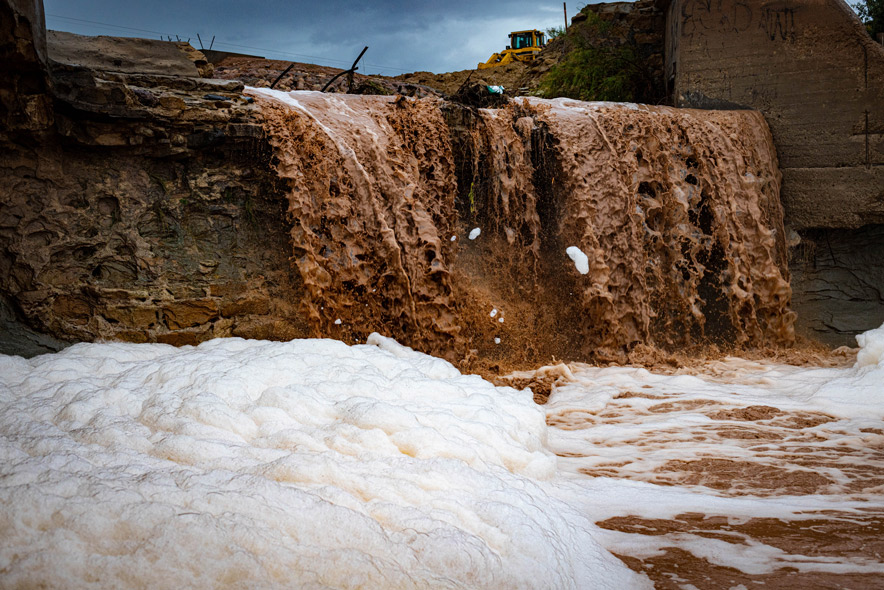
Muddy floodwater rushes over exposed rock and eroded soil near Road 9650 in Two Grey Hills, N.M., as thick foam gathers below Wednesday afternoon, Sept. 16. Heavy equipment sits above the wash following flooding in the community, where three people died.

WINDOW ROCK
Three members of the same family, including a juvenile, died after being swept away by floodwaters early Wednesday in the Two Grey Hills area as heavy rains caused flooding in parts of the Navajo Nation.
At about 12:30 a.m., the Navajo Police Department’s Shiprock District responded to a report of people swept away by floodwaters in the Two Grey Hills area. Navajo Nation Fire and Rescue personnel from Newcomb and Shiprock, Navajo EMS and 4 Corners K9 Search and Rescue joined the response and search.
Two adults and a juvenile died.
Navajo Police had not publicly said whether a vehicle was involved or how the three entered the floodwater. The incident remained under investigation.
Bernadine Beyale, the founder and executive director of 4 Corners K9 Search and Rescue, said all three were members of the same family.
She described watching an officer deliver the news to the mother of the juvenile.
Navajo Times | Sharon Chischilly
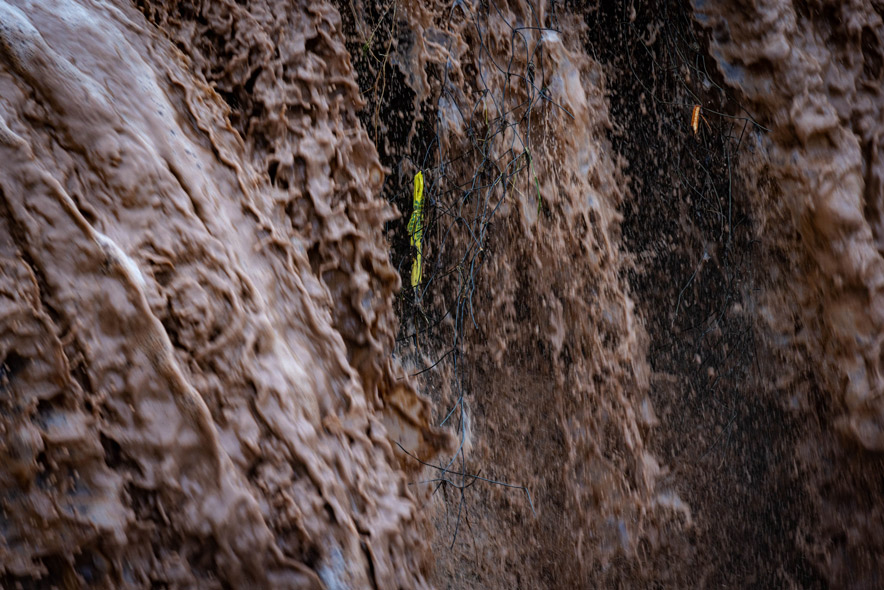
A strip of yellow caution tape hangs from brush as muddy floodwater rushes through debris Wednesday afternoon, Sept. 16, near Road 9650 in Two Grey Hills, N.M. Three people died in the Two Grey Hills community during the flooding.
“It was just heartbreaking to see him tell her, ‘You’re gonna have three family members not come home today,’” Beyale said.
The incident came as emergency crews responded to flooding elsewhere on the Navajo Nation. Navajo officials said the Department of Emergency Management was coordinating three rescue operations while emergency medical personnel assisted with response and transportation.
In the Chinle area, water levels had begun to subside while Chinle Chapter personnel continued working on an earthen dam. The Chinle Chapter House was also being evaluated as a possible emergency shelter because a facility in Many Farms was unavailable for sheltering.
The Navajo Nation Commission on Emergency Management was scheduled to meet to discuss additional resources and actions while the Navajo Division of Transportation remained on standby.
Beyale said rescuers encountered muddy roads and flooded washes while trying to reach locations during the Two Grey Hills response. On one route, they reached a wash they determined they could not safely cross and turned around.
She followed a Navajo police officer whose vehicle had better lighting. Unfamiliar with the roads and conditions, they repeatedly stopped to evaluate the ground.
“We kept getting out of our vehicle, looking at the road, looking at how soft the sand was,” she said. “Are we sinking in? Is it even worth it?”
Eventually, Beyale said, the risk outweighed the advantage of taking the shorter route.
“My gut feeling this whole time was this road isn’t safe. I’m not going to cross it,” she said. “Even though the other way is a long way around, I said, ‘Hey, at least we’ll be safer that way.’
“Don’t trust your vehicle more than you trust the water,” she said. “You know, just having four-wheel drive or a lifted truck or a bigger vehicle doesn’t mean that moving water can’t move you.”

Navajo Times | Sharon Chischilly
Muddy floodwater churns through a wash near Road 9650 Wednesday afternoon, Sept. 16, in Two Grey Hills, N.M., following heavy rain in the area.
The National Weather Service warns that about 6 inches of fast-moving water can knock an adult down, 12 inches of rushing water can carry away most cars, and 2 feet can carry away SUVs and trucks. More than half of flood-related drownings occur when a vehicle is driven into hazardous floodwater, according to the Weather Service, citing the Centers for Disease Control and Prevention.
Floodwater can also wash away a roadbed, leaving drivers unable to determine whether a road remains beneath the water. Flooding in washes and arroyos can develop even when rain is not falling at a particular location because runoff can move rapidly downstream.
Beyale said familiarity with a road can become dangerous if it leads a driver to underestimate changing conditions.
“People see a wash they’ve crossed 100 times and they think, I know this road, I can make it,” Beyale said. “But the road underneath may already be washed out, and the water may be deeper than it looks and the current may be stronger than you realize.
“If you come to running water, especially at night when you can’t see the depth, the road, or what’s downstream, please don’t attempt it,” she said. “Turn around and find another route, even if that means going a long way around or waiting until conditions improve.”
If someone is swept away or trapped, Beyale said, call 911 and provide emergency personnel with the best location possible.
“Don’t have additional family members or bystanders enter the water trying to help,” Beyale said. “Because now, we may end up with multiple victims.”
Beyale said the problem on the Navajo Nation is more complicated than telling people not to cross a flooded road.
Some families depend on remote dirt roads that can become muddy or impassable during prolonged rain. A flooded wash may separate residents from their homes, jobs or the nearest paved highway.
“I just feel so bad on how do these families even get home after work or how do they get to work this morning?” Beyale asked. “If the alternative is a long detour or there isn’t another safe road home, that is part of the problem too. But if families can’t get home, then where do they go?”
She said that question should become part of the Navajo Nation’s flood preparedness discussions.
Communities have discussed warning signs, barricades, law enforcement road closures and emergency alerts, Beyale said. But with numerous remote washes and crossings throughout the Nation, placing barriers at every dangerous location may not be realistic.
Instead, she said, officials need to identify high-risk crossings and work directly with residents, chapter officials and road crews who know where flooding routinely cuts off travel.
“Instead of just making these decisions without talking to the community, talking to the people in the chapter house, talking to the people actually working on the roads out there and asking for their input,” Beyale said.
“If families can’t get home, then where are they going to stay?” she said. “How are they going to get to work? What do they tell their bosses when they cannot get back to work?”
Beyale said Wednesday’s response also showed the importance of calling multiple emergency resources early.
She said this was 4 Corners K9 Search and Rescue’s first flood-related call of the year. The criminal investigator who requested the organization’s assistance did not yet know whether its search team would ultimately be needed, she said, but asked it to respond and stage with other resources.
Beyale said that approach can save critical time because rural responders may travel hours before reaching an emergency.
“You don’t know who you’re going to need until the time happens,” she said.
With rain continuing to create hazardous conditions, President Buu Nygren asked residents to remain cautious, stay away from flooded roads and washes and allow first responders room to conduct emergency operations.
“If you cannot see the road beneath the water, you don’t know what you’re driving into,” Beyale said. “No vehicle and no shortcut is worth your life.”
Get instant access to this story by purchasing one of our many e-edition subscriptions HERE at our Navajo Times Store.

 Highway 264,
 I-40, WB @ Winslow