





Navajo Nation camera rollout exposes gap with McKinley County law enforcement system
Navajo Times | Krista Allen
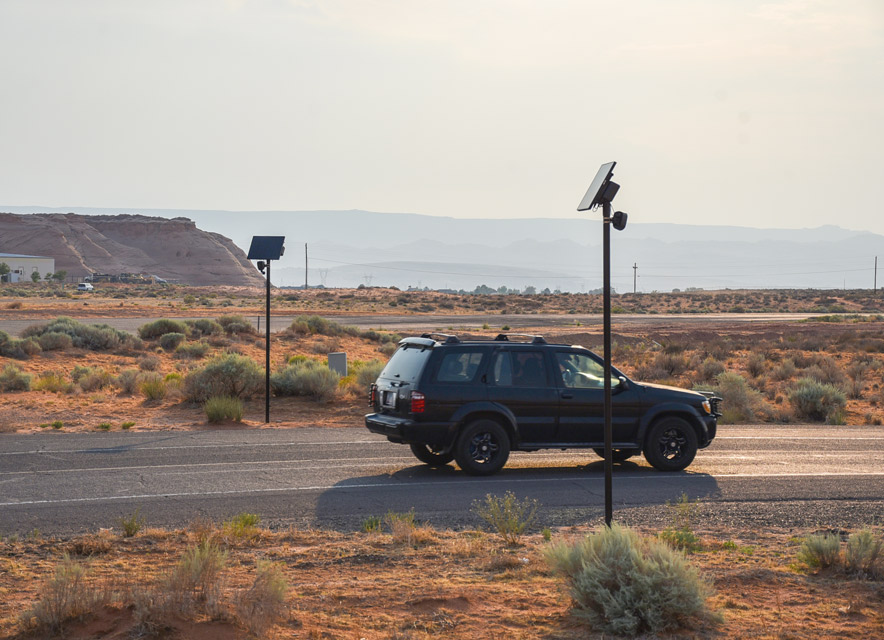
A vehicle passes license plate readers at 1501 Coppermine Rd. near Big Lake Trading Post in Page, Ariz., Aug. 7, 2026. The cameras capture vehicle details rather than people and provide searchable data that can be used for real-time alerts.

GALLUP
As the Navajo Nation prepares to activate hundreds of license plate-reading cameras throughout its 27,000 square miles, McKinley County Sheriff James Maiorano III said his deputies will not be able to access images from the network because the county uses a different system.
Maiorano said his office uses Vigilant, a Motorola Solutions license plate reader system that he said is used by the New Mexico Department of Public Safety. The Navajo Nation is partnering with Flock Safety.
“Flock and Vigilant do not share information, so I cannot see information coming in on Flock cams, nor can Flock operators see what’s coming in on Vigilant cams,” the sheriff said.
Maiorano said access requires agencies to use the same system, with licensed law enforcement users vetted through the vendor.
Flock Safety announced its partnership with the Navajo Nation July 30, with cameras supporting the Navajo Department of Criminal Investigations and Navajo Police Department on Navajo Nation land in Arizona, New Mexico and Utah.
A deployment map was developed with police district leadership to identify locations including major intersections, highways and areas with higher crime rates, according to the company’s news release.
The company’s July 30 news release cited police staffing and long response distances, including roughly one officer per 1,000 residents and response distances that can exceed 100 miles. The release also stated that the cameras could assist in missing-person cases.
Farmington police operate roughly two dozen Flock cameras, and the San Juan County Sheriff’s Office operates several more. The agencies have credited the system with tracking a homicide suspect’s vehicle from Aztec and assisting with drug interdiction.
Durango police operate about two dozen cameras and earlier this year used the regional Flock network to track a Utah murder suspect’s vehicle as it traveled through Farmington and Aztec toward Colorado.
New Mexico State Police have operated a statewide plate reader program since July 2024 using vehicle-mounted and fixed cameras checked against a list maintained by the FBI, according to the Department of Public Safety.
Maiorano said McKinley County uses Vigilant in cases involving Amber Alerts, missing persons, stolen vehicles, drug distribution and human trafficking.
He cited the recovery of the county’s stolen inmate transport van. After the plate was entered into the system, a Vigilant camera in the To’hajiilee area recorded a hit within about 10 minutes, he said. Deputies later recovered the van.
“We don’t use it to spy,” Maiorano said. “It just takes a photograph of the vehicle with the license plate that you’re looking for and tells you the time, date, and location that that vehicle is at so I can send resources to try to recover it.”
“If we were looking for a particular plate or we knew a particular plate, I can just enter that into the system and it will tell me who queried it,” he said.
Questions over data access
Flagstaff City Council ended its Flock contract and deactivated its cameras last December. Durango residents sought an ordinance restricting data retention and requiring warrants to access camera data. The city also began monthly public reporting on police use of the system.
New Mexico’s Driver Privacy and Safety Act, which took effect July 1, prohibits license plate reader users from sharing data if they reasonably believe it may be used for immigration enforcement, investigations or prosecutions involving protected health care activity or efforts to impose liability based solely on constitutionally protected activity.
The law also makes license plate reader data confidential under the state’s Inspection of Public Records Act.
The Navajo Nation’s July 30 announcement did not detail its data retention, access or sharing terms with Flock.
According to information published by Flock Safety, customers own and control their data, including access, sharing and retention. The default retention period for license plate reader data is 30 days, though customers can configure retention where applicable. Flock also requires a documented reason for each search and logs searches for review.
Cross-commissioning agreement
McKinley County has had a cross-commissioning agreement with the Navajo Nation dating to about 2007. Fifteen deputies, including Maiorano, are commissioned to act as Navajo Nation police officers on Navajo Nation land.
“We cannot enforce New Mexico State statute on tribal land. We have to enforce tribal code on tribal land. So we act as a Navajo Nation police officer when we’re doing that,” Maiorano said.
Maiorano said the arrangement allows deputies to assist Crownpoint Police District officers when officers are short staffed or responding from long distances. Deputies also can secure crash scenes and call ambulances before Navajo Police officers arrive.
Cross-commissioned deputies do not take over investigations. They secure scenes until Navajo officers assume responsibility, he said.
The Navajo Nation has sent the county a new draft agreement structured more as mutual aid than cross-commissioning, Maiorano said. Delegate Andy Nez also arranged meetings between Maiorano and the Navajo police chief.
“I think we’re going to move toward renewing that contract and kind of refreshing some of the language,” Maiorano said.
Maiorano said he is also pursuing federal Special Law Enforcement Commissions through the Bureau of Indian Affairs for his deputies to address federal liability protections when they exercise federal authority on Navajo Nation land.
“It limits what we’re allowed to do and how we’re allowed to help,” Maiorano said.
Maiorano also cited McKinley County’s joint drug task force with Gallup police, the FBI and BIA. He said the task force has seized thousands of fentanyl pills, including shipments moving in 1,000-pill quantities.
“We are working very well together to kind of blur those jurisdictional lines to keep bad guys from using those jurisdictional lines to avoid prosecution,” he said.
Get instant access to this story by purchasing one of our many e-edition subscriptions HERE at our Navajo Times Store.

 Highway 264,
 I-40, WB @ Winslow