






‘Find your rhythm’
Chief Manuelito Scholars prepare for college with lessons from those who came before
Submitted | Office of Navajo Nation Scholarship and Financial Assistance
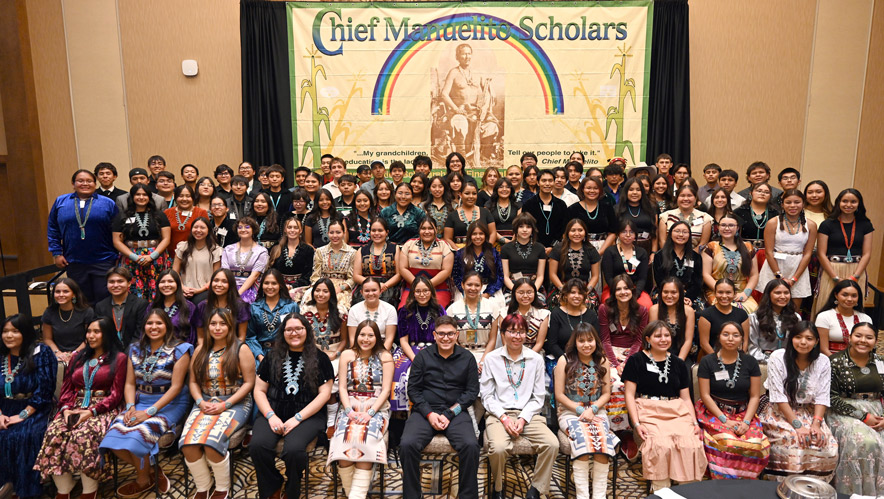
Chief Manuelito Scholarship recipients pose for a group photo July 31 during an awards ceremony at Twin Arrows Navajo Casino Resort in Twin Arrows, Ariz. The Office of Navajo Nation Scholarship and Financial Assistance honored 186 graduating high school students with the academic award.

BÉÉSH HÁÁT’I
Thirteen years after Isabella Robbins was named a Chief Manuelito Scholar, the Tuba City High School graduate addressed this year’s scholars at a ceremony honoring 186 graduating high school students with the Navajo Nation’s highest academic award.
See the full list of this year’s 186 recipients.
Robbins delivered the keynote address July 31 at Twin Arrows Navajo Casino Resort, where the Office of Navajo Nation Scholarship and Financial Assistance recognized this year’s recipients of the Chief Manuelito Scholarship. The ceremony drew a crowd nearing 500.
Robbins earned the scholarship in 2013 before attending Stanford University, where she received a bachelor’s degree in art history. She later earned a master’s degree in public humanities from Brown University and a doctorate in the history of art from Yale University. She will begin her career as an assistant professor in the University of Arizona’s Art History Department.
Robbins began her address as she would a class, with an image of Shonto Begay’s painting “Book of the Shepherd.”
The painting depicts a young boy wearing a wool cap as he sits on a mule, reads a book and herds sheep in winter with the help of several sheepdogs. Robbins connected the scene to her own childhood, when her parents drove her from Tuba City to Flagstaff three or more times a week so she could attend evening ballet classes.
“I had to do homework by flashlight on the ride home. This kind of multitasking, I’m sure, is not unique to many of you. I’ll bet there were days when you came home late from practice or games and stayed up even longer to finish homework,” Robbins said.
“Being committed scholars and fulfilling your obligations as leaders, athletes, community members, sons and daughters, and brothers and sisters is not an easy feat. It is often challenging and uncomfortable,” Robbins said. “This doesn’t stop when you get to college or grad school, in my case.”
Robbins had lived her entire life on the Navajo Nation before leaving for Stanford. She recalled being excited about California, making close friends and discovering subjects that had not been available to her in high school.
Robbins remembered the homesickness she felt after her father dropped her off at her dorm and receiving a C on a physics exam after graduating from Tuba City High School as a straight-A student. She told the scholars those moments were part of learning how to handle unfamiliar situations and setbacks.
“Even when you are having the time of your life, discomfort is necessary to experience new things and gain incredible opportunities,” Robbins said. “Like the painting, both reading and sheep herding are not simple. They require discomfort, balance, multitasking, and putting yourself in a position to fail, learn, persevere, and eventually succeed.”
© 2026 Navajo Times Publishing Co. Inc.
Former Navajo Nation President Jonathan Nez, a candidate for Congress, spoke about another challenge the scholars could encounter years from now if they return to work for the Navajo Nation. He told them a college degree may not immediately lead to a management position and encouraged them to be willing to begin elsewhere within the workforce.
“Sometimes you’re going to feel completely alone,” Nez said. “You’re going to feel like the Navajo Nation doesn’t want you back. But don’t quit. Don’t feel entitled to these management positions just because you have a degree. Go back to the lower levels and get your foot in the door first.”
“Show the Navajo Nation staff and employees what you’re all about,” he said. “When you do, you will be elevated to leadership positions. Don’t be the one who says, ‘The Navajo Nation doesn’t want me,’ and then starts speaking negatively about your Navajo homeland. Enough is enough. We do want you to come home. But you’ve got to show those individuals what you’ve learned and what you’re all about.”
Other speakers focused on choices the scholars will face while they are in college.
Delegate Andy Nez spoke about finding a routine and managing scholarship money carefully. Nez sponsored legislation last fall that provided $19 million annually to Diné College, Navajo Technical University and ONNSFA.
“I always tell students, you know, find your rhythm,” Andy Nez said. “It’s going to look different for everyone.”
He also cautioned students against treating scholarship reimbursements as spending money.
“Some of you may see high figures for the first time,” Nez said. “Don’t splurge. That is another discipline you have to practice. But now’s the time to discipline yourself, to be fiscally responsible, and to make sure you’re not eating out all the time.”
Speaker Crystalyne Curley drew from her own changes in college to tell students that choosing a major does not necessarily determine where they will end up.
Curley entered college as an engineering major because she enjoyed math and later changed direction after taking a psychology course. She eventually earned bachelor’s degrees in justice studies and psychology. Her plans changed again as she moved toward public administration.
She told the scholars that fields including artificial intelligence, data sovereignty, water science and climate resiliency are creating new areas where their education may be needed.
“Whatever direction you take, always think ‘back home,’” Curley said.
Acting Navajo Nation Attorney General Kris Beecher spoke about avoiding unnecessary college debt and pursuing other scholarships. He told the students their education could eventually lead family members, community members or Navajo Nation leaders to ask them to serve.
Vice President Richelle Montoya focused on the people students keep close as they move into the next stage of their lives. She encouraged them to maintain ties with their families and take lessons from mistakes along the way.
“Find and keep good people around you and be just as good to them in return,” Montoya said.
The ceremony closed as the scholars who were present took the microphone one by one to introduce themselves, share their clans and parents’ names and identify the colleges they will attend and the majors they plan to pursue.
Each then received a commemorative plaque.
Get instant access to this story by purchasing one of our many e-edition subscriptions HERE at our Navajo Times Store.

 Highway 264,
 I-40, WB @ Winslow