




Trump move puts Chaco protections at risk
Special to the Times | Donovan Quintero
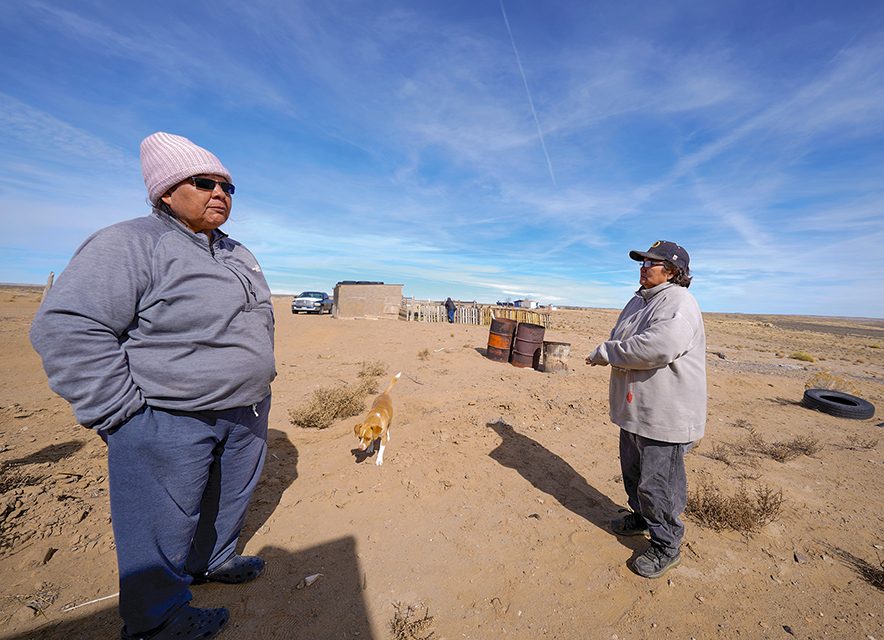
Marlene Pinto, left, and Sheila Wero, who both live within the 10-mile buffer zone of the Chaco Culture National Historical Park, speak about not having running water or electricity on Feb. 16, 2025.

WINDOW ROCK
The Trump Administration has opened a seven-day public comment period on a proposal to revoke federal protections around Chaco Culture National Historical Park, setting up a fast-moving fight over whether more than 336,000 acres of public land near the sacred landscape could be reopened to oil and gas development.
Public comments will be accepted through April 7 as the Bureau of Land Management moves ahead with an environmental assessment on whether to keep, shrink or fully revoke the 20-year mineral withdrawal established in 2023 under former Interior Secretary Deb Haaland, who is now a New Mexico gubernatorial candidate.
Backlash builds quickly
The proposal drew swift backlash from New Mexico’s congressional delegation and Pueblo leaders, who say the administration is moving too quickly on a decision involving a landscape with deep cultural, spiritual and archaeological importance. The review also reopens a long-running dispute over Chaco, where Pueblo nations have pushed for permanent protections while Navajo leaders have argued the broader buffer cuts into royalty income for allottees.
At issue is a June 2023 order, Public Land Order No. 7923, that withdrew about 336,404 acres of federal land in San Juan, Sandoval and McKinley counties from new mineral leasing and mining claims for 20 years.
The withdrawal still allowed production on existing wells, drilling on current leases and mineral leasing by Navajo Nation allottees. It did not apply to minerals owned by private, state or tribal entities.
The BLM said it will study three options: keep the withdrawal in place, revoke it entirely, or partially revoke it by reopening lands beyond a five-mile buffer while keeping protections closer to the park. The agency identified full revocation as its preferred option.
In a joint statement released April 2, members of New Mexico’s congressional delegation sharply criticized both the proposal and the seven-day timeline.
“Chaco Canyon is a living cultural landscape that holds deep historical meaning and is a sacred space for many of our New Mexico tribes,” Sen. Martin Heinrich said. “It is not just one more place to drill. The disrespect shown by the Trump administration toward New Mexicans seems to know no bounds.”
Sen. Ben Ray Luján called the seven-day comment period “inadequate and disgraceful,” saying the administration was “jamming a comment period into Holy Week and limiting public participation to online-only access, all while Pueblos are in the midst of preparations for sensitive cultural activities.”
“This is unacceptable, and I will continue pushing back against this administration’s attempts to undermine tribal sovereignty,” Luján said.
Rep. Teresa Leger Fernández, Rep. Melanie Stansbury and Rep. Gabe Vasquez also criticized the plan, saying it would undo protections secured through a lengthy public and tribal process and put an important cultural landscape at risk.
Sharp break from the earlier review
The speed of the current review stands in sharp contrast to the process that created the withdrawal.
After President Joe Biden announced support for protecting the Greater Chaco landscape in November 2021, the BLM launched a 120-day public comment period in January 2022, held six public meetings, received more than 110,000 comments and later conducted two more in-person meetings during environmental review. The agency also invited 24 tribal nations into government-to-government consultation.
By contrast, the current scoping period lasts seven days, accepts comments only online and comes during Holy Week, when Pueblo communities are engaged in cultural preparations.
The All Pueblo Council of Governors, which represents 20 federally recognized Pueblos, has repeatedly called for permanent protection of the Greater Chaco landscape.
Navajo Nation opposed the 10-mile buffer
The Navajo Nation has long taken a narrower position.
While not seeking full revocation, Navajo leaders have opposed the full 10-mile buffer, arguing it harms Navajo allottees who rely on royalty income from oil and gas development. The Navajo Nation has instead supported a smaller five-mile buffer.
In January 2025, the Navajo Nation sued the federal government, arguing the Interior had not adequately consulted the tribe about the withdrawal’s economic effects. The lawsuit challenged the process behind the withdrawal, not the existence of the protections themselves. Court records show the case was dismissed this week after the parties reached an out-of-court settlement.
The Pueblos of Acoma and Laguna intervened in the case in support of keeping the withdrawal in place.
The review is part of a broader push by the administration to revisit recent public land withdrawals. Interior Secretary Doug Burgum ordered the review after President Donald Trump signed Executive Order 14154 in January 2025 directing the Interior to reassess recent withdrawals. On Oct. 30, 2025, the BLM notified tribal governments it was studying whether to retain, modify or rescind the Chaco buffer.
The Greater Chaco Region sits within the San Juan Basin, one of New Mexico’s most productive oil and gas fields. Chaco Culture National Historical Park, designated a UNESCO World Heritage Site in 1987, preserves monumental stone great houses and ancient roads built by Puebloan peoples between about A.D. 850 and 1250. More than 4,700 known archaeological sites lie outside the park boundary in the surrounding landscape.
During its earlier review, the BLM concluded that a 10-mile withdrawal offered the strongest protection for those sites. A five-mile buffer, the agency found, would leave more than 2,800 known sites vulnerable to development.
Public comments may be submitted through the BLM’s National NEPA Register under “Evaluation of Potential Revocation of Chaco Withdrawal.”
Get instant access to this story by purchasing one of our many e-edition subscriptions HERE at our Navajo Times Store.

 Highway 264,
 I-40, WB @ Winslow