



As Utah declares drought emergency, Diné families still haul water
Special to the Times | Donovan Quintero
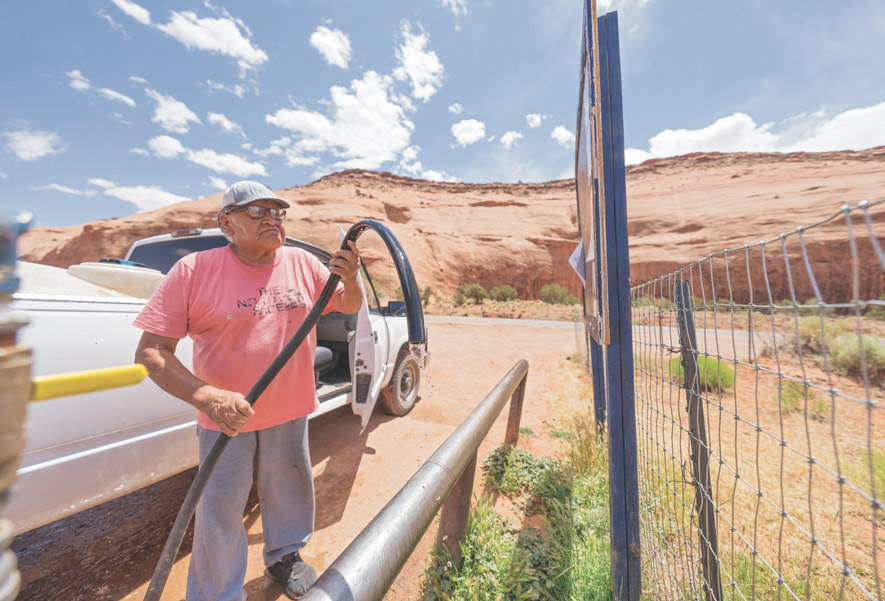
Lewis G. Bedonie handles a water hose at a community standpipe near Oljato, Utah. Bedonie, 71, said he has hauled water for nearly five decades from the site to his home near Paiute Farm.

OLJATO-MONUMENT VALLEY, Utah
Under a cloud-streaked sky, the line at the community standpipe inches forward beneath red sandstone cliffs.
A blue pickup with an IBC tote strapped into its bed pulls up to a battered black valve set into a steel rail. The driver, hat tugged low against the sun, leans against the fence and waits.
Two days earlier, 370 miles north, Utah Gov. Spencer Cox stood at Little Dell Reservoir east of Salt Lake City to announce an executive order declaring a statewide drought emergency. He told reporters Utah is coming off the warmest winter on record by nearly three degrees and an April 1 snowpack of 2.7 inches of snow water equivalent, the lowest since at least 1930, against a normal of 14.2 inches.
Cox was speaking about Utah’s water shortage. At the standpipe near Oljato, Navajo families were living it.
The snow that did not fall on the Wasatch and Uinta ranges is part of the same shortage that has dried windmills and natural springs on the Utah side of the Navajo Nation. Families in Oljato, Douglas Mesa and the country toward Piute Farm have been living a household-level drought emergency for decades, with or without an executive order.
To read the full article, please see the May 28, 2026, edition of the Navajo Times.
Get instant access to this story by purchasing one of our many e-edition subscriptions HERE at our Navajo Times Store.

 Highway 264,
 I-40, WB @ Winslow