




Letters | Results matter

Results matter
Editor,
The primary elections are over, and they reveal several important trends. Within the past 10 years, the Navajo people have twice elected relatively young presidents, both in their 30s, and both were defeated after serving a single term. Each administration faced significant challenges and controversies that remained unresolved during their tenure.
President Buu Nygren’s 2026 primary defeat has been widely associated with several issues, including concerns over unspent American Rescue Plan Act funds, the handling of the ZenniHome housing project, allegations involving the vice president, and ongoing disagreements with the Navajo Nation Council, including criticism that the administration did not maintain a productive working relationship with Council delegates.
Former President Jonathan Nez’s 2022 primary loss was influenced by a different set of circumstances. Many voters were frustrated by his support to the closure of the Navajo Generating Station and the Kayenta Mine, which resulted in the loss of hundreds of Navajo jobs. His administration also faced criticism over the failed glove manufacturing project, which involved a tribal investment of approximately $20 million.
It is encouraging that the Navajo people are willing to give younger leaders an opportunity to serve. At the same time, governing a large and complex government such as the Navajo Nation requires extensive leadership, administrative and management experience. Much of that experience is often gained over decades, 25-plus years of working in government, business or other large organizations.
For many Navajo citizens, the priorities remain straightforward: good-paying jobs, safe communities, reliable infrastructure and opportunities for future generations. If an administration is unable to make measurable progress in these areas, voters have consistently shown a willingness to elect new leadership after a single term. The Navajo voters have to see the results, not just smooth-talking points.
The continued outmigration of young Navajo people from the reservation is one of the nation’s greatest short-term challenges. Without sustained job creation and meaningful economic development, many young Navajo adults will continue to seek opportunities elsewhere. Attracting private investment, supporting business development, and creating industries that provide stable employment are essential to reversing this trend. This is a crisis every new elected Navajo leader has to face.
Ultimately, the question is not whether voters prefer youth or more seasoned experience. While several candidates emphasized their fluency in the Navajo language and cultural connections during the campaign, voters appeared to focus on which candidate offered the most credible vision for improving life on the reservation. The Navajo people are looking for leadership that can make difficult decisions, responsibly manage risk, and produce tangible results. Creating economic opportunity and improving the quality of life for future generations remain the issues that matter most for the Navajo voters.
Delila Yazzie
Kirtland, N.M.
Protecting Chaco
Editor,
I recently made a trip to Chaco Culture National Historical Park in New Mexico to take in its beauty, to pray for the right words to write about Chaco Canyon’s public comment of the proposal to the possible elimination of the 10-mile buffer zone, which blocks new oil, gas, and mineral development near Chaco Canyon.
Being there in the high desert amid the mesas, buttes, and deep canyons, inspired me to write what I thought to leaders in Washington DC.
I am an emeritus pastor who lives 32 miles from Chaco Canyon.
Chaco Culture National Historical Park is a sacred ground rich in cultural and historical significance. Native Americans depend on this land not only for spiritual nourishment but also for their very survival.
While the area is a physical desert, it also represents a spiritual desert that is rich in sacred possibilities.
A spiritual desert can be a metaphor for a time or season in the life of area tribes when people feel spiritually dry and that God has deserted them. When we journey through a spiritual desert, we need to have a survivalist’s mentality and understand the experience as an opportunity for our faith to develop.
Chaco Culture National Historical Park is home to over 100,000 Native American archaeological and cultural sites. Considering the amount of Native life that was destroyed throughout U.S. history, it is only right that we take care to enshrine what remains.
Chaco Culture National Historical Park remains an important site for ceremonies and foraging for herbs and food.
I urged our nation’s leaders as stewards of creation and reminded them of the danger of reducing or rescinding and the elimination of the current 10-mile buffer zone, which blocks new oil, gas, and mineral development near Chaco Canyon.
More is involved in this issue than elimination of the buffer zone, although that is important because of the protection it provides.
What needs to be said, and what overrides everything is that Chaco Culture National Historical Park is a place where the Creator can meet his people. It is in this geological desert that Native people and others can learn to follow God completely, and, in doing so, survive as people connected to and nourished by God.
Through the burning crucible of the desert, trauma survivors, medicine people, pilgrims, and all sinners and saints can find healing and be cleansed and purged for the Creator’s great purpose.
Richard Silversmith
Crownpoint, N.M.
Saving soil
Editor,
I take great pride in continuing my family’s legacy of caring for the land. My dad, James Hóyéé’ Begay, and my grandfather, Hastiin Hóyéé’, taught me to respect Mother Earth, the one who provides for our food and water, our homes, and the homes of all plants and animals.
When we take care of Mother Earth, we care of ourselves. I have particularly enjoyed working to hold our soil in place during our summer rains. When soil washes away, plants wash away. With no plants, water for our springs washes away, too. This situation will not get better by itself.
Dad used to remind me how much our ancestors yearned to step foot on Diné Bikéyah while they were incarcerated in Fort Sumner. I never forget that. I wonder what they would say about Diné Bikéyah today.
To control water on the land, I build check dams. Anyone can do this. These are really just obstacle courses to slow down the movement of water. They can be as simple as enough rocks strategically placed to manage flow. They can be little dams built mostly from materials just lying around: rocks, weeds, tree branches and animal manure. Larger cedar branches and some kind of wire fencing can keep these materials in place. If you have t-posts, they work well, too.
Check dams should be made as close to the source of your water flow areas as possible. Look for V-shaped areas. These are good places to build.
For larger wash areas, first make a kind of cross bar to act as your main support against moving water. Place larger branches horizontally across this area. Add rocks, weeds and tree materials.
Now, space vertical posts across your cross bar to hold the materials in place. Attach chicken wire, unusable barbed wire, or some kind of wire to these posts to secure everything. If you have them lying around, gunny sacks anchored to wooden stakes can also work.
Put in two anchor posts on both sides of the check dam, if needed. These posts help keep the check dam standing up. They should be nine inches or so off the lower ground level and two feet higher than the ground level.
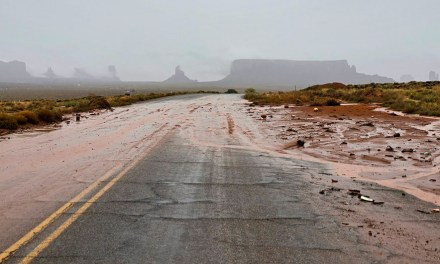
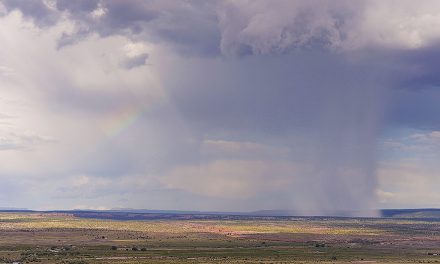
I’d like to share two photographs that show the results of the check dam I build last November in Hóyéé’ Canyon. This was a larger area with serious runoff next to rock walls. Both pictures show the success of this check dam. The dam held a great deal of the moving soil from last week’s heavy rain. Now this area has leveled out. The silty topsoil is perfect for planting some grass seeds to stabilize the area.
I hope my story inspires people to spend more time walking on Mother Earth. If you see wash areas, spend some time trying to help.
I’d like to end my story by giving thanks to Nahasdzáán Shimá dóó Yádiłhil Shitaa, Mother Earth and Father Sky. Tábąąhá nishłį, Naakaii Dine’é bá shíshchíín, dóó Tsi’naajinii dashicheii dóó dashinálí.
Interested readers can contact me for technical assistance with building a check dam at 928-206-3077.
Ernest Begay
Steamboat, Ariz.
Monuments threatened
Editor,
During Europe’s Late Stone Age (25,000 BCE), migrants from southeast Asia (proto-Hopi), Japan (proto-Zuni), and other Native tribes began crossing Siberia’s “land-bridge” into “America.” Over 500 “tribes” inhabited this continent prior to Columbus, who thought he’d landed in India and “discovered” land that was already rich with agriculture and cultural settlements. Diverse people adapted to ecologically rich landscapes prior to Europeans’ rushing to claim settled lands, egotistically slaughter wildlife, and rip earthen cover to amass wealth from fossil fuels and minerals – a pattern which continues today. Euro-Americans have occupied America for >1 percent of the time of human occupation.
Currently, Bears Ears and Grand Staircase national monuments, and Chaco Canyon (National Historical) Park are being stripped of protective measures that ensure their cultural significance for future generations of Natives and Euro-Americans. To acquire energy fuels and minerals, over 90 percent of Bears Ears and Grand Staircase lands are being converted to dredge pits so that current billionaires can become trillionaires and holders of more power. Native and non-Native Americans concerned about cultural legacy are witnessing the loss of pre- and current American history as the Antiquities Act is burned at the stake.
To northern Arizona and Colorado Plateau residents, this equates to losing tourist dollars, local employment, and the desecration of familial history. One might consider it poetic justice if instead of pre-historic national monuments, the commander and chief of desecrating cultural monuments were to instead bulldoze the Sistine Chapel.
Bryan Bates
Flagstaff, Ariz.
Constitutional contradictions
Editor,
A continuing commentary of last week’s “Constitutional Concern.” Now that we know who survived the primary, there is more to learn about why the new Navajo Constitution should not be supported, and we can begin to take things apart that do not make sense. A “No” vote on the referendum is to say, put it aside for now and keep working on it; maybe next year or the next, until “the people” are ready with a better understanding, then vote on it.
Diné Beehaz’áanii is so much more than a political philosophy, especially within social contract theory and theories of sovereignty when our traditional philosophy is based on Hózhó: a unique type of governance when it is said in Diné bizaad, “Nihi Diyin Nohookáá Diné’é ni’ gleeni’gih, Sa’ah Nagháí Bik’eh Hózhóón bi’nah’gaii, by our collective will” is the heading of the new Navajo Constitution is meaningful. But it does not jive legally.
The new constitution appears to reference Navajo concepts, but it does not structurally insert the traditional Diné value system of collective will. Instead, it mirrors Western constitution and uses Navajo terminology as cultural decoration. In the draft, it does not appear to function as operative legal language that shapes governmental powers, institutional design, or enforceable procedures. This creates the impression of appeasement for federal approval rather than an assertion of inherent sovereignty (identity language vs. operative law). Even when Navajo terms appear, they are defined in English, and the legal rule never leaves English meaning. This means the Navajo term does not carry legal force on its own.
The 2002 Fundamental Law codification tried to bring Navajo concepts into statutory form, but the structural compromise forced them into Western categories (traditional, customary, natural, common law). Scholars note this translation stripped the concepts of their holistic and relational structure. If that is what we are doing to our language, then we really can’t say it is ours, when the legal architecture is still Western. The draft constitution does not embed Navajo language into the machinery of government – only into its spirit – trying to fit Navajo into English terminology is not just going to happen.
This is why the Diné Hataałii Association is in non-support because they were never consulted. I support their decision, and most of all the Navajo words should be taken out and only leave a few words. The courts will dissect our Holy Peoples words, like what they did with the “Trinity.” Nothing is sacred in federal court.
Every time you say a word of thanks, “Shima Nahasdzáán, yádiłhxił shitaah,” you are saying everything around is all relational between these two entities to you; none left out. I hate to be didactic, but it is true because I fell into that trap knowing what I thought was superior knowledge. I was put in my own place by my own people. So, I’m not picking on anyone because I was once there. Writing a constitution is a huge, monumental task.
If Diné Hataałii Association were consulted, they will tell you to cut down Navajo usage to a few appropriate-alternative terms for “structural language” that fits Diné epistemology rather than forcing a Western linguistic frame onto Navajo thought by educated Navajos, who were not raised around the sacred holy fireplace inside a hogan, but from book learning makes a lot of difference.
They will tell you not to make our language sound so high and mighty, trying to match a polyglot (many tongue) language (‘Ana’í bizaad – English). They will also tell you that that is a violation of their spiritual language used for a different purpose. Instead, they might suggest using alternative-appropriate terminology like: “Diné bi bizaad bits’áád bee haz’ą” (“The way Navajo language is shaped / formed”). It emphasizes form, emerging from action, not a rigid structure. “Diné bi bizaad bee na’nitin dóó bee iiná” (“The knowledge and life within Navajo language”).
These are the most culturally agreeable and common usage because it frames our language as living knowledge, not mechanical system, as this new constitution is trying to do. “Diné bizaad t’áá íiyisíí bee haz’ą́ dooleełígíí” (“The natural way Navajo language forms itself”). This signals that Navajo language is self-organizing, not externally structured. “Diné bizaad bee na’nitin dóó bee iiná” (“The knowledge and life within Navajo language”) are some of the strongest terms that is safe to use among English terminology, and ceremonial language can be taken out to make our hataałii more comfortable.
Traditional Diné “collective will” is not a political procedure per se but a relational ethics rule: a consensus brought about through harmony. If asserting Navajo terminology, then it would not be majority rule of 50 percent + 1 vote but must have majority consensus of ¾ or more and obligations directed toward future generations, not just for present-day voters. It is clan-based relational accountability, not individualistic rights but decision-making through hózhǫ must be kept, not adversarial debate our candidates are having. Leadership (Nach’id) is service, not authority or prestige. In traditional governance, a decision is legitimate only when the people, the land, and the spiritual order are aligned.
The polyglot language mentioned comes from a people who has been around the world starting with trading and fighting their own tribal European ancestors, all light skin but different languages. They used part of other people’s words to combine with their own, formed new words to add to their vocabulary is as old as civilization. Today, it is not surprising, we are trying to preserve our Navajo language.
This brings up an old fireside story of the Navajos – Da’ayooyałt’i’. A maverick Holy Person who self-asserted himself as supreme above all but was rejected by the Holy People because he violated the relational order of knowledge. A lesson that is instructive and valuable told only during the dead of winter. A story of epistemic ignorance we would face one day. He was not evil, but because he dared to cross a sacred boundary: He thought of himself as above the other Holy People and relational knowledge went out of kilter, out of order, not balanced. Unapologetically, this puts us into deep Navajo philosophy because the use of Diné saad is not used as foundational or not part of the load-bearing structure in the new constitution by adding another separate branch and protecting investors’ rights. Will it support the new weight or make it un-balanced?
The emphasize here, something is not right and needs a deeper look into the contradictions we hear so much about. The ONGD proposal is described by traditional knowledge holders (Diné Hataałii Association) as “totally devoid of the values and principles underlying Diné traditional fundamental law.” If adopted, the Fourth Branch will stay with us for the next 20 years as supreme law of the Navajo Nation. What will this new constitution do to us in that length of time? For good or worse? Until next time.
Teddy Begay
Kayenta, Ariz.
Get instant access to this story by purchasing one of our many e-edition subscriptions HERE at our Navajo Times Store.
 Highway 264,
 I-40, WB @ Winslow