




Sheep butchering puts Miss Navajo Nation contestants to the test
Navajo Times | Sharon Chischilly
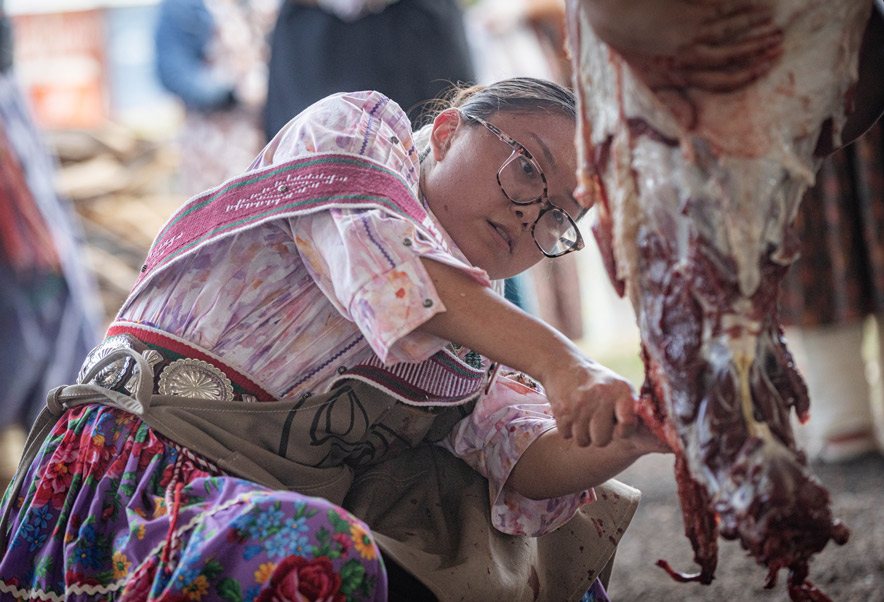
Miss Navajo Nation contestant JoAnni Begay of Pinedale, N.M., cuts meat with a knife during the sheep-butchering competition Monday morning at the Navajo Nation Fairgrounds in Window Rock.

WINDOW ROCK
The sky over Window Rock was gray Monday morning when the countdown started, and three young women dropped to their knees over stacked cedar to build the fires that would open their run at the 74th Annual Miss Navajo Nation title.
Rochelle Francisco of Valley Store, Arizona, Tonana Ben of Chilchinbeto, Arizona, and JoAnni Begay of Pinedale, New Mexico, worked in velveteen blouses adorned by their contest sashes.
Navajo Times | Sharon Chischilly
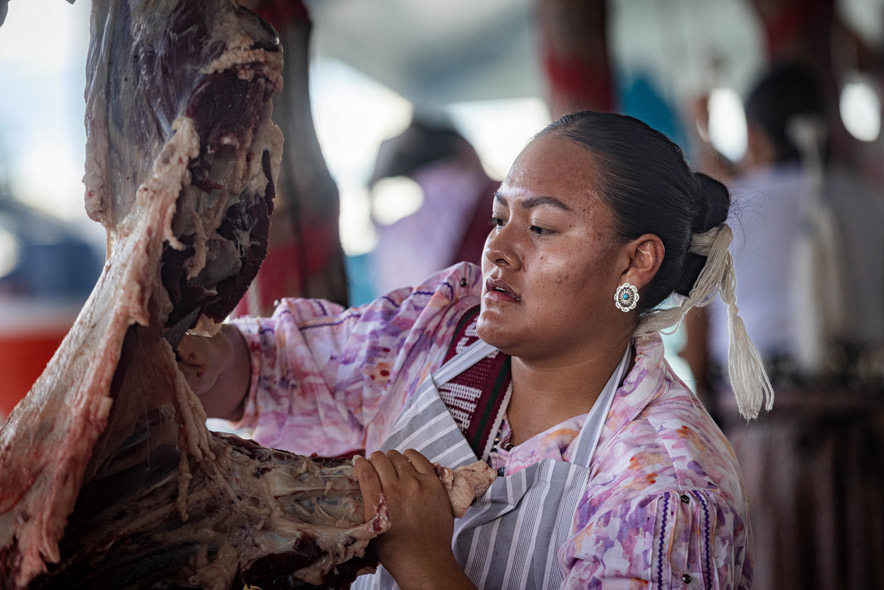
Miss Navajo Nation contestant Tonana Ben of Chilchinbeto, Ariz., uses a knife to cut meat during the sheep-butchering competition Monday morning at the Navajo Nation Fairgrounds in Window Rock.
Begay was the only contestant who wore moccasins protected by plastic. Ben and Francisco wore sneakers.
The contest was held beneath a white event tent at the Navajo Nation Fairgrounds, its cedar posts wrapped in red, while spectators watched from the stands and folding chairs pressed against the orange safety fencing. The sheep butchering competition filled the stands at 7 a.m.
Contestants were graded not only on their knife work but on their answers to questions fired at them mid-cut about why cedar and not piñon, how one knows a sheep is fat, what Diné do with wool and what Western society does with it and what a sheep hide is for once the animal is down.
“The cedar, it burns faster than the oak or the pine, and it’s just better to get your fire started that way,” Begay said when asked about her firewood choice.
Asked how a butcher knows a sheep carries enough fat, she said you can feel it and that the animal looks bigger. She told the judges you can also read a sheep’s hooves to know whether it has been grazing free-range or fed inside a corral, and named the grass, cedar and juniper the sheep eat on the range where she comes from.
Navajo Times | Sharon Chischilly
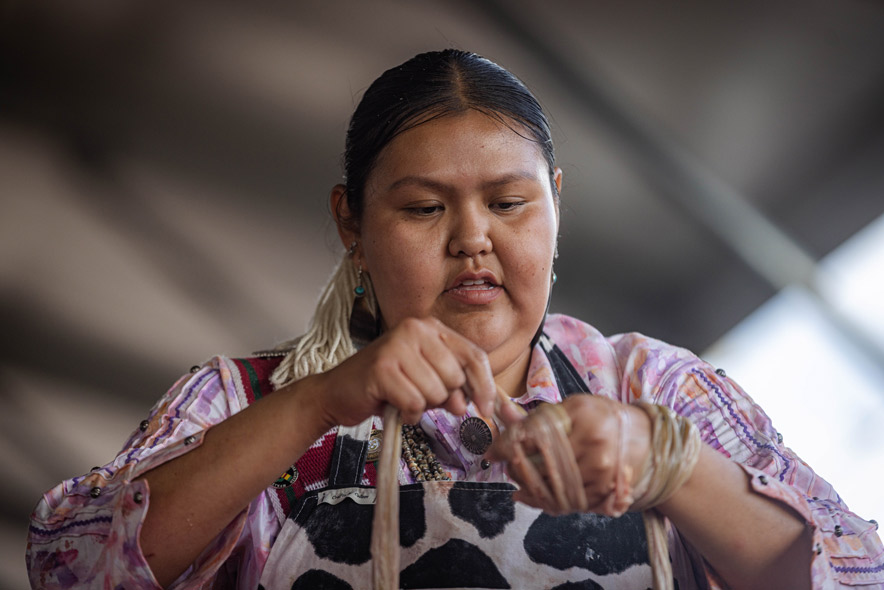
Miss Navajo Nation contestant Rochelle Francisco of Valley Store, Ariz., wraps sheep intestine around her hand during the sheep-butchering competition Monday morning at the Navajo Nation Fairgrounds in Window Rock.
Ben answered the Diné half of the wool question but did not finish the second half about Western use. Francisco, asked the same question, said Diné make rugs from the wool and likewise left the Western half unanswered. Begay was unable to answer a question about the word spoken before a sheep is butchered.
Emcee Jonathan Hale of Oak Springs, Arizona, a former Navajo Nation Council delegate, used the gaps as teaching moments for the crowd and livestream audience.
“So as a rancher in your own families, I guess those are great questions to ask and great educational ones to even ask your children,” Hale said. “How can you tell it’s good enough to butcher? How is it ample?”
Between time calls, Hale walked viewers through what the animal has meant to Diné households, including subsistence, clothing, wool for yarn and rugs, sheep given at marriage alongside horses and cattle and the breeds that show up in Navajo herds, from Rambouillet to Suffolk to Dorper crosses. The black-faced animals on the ground Monday, he noted, were Suffolk.

Navajo Times | Sharon Chischilly
Miss Navajo Nation contestant JoAnni Begay of Pinedale, N.M., removes the ’atsii’ from the grill during the sheep-butchering competition Monday morning at the Navajo Nation Fairgrounds in Window Rock.
“This is what you’re going to feed your children, your grandchildren,” he told the contestants early on.
Begay was the first to hoist her sheep clear of the ground to work the innards, with Ben following. She was also first to finish, closing out with eight minutes still on the clock. Asked about the hide, she said it is used to catch the stomach.
Ben finished next, with six minutes remaining. Asked what she does with the skin once the butchering is done, she said it is used to cover the blood.
Francisco worked to the last, the stands cheering her through the final minutes. She finished with four minutes left. Asked how a hide is prepared, she said you dry it and salt it and stretch it out using a loom. Asked what makes it soft, she said salt, water and sheep fat.
Hale called the butchering portion complete with two minutes left on the official clock.
Before the first fire was lit, Miss Navajo Nation Camille Uentillie, nearing the end of her term, thanked the contestants’ parents seated at the front of the tent.
“I always say it takes a village, it takes a community,” Uentillie said, thanking the communities and clans the three women represent and the relatives who drove in to watch. “I know it takes a lot of gas.
“I’ve come to a full circle,” she said. “I was here last year as a contestant. Today, y’all were on the planning side and we’re seeing it all play out.”

Navajo Times | Sharon Chischilly
Miss Navajo Nation contestant JoAnni Begay of Pinedale, N.M., wears plastic over her moccasins, with the covering worn through at the sole, during the sheep-butchering competition Monday morning at the Navajo Nation Fairgrounds in Window Rock.
Pageant coordinator Brianna Davis, a teacher, introduced the day’s judges, Stephen Salazar, who runs the NTUA Iiná Café, Lee Roland-Tso, a project manager for the Navajo Nation Department of Water Resources and a former grazing official, and Lee Basenti, a social worker and educator.
“You’re never too old or too young to learn anything,” Davis told the crowd before the countdown.
The Office of Miss Navajo Nation supplied the tables, water, wood and sheep. Everything else, including the knives, bowls, hatchets and aprons, came from the contestants and their families. Each contestant worked with one assistant, and Hale reminded the crowd that judges deduct points if an assistant offers advice.
Davis credited program supervisor Carletta Benally, office specialist Trey A. Dahozy and a volunteer crew for putting the day together.
Monday’s schedule carried on with the traditional foods competition at 1 p.m. The contestants will move to the Navajo Nation Museum on Tuesday for the business interview at 9 a.m. and contemporary skills and talent at 1 p.m. and return Wednesday for the traditional knowledge interview and traditional skills and talent.
The new Miss Navajo Nation will be crowned Saturday at 4 p.m. at the fairgrounds.
Get instant access to this story by purchasing one of our many e-edition subscriptions HERE at our Navajo Times Store.

 Highway 264,
 I-40, WB @ Winslow