






DOJ pressed for public testimony plan in ZenniHome hearing
For the Navajo Times | Nicholas House
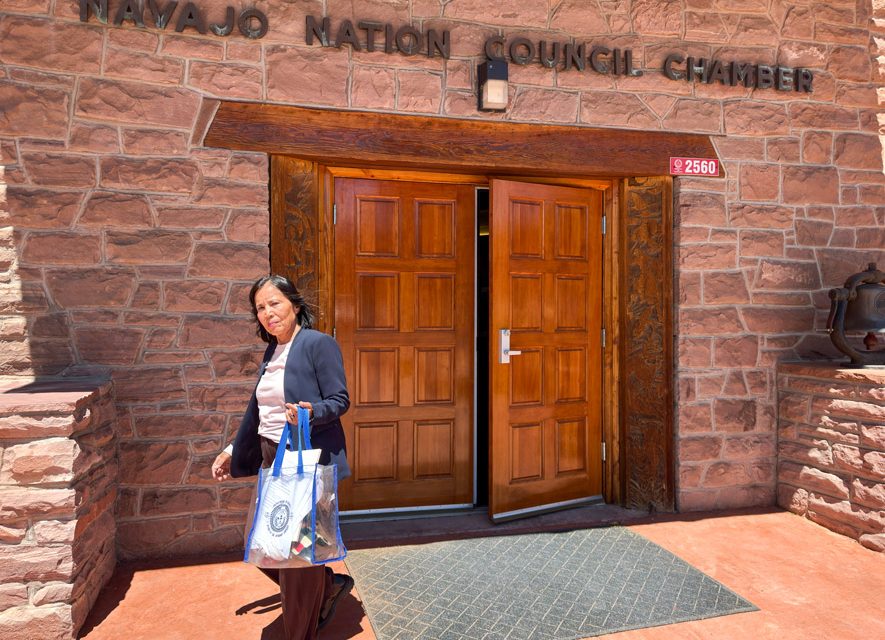
Acting Deputy Attorney General JoAnn B. Jayne exits the Council Chamber in Window Rock on Tuesday, June 9, 2026, after the second day of hearings on federally funded housing contracts.

DÁ’DEESTŁ’IN HÓTSAA
The Budget and Finance Committee’s second day of hearings over federally funded housing contracts centered Tuesday on whether the Navajo Nation Department of Justice would help create a process for public witness testimony after it advised subpoenaed employees not to appear.
Acting Deputy Attorney General JoAnn B. Jayne told committee members that the DOJ wanted to meet with the committee in executive session to discuss how attorney-client privilege would apply to the investigatory hearing and the contracts under review.
“The Department of Justice is not here to hinder the process,” Jayne said.
The June 9 hearing in the Council Chamber in Window Rock followed Monday’s opening hearing, when no subpoenaed Executive Branch officials testified after Jayne on June 8 advised employees not to participate. BFC Vice Chair Carl R. Slater conducted the hearing again Tuesday as chair pro tem.
Jayne said the DOJ viewed an executive session as the proper place to discuss how the department could advise the committee while protecting attorney-client privilege. She said the DOJ represents the Navajo Nation government and provides legal services to all three branches, chapters and other government entities.
Slater questioned why the DOJ did not work with the committee earlier, noting that legislation authorizing the investigatory hearings was approved in July 2025. He said the committee received a briefing on housing contracts in August and later acted on legislation setting hearing rules and changing hearing dates.
Slater said President Buu Nygren’s court filing seeking to stop the hearings made it difficult to understand the DOJ’s position, along with arguments that public testimony could affect investigations or enforcement actions.
DOJ seeks executive session
For the Navajo Times | Nicholas House
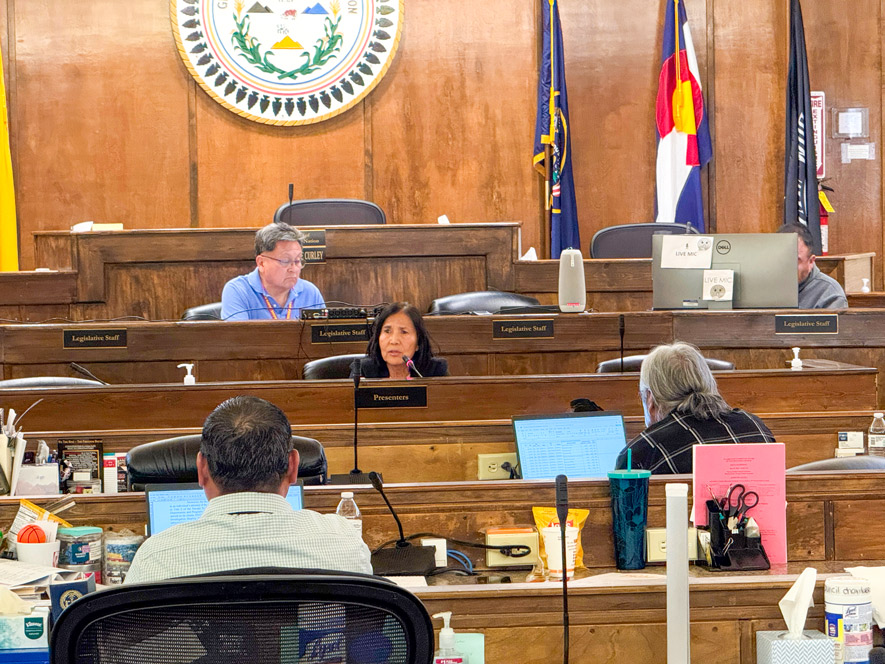
Acting Deputy Attorney General JoAnn B. Jayne answers questions Tuesday, June 9, 2026, during the second day of hearings on federally funded housing contracts at the Council Chamber in Window Rock.
“What can you tell the Navajo people right now to provide them assurance that both the Executive Branch through the Department of Justice or any other entities and the Legislative Branch are performing their appropriate oversight enforcement and accountability functions,” Slater asked.
Jayne said the DOJ was committed to working with the committee but said those discussions should take place in executive session with other DOJ attorneys who have more knowledge of the matters before the committee.
Slater asked whether the DOJ could help the committee handle witness testimony on a question-by-question basis instead of advising employees not to appear.
Jayne said advising witnesses during questioning would involve legal advice and protected communication. She repeated that the BFC is also a DOJ client and said those questions should be discussed in executive session.
Slater said the committee was trying to avoid a blanket bar on testimony.
“What is the issue with doing things on the particular-by-particular basis? Instead of preventing it from happening wholesale,” Slater asked.
Slater said the committee could ask basic questions about when contracting began, who spoke to whom and when officials became aware of a contract. He said more sensitive questions could be handled differently if the DOJ identified a legal concern.
He said the committee does not have prosecutorial power and could only make referrals to entities such as the Ethics and Rules, the FBI’s white-collar crime program or the U.S. Department of Health and Human Services’ Office of Inspector General.
“It’s not a prosecutorial body,” Slater said. “It’s oversight, accountability … transparency,” he said.
Public testimony questioned
Slater then pressed Jayne on whether the DOJ would use an executive session to create a way for witnesses to provide public testimony.
For the Navajo Times | Nicholas House
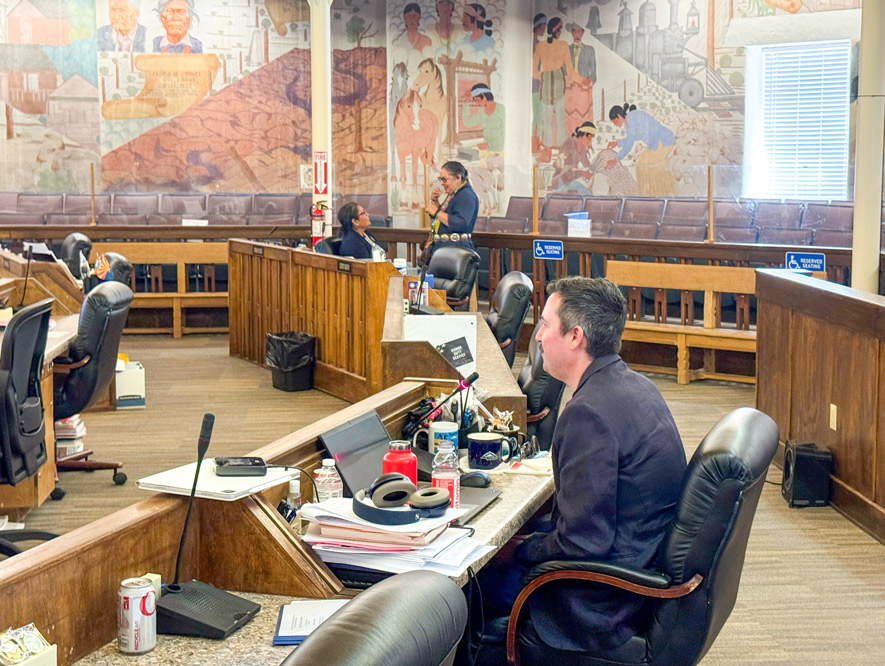
Delegate Carl Slater, the vice chair of the Budget and Finance Committee, questions Acting Deputy Attorney General JoAnn B. Jayne on Tuesday morning during the second day of hearings on federally funded housing contracts at the Council Chamber in Window Rock.
“Will the Department of Justice provide a path forward for witnesses to come forward?” Slater asked.
Jayne did not commit to that outcome. She said the executive session would allow attorneys and clients to discuss confidential matters and possible steps.
Slater asked again whether the DOJ would advise the committee on a process that would allow public testimony.
Jayne said the DOJ would need to discuss the law and whether such a process would be legally sufficient before answering.
Slater also asked whether the DOJ believes the committee and Council have the authority to investigate and publicly report on Navajo Nation contracting and financial matters.
Jayne said the DOJ addressed that issue in a confidential attorney-client privileged memorandum submitted to the BFC on Monday and said she could not discuss its contents publicly unless privilege was waived.
Delegate Cherilyn Yazzie, a member of the BFC, said the committee has a duty to seek facts and review documents tied to American Rescue Plan Act funding.
She said people are asking what happened to federal funds that were supposed to serve families, communities, homes and future projects. She said the committee is not trying to create conflict, but to understand what happened.
Yazzie said the Diné Fundamental Law, k’é and hózhǫ́ have been cited in court filings and memos, but those principles require responsibility and accountability. She said they should not be used as words in legal documents without action behind them.
Yazzie said those principles do not relieve the committee of its obligations.
Documents sought
Yazzie referred to an April 21, 2025, directive to the Executive Branch and a response sent April 25, 2025, to the Office of Legislative Services. She said the response included contract information but also referred to documents that were supposed to be provided later.
“I don’t believe we’ve ever gotten that,” Yazzie said.
She asked the Office of Legislative Counsel and Office of Legislative Services to review whether the committee received the complete documentation connected to that directive. She said she wanted her questions for subpoenaed witnesses placed in the record, even if employees were advised not to appear.
“It doesn’t matter, I guess, if employees are told not to show up,” Yazzie said. “I mean, I’m still going to do my job.”
Yazzie said the ARPA funding carried federal rules from the U.S. Department of the Treasury and questioned when anyone from the Navajo Nation reported concerns to the department. She said the people who signed contracts and subcontracts were responsible for those funds.
She said the DOJ may be trying to protect the Navajo Nation now, but questions remain about how the contracts were reviewed and how the money was monitored from the beginning.
Jayne said she believed the DOJ met with the Naabik’íyáti’ Committee in August 2025 and raised red flags at that time. She said she did not know of follow-up from the Legislative Branch after that meeting, though she said her records could be incomplete because she was not there then.
Jayne also rejected suggestions that the DOJ was not impartial.
“The Department of Justice is impartial,” Jayne said.
She said the DOJ responds to legal matters involving the Navajo Nation and noted that court proceedings and a special prosecutor’s investigation are underway.
Speaking partly in Navajo, Jayne said the DOJ wanted to sit down with the committee and talk through the issues without releasing client information. She said releasing that information would harm the justice system and the obligations attorneys and leaders have.
Slater said the committee had asked for specifics, not an open-ended discussion. He questioned why the committee should enter an executive session without a commitment from the DOJ that the goal would be to identify a path for public testimony, accountability and transparency.
Jayne said that could be discussed in executive session.
The committee then turned to Delegates Norman M. Begay and Lester C. Yazzie, who spoke in Navajo and questioned why the DOJ could not answer simple yes-or-no questions or explain where the $24 million went.
The next hearing is scheduled for Wednesday at 10 a.m., with three people – Alfreida Nez, Candice Yazzie and Alray Nelson – under subpoena expected to appear.
Get instant access to this story by purchasing one of our many e-edition subscriptions HERE at our Navajo Times Store.

 Highway 264,
 I-40, WB @ Winslow