


Jones names former rival Ellison to presidential ticket
Special to the Times | Donovan Quintero
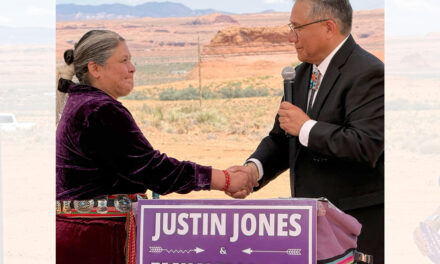
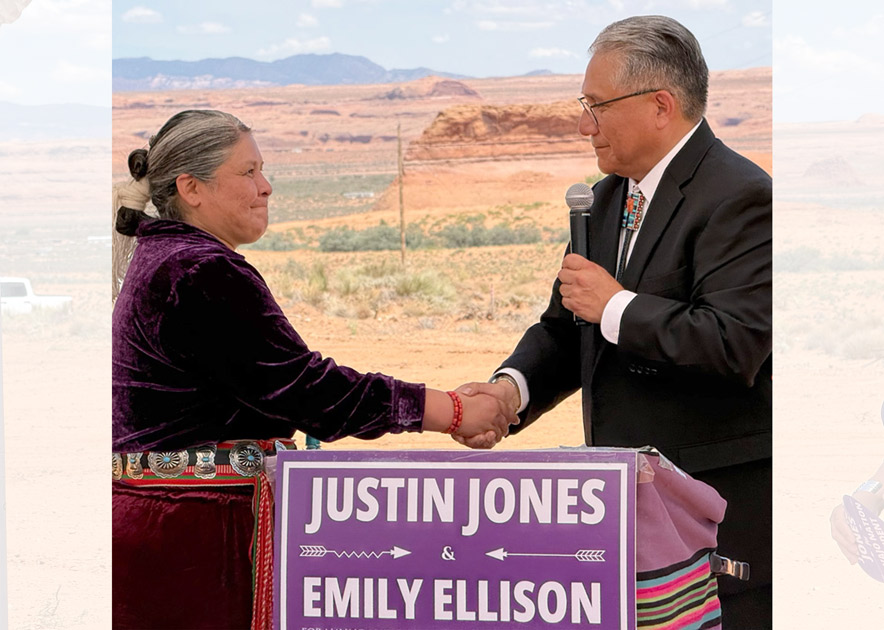
Presidential candidate Justin Jones, right, shakes hands with Emily Ellison after announcing her as his running mate Monday in Rock Point Valley in Tsé Ntsaa Deez’áhí, Arizona. Ellison was among the 16 presidential candidates in the July 21 primary. She is Naakaii Dine’é and born for Haltsooí. Her maternal grandfather is Kiyaa’áanii and her paternal grandfather is Bit’ahnii. Her great-grandparents are Tsé Nahabiłnii and Áshįįhí. Ellison grew up in Manuelito, New Mexico, and was raised by her nálí asdzą́ą.
ROCK POINT, Ariz.
Presidential candidate Justin Jones announced Emily Ellison as his running mate Monday at his family home in Rock Point Valley, selecting a former rival who made government reform central to her campaign.
After unofficial results showed Jones and Speaker Crystalyne Curley advancing to the Nov. 3 general election, Ellison outlined the priorities she wanted Jones to carry forward.
“For Mr. Jones, I would like for the emphasis to be on taking corruption out of government and replacing it with trust,” Ellison said in an interview on primary night July 21. “The hope is that, that results in efficient services and efficient process in our lives.”
Jones led the 16-candidate field with 15,039 votes, or 31.04% of votes cast in the presidential primary. Ellison, of Manuelito, New Mexico, finished 13th with 397 votes, or 0.82% of votes cast.
Jones linked his choice to Ellison’s New Mexico background, noting that her maternal family is from the Chéch’iltah and Jones Ranch areas.
“And I’ll tell you today, we did not neglect and forget all of you from New Mexico,” he said. “And I made a promise to you that I will not forget you.
“We just didn’t come home from some city and try to be your leader today,” Jones added. “No, we live this every day.”
The event took place at Jones’ parents’ home, where a traditional ceremony preceded the announcement.
“This particular place, this home right here, this is where I grew up,” he said.
Based on their clan relationship, Jones called Ellison his nálí, while Ellison called him “shinálí.”
Ellison, the executive director of Battered Families Services, made restoring public trust central to her presidential campaign. She argued that corruption, weak oversight and outdated laws had eroded confidence in government and that housing, water, healthcare and other issues could not be addressed without reform.
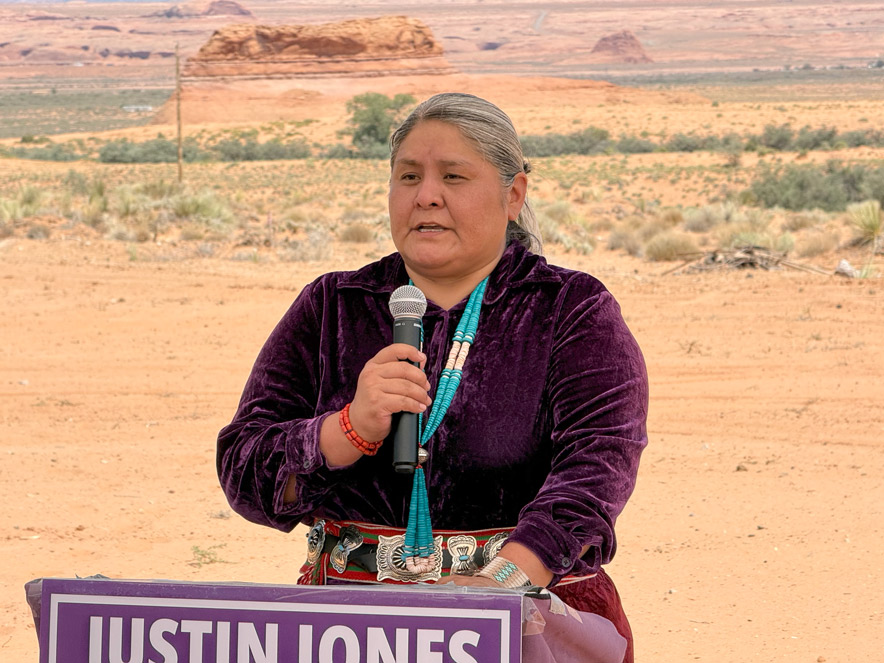
Special to the Times | Donovan Quintero
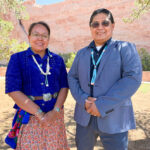
Emily Ellison speaks Monday in Rock Point Valley in Tsé Ntsaa Deez’áhí, Ariz., after Justin Jones announced her as his running mate. Ellison’s maternal family is from the Chéch’iltah and Jones Ranch, N.M., areas. She said livestock and sheepherding were cornerstones of her childhood.
Much of her criticism focused on the Executive and Legislative branches.
“The laws need to be updated, and that’s Council’s responsibility,” she said on primary night. “At the end of the day, they’re not the president. They are lawmakers.”
Ellison proposed rewriting sentencing laws for financial crimes, adding prosecutors and placing the Navajo Nation Ethics and Rules Office under an independently elected attorney general rather than the Legislative Branch.
She also called on Curley to pursue investigations into alleged corruption and determine responsibility for the disputed funds connected to the ZenniHome housing project.
The controversy centers on approximately $24 million the Navajo Nation paid for housing units through Indigenous Design Studio + Architecture, which subcontracted with ZenniHome. According to a February statement from the Navajo Nation Department of Justice, the companies had not delivered any completed units, and the department was pursuing remedies against both.
Ellison said Monday that her decision to run for president had been about reforming government and helping elect leaders who respect the Navajo people.
“What an honor to be selected today,” Ellison said. “Now is an opportunity to make that happen.”
“We work it through our action, and we’re going to continue doing that,” she said. “We’re not going to use our words. You’re going to see it through action.”
Jones also described the conditions at his family home.
“We still do not have water. We barely got electricity here at this home site when I was a senior in high school,” he said.
He described the road leading to the home as one of “thousands and thousands” throughout the Navajo Nation that need improvement.
“This good day, this July the 27th,” Jones said. “You can mark this day as a new beginning for the Navajo Nation.”
Get instant access to this story by purchasing one of our many e-edition subscriptions HERE at our Navajo Times Store.

 Highway 264,
 I-40, WB @ Winslow